AI Policy Template for Schools: Academic Integrity Guidelines
TABLE OF CONTENTS
Introduction
Key Highlights
Why Every School Needs an AI Policy in 2026
What Should a School AI Policy Include?
Free AI Policy Template for Schools (Copy and Adapt)
Can Students Use ChatGPT for Homework?
How Should Schools Handle AI-Generated Assignments?
Should Schools Use AI Detectors?
How to Handle False AI Detection Accusations
How to Prevent AI Misuse in Schools
AI Guidelines for Teachers
How to Create an AI Policy for Schools Step by Step
Conclusion
FAQs
Get an AI summary of this post on:




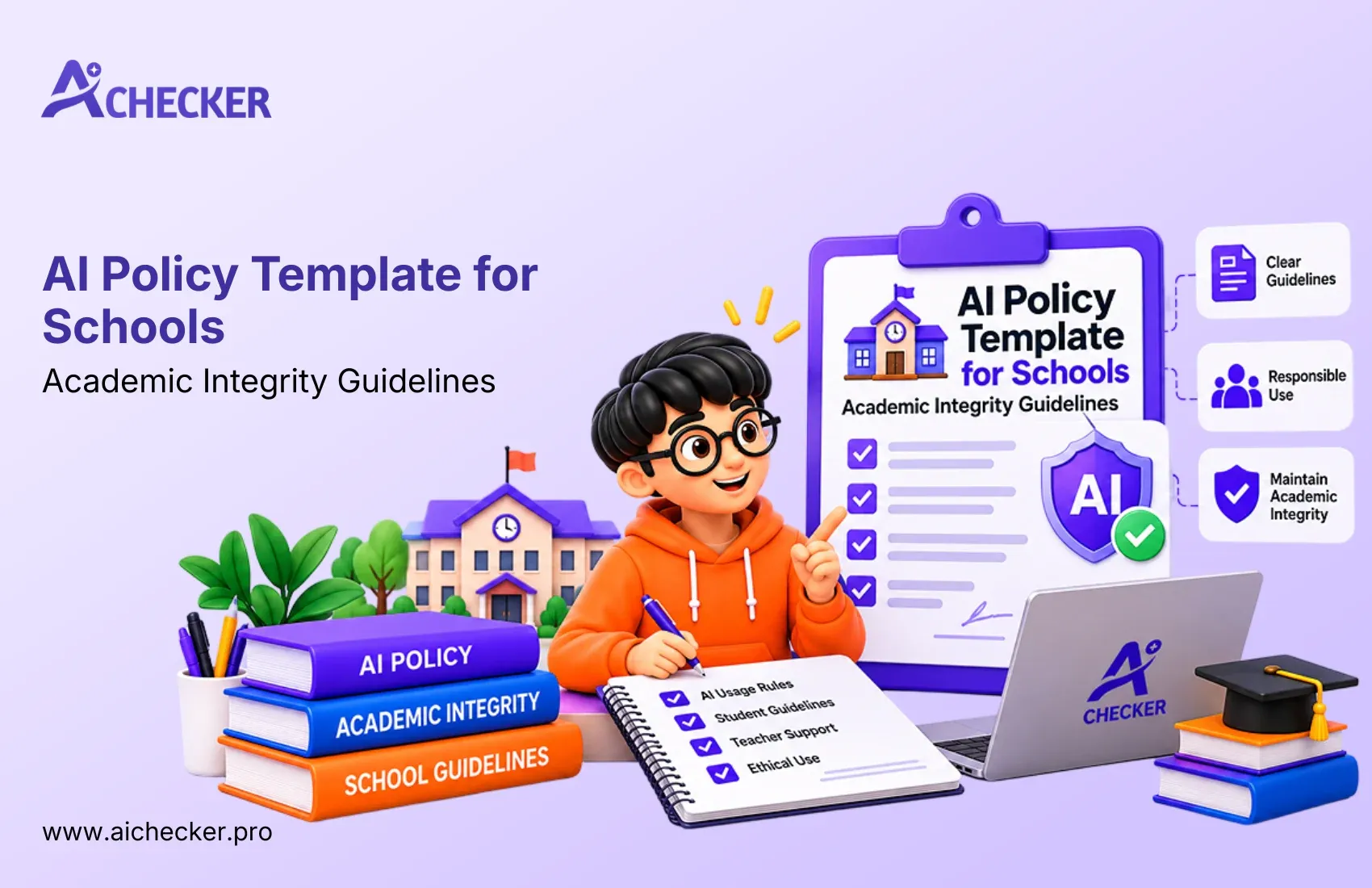
An AI policy template for schools provides direction on generative AI for teachers, students, and administrators.
This guide offers a breakdown of what to include in a policy, along with a copy and paste template, as well as information on handling and responding to detection, false accusations, and misuse.
The short version is that you must establish clear tiers of acceptable use, require disclosure, treat detectors as a best practice, and offer students due process.
Introduction
Every semester I hear the same question from teachers and principals: what do we actually do about ChatGPT in our classroom? Banning everything and hoping it goes away isn't an option, but pretending it isn't a problem is equally unproductive.
With an AI policy template for schools, you have your answer the next time that suspicious essay shows up in your inbox.
An AI policy template for schools is a ready-to-adapt document that outlines when students and teachers can use generative AI, how and if its use should be disclosed, and what the repercussions for unethical use should be
This ensures academic integrity while still allowing education professionals to responsibly and equitably lean into this new technological innovation.
Get Lifetime Access with 60% OFF
Stop paying monthly subscriptions. Enjoy unlimited AI detection and humanizer access forever with future updates included.
- One-time payment
- Unlimited access forever
- All future updates included
Key Highlights
- Clear tiers of AI use (none, limited, open) work better than a blanket ban.
- A solid AI policy template for schools puts disclosure rules ahead of detection scores.
- No AI detector is 100% accurate, so a score should never be the only proof.
- Writing by English language learners and very formal writers gets falsely flagged more often.
- Teachers need written rules for their own AI use, not just students.
- Every policy needs an appeal process and a review date each term.
Why Every School Needs an AI Policy in 2026
Here's what I see when I talk with educators: students already use AI, whether the school has rules or not
Some use it to brainstorm. Some paste in the full prompt and submit whatever comes back. Without a generative AI policy for schools, every teacher makes up their own rules, and students get confused fast.
Picture a typical US high school. One English teacher allows ChatGPT for outlines. The history teacher down the hall treats the same behavior as cheating.
A student who follows one set of rules gets punished under the other. That's not an honesty problem
It's a policy problem, and a good AI policy template for schools fixes it by setting the same expectations in every classroom.
Tools like ChatGPT, Gemini, and Claude now write essays that sound confident and polished, making an AI cheating policy for schools more urgent, but also more important, because suspicion without clear rules hurts honest students.
Most districts now treat this as part of a wider AI in education policy that covers privacy, tool approval, and classroom practice.
Your existing academic integrity policy is the best place to start, so you don't have to rebuild everything from scratch.
What Should a School AI Policy Include?
When people ask me what should a school AI policy contain, I give them six essential elements. Use this checklist to ensure that when you draft, or ask others to draft, your school's AI policy, it doesn't miss anything.
Purpose and Scope
Your AI policy template for schools should state why the policy exists and who it covers: students, teachers, and staff. Name the tools it covers, such as ChatGPT, Gemini, Claude, and built-in AI features in writing apps. Your AI academic integrity policy should connect directly to the honor code students already know.
Allowed and Prohibited Uses
This is the heart of the document. List what is fine, what needs permission, and what is never okay.
- Allowed: brainstorming, grammar feedback, study questions, practice quizzes
- Needs permission: drafting sections, summarizing sources, translation help
- Prohibited: submitting AI output as your own work, making up citations, using AI during a closed test
Disclosure and Citation Rules
Every AI policy for schools should tell students how to disclose how they used AI. The best way to do this is with a note at the end of the assignment, including which tool was used, what prompt the student input, and how the text was used. An AI plagiarism policy should treat any AI-generated text that isn't disclosed the same way as text copied from another website.
Detection and Review Process
Explain how teachers review suspected misuse, what evidence counts, and who makes the final call. I will cover detectors in detail below.
Consequences and Appeals
A fair AI policy template for schools uses steps, not surprises. A first offense might mean a conference and a redo. Repeated offenses follow your normal discipline code. Always include a way for students to appeal.
Privacy and Tool Approval
Students should never paste personal data, grades, or private records into public AI tools. Name which tools your AI policy template for schools approves and who checks them.
Free AI Policy Template for Schools (Copy and Adapt)
Here's a free AI policy template for schools that you can paste into a Google doc and edit. It's like a school AI policy template that you can mold to fit your building's, district's, or charter network's needs.
Don't copy this AI policy template for schools verbatim, since each school has different grade levels and criteria.
XYZ School, Generative AI Honor Code Policy
Purpose. This policy explains how students and staff may use generative AI tools such as ChatGPT, Gemini, and Claude while protecting honest learning.
Use levels. Every assignment carries one of three labels:
- Level 0, No AI: all work must be created by the student.
- Level 1, Limited AI: AI may be used for brainstorming, outlines, and grammar feedback. The final writing must be the student's own.
- Level 2, Open AI: AI may be used throughout, but the student must disclose it and verify every claim.
Unlabeled assignments default to Level 1.
Disclosure. Students must add a short note naming the tool and how they used it.
Prohibited actions. Submitting AI output as original work without permission, inventing sources, and using AI during closed assessments.
Detection. AI detection scores are never proof by themselves. They may start a conversation, not end one.
Review process. Teachers may ask for drafts, version history, notes, and a short oral explanation of the work before any decision is made.
Consequences. First concern: conference and revision. Confirmed misuse: follow the school discipline code. Students may appeal in writing within five school days.
Teacher responsibilities. Staff must label assignments, explain the rules, and avoid entering student data into unapproved tools.
Review. This policy is reviewed every term by a committee of teachers, administrators, students, and parents.
Most of the AI policy examples for schools I have reviewed share the same strength: they are short enough that students actually read them. Keep yours to two pages if you
Can Students Use ChatGPT for Homework?
Short answer: it depends on the assignment label, and any AI policy template for schools should make that clear. A good ChatGPT policy for schools doesn't say yes or no about all things.
It says yes to some, no to others, and demands honesty about the rest.
Let me tell you what this means in a really simple way. Using ChatGPT to quiz yourself before a chemistry test is studying. Using it to write your lab report and turning it in without a word changed- that's outsourcing your education. Same tool, very different outcomes.
A good AI use policy for students should ask three questions about every assignment: Is it permitted? What assistance is appropriate? And how should disclosure happen?
Here are practical AI guidelines for students you can post in every classroom:
- Check the assignment label before you open any AI tool.
- Write your own thesis, opinions, and conclusions.
- Verify every fact and source, because AI makes things up.
- Keep your notes and drafts as proof of your process.
- When in doubt, ask your teacher first.
How Should Schools Handle AI-Generated Assignments?
If a teacher suspects that one's essay is AI-generated, he should never accuse him immediately. Instead, he should have a one-to-one talk with the student about AI academic honesty guidelines.
Here is a process that works:
- Compare the work to the student's earlier writing in class.
- Ask the student to explain their argument and sources out loud.
- Review drafts, version history, and notes.
- Run the text through a detector as one extra data point, never the only one.
- Decide based on the full picture and document the reasons.
Your AI policy template for schools should also name who investigates. This is where a strong AI policy for assignments saves you. If the assignment was labeled Level 0 and the student ignored it, the rule was clear. If the label was missing, the school shares part of the responsibility.
Should Schools Use AI Detectors?
Honestly, I have tested many AI detectors, and the answer is yes, but carefully. A detector is as good as a smoke alarm. It can show you where to look, but it can't tell you what happened.
No AI detector is 100% accurate, and tools like Turnitin, GPTZero, Originality.ai, and Copyleaks all make mistakes, and all, even the creators, say should be looked at by a human first. Accuracy also decreases drastically when AI text has been paraphrased or edited, rather than simply ChatGPT. Several big-name universities have reduced their use of a single AI detector for these very reasons.
When I ran a bunch of student-style essays through 3 different detectors last month, the results were conflicting,
one essay, written entirely by hand, was flagged by one, and not by the other.
That is why your AI detection policy for schools should say plainly what the scores mean, and your AI policy for schools should say as well.
Tools like our AI Checker Pro allow you to easily identify AI content by pointing out the sentences that make it seem like it was written by a machine, as opposed to a human. It works with text from ChatGPT, GPT -4, GPT 5, Gemini, and Claude, and is used by 100K+ users.
Here is how the main options compare if your AI policy template for schools includes detection:
| Tool | Accuracy | Free Tier | Humanizer Included | Best For |
|---|---|---|---|---|
| AI Checker Pro | Sentence-level detection, good on raw AI text | Yes | Yes | Teachers, students, bloggers, and agencies |
| Turnitin | Strong on raw AI text, weaker on edited text | No public free plan | No | Schools with an existing license |
| GPTZero | Solid on raw AI text, mixed on edited text | Yes | No | Teachers who want a quick check |
| Originality.ai | Strong on raw AI text, mixed on edited text | No | No | Publishers and SEO teams |
No tool here is perfect, so use any of them as a starting point. If you want to compare plans, see the pricing page.
How to Handle False AI Detection Accusations
This is the part most schools miss and where the most damage is done. Human-written text can be flagged as AI, especially formal writing, short answers, and work by learners of English. Their simpler sentence structures can seem suspicious to a detector, even if every word is human.
If you are a teacher or administrator, make sure to build the appeal process into your AI policy template for schools right away. Your policy on how to deal with false accusations of AI detection should include:
- A rule that no student is punished on a detector score alone.
- A written appeal process with a clear deadline.
- A second reviewer who did not make the original claim.
- Permission for students to share drafts and version history as evidence.
If you are a student who got flagged, stay calm. Open your Google Docs version history, gather your notes, and offer to explain your work in person. Many students now run their writing through AI Checker Pro before submitting, so they can see in advance which sentences might look suspicious and revise them in their own voice.
Have you ever seen a student wrongly accused? It happens more than people think, and a fair process protects everyone.
How to Prevent AI Misuse in Schools
Rules alone will not stop misuse, so pair your AI policy template for schools with good assignment design. Here is what I have seen work across US classrooms:
- Start major writing in class, then finish it at home.
- Grade the process, not just the final product: outlines, drafts, and reflections.
- Ask for personal connections and local examples that a chatbot cannot guess.
- Add short oral check-ins where students explain their own work.
- Teach students how AI makes mistakes so they learn to verify.
That last point is the heart of responsible AI use in education. Students who understand what AI can and cannot do are less tempted to hand over their thinking to it.
AI Guidelines for Teachers
Students are not the only ones using AI, teachers use it to create lesson plans, quizzes, and emails to parents. This is acceptable as long as there are boundaries. Having strong AI guidelines for teachers will help staff stay on the same page, and keep students data safe.
Add a staff section to your AI policy template for schools. An effective AI policy for teachers should cover:
- Never enter student names, grades, or records into unapproved tools.
- Label every assignment with an AI level before it goes out.
- Review all AI-generated materials before sharing them with students.
- Do not use AI alone to grade work or decide discipline.
- Model good behavior by disclosing your own AI use.
Together, these form practical school AI usage guidelines that staff can follow without a long training session.
How to Create an AI Policy for Schools Step by Step
If you are wondering how to create an AI policy for schools, here is the process I recommend.
- Form a small committee. Include teachers, an administrator, a technology lead, a parent, and at least one student.
- Audit your current rules. Find gaps in your honor code, discipline code, and technology agreements.
- Adapt the AI policy template for schools above. Change the language to match your grade levels and culture.
- Train your staff. One short session beats a long handbook nobody reads.
- Share it with families. Send it home, post it online, and review it in class.
- Review every term. AI changes quickly, so a good AI policy for schools is never really finished.
Conclusion
A strong AI policy for schools doesn't have to be complicated. Establish specific levels of acceptable use, request students to disclose assistance, treat detectors as one tool, and provide every student with a fair opportunity to respond.
Pair this with smarter assignments and clear guidelines for teachers, and academic integrity becomes something you build, rather than something you police.
Start with the AI policy for schools template above, and adapt it this week. Then revisit it each term. If you have questions, check out the related blog post for more.
FAQs
What is an AI policy template for schools?
What should a school AI policy include?
Can students use ChatGPT for homework?
How should schools handle AI-generated assignments?
How to prevent AI misuse in schools?
How to handle false AI detection accusations?
Should schools use AI detectors?
Why do AI detectors flag work written by humans?
What should AI guidelines for teachers include?
How to create an AI policy for schools?

Harshil Barvaliya
SEO Executive & Content Writer at AI Checker Pro
I’m Harshil Barvaliya, an SEO Executive and Content Writer at AI Checker Pro. I focus on improving the website’s search engine visibility through effective SEO strategies, including keyword research, on-page and off-page optimization, and content development.Get Started Free
Create a free account for advanced AI detection and scan history.
Trusted by thousands worldwide.
Recent Blog's
Discover how AI-powered content creation can elevate your website's reach and engage your audience like never before. Explore the real impact of AI on crafting content that connects.