How Accurate Are AI Detectors? Crossplag vs Grammarly vs Turnitin Explained
TABLE OF CONTENTS
What Is a Crossplag AI Content Detector?
Is Grammarly AI Detector Accurate as Turnitin?
What AI Detector Does Edgenuity Use?
Why Do AI Detectors Give Different Results for the Same Text?
Crossplag vs Grammarly vs Turnitin: Side by Side Comparison
How to Reduce the Risk of False Positives
Should Bloggers and SEO Writers Worry About AI Detectors Too?
Conclusion
FAQs
Get an AI summary of this post on:




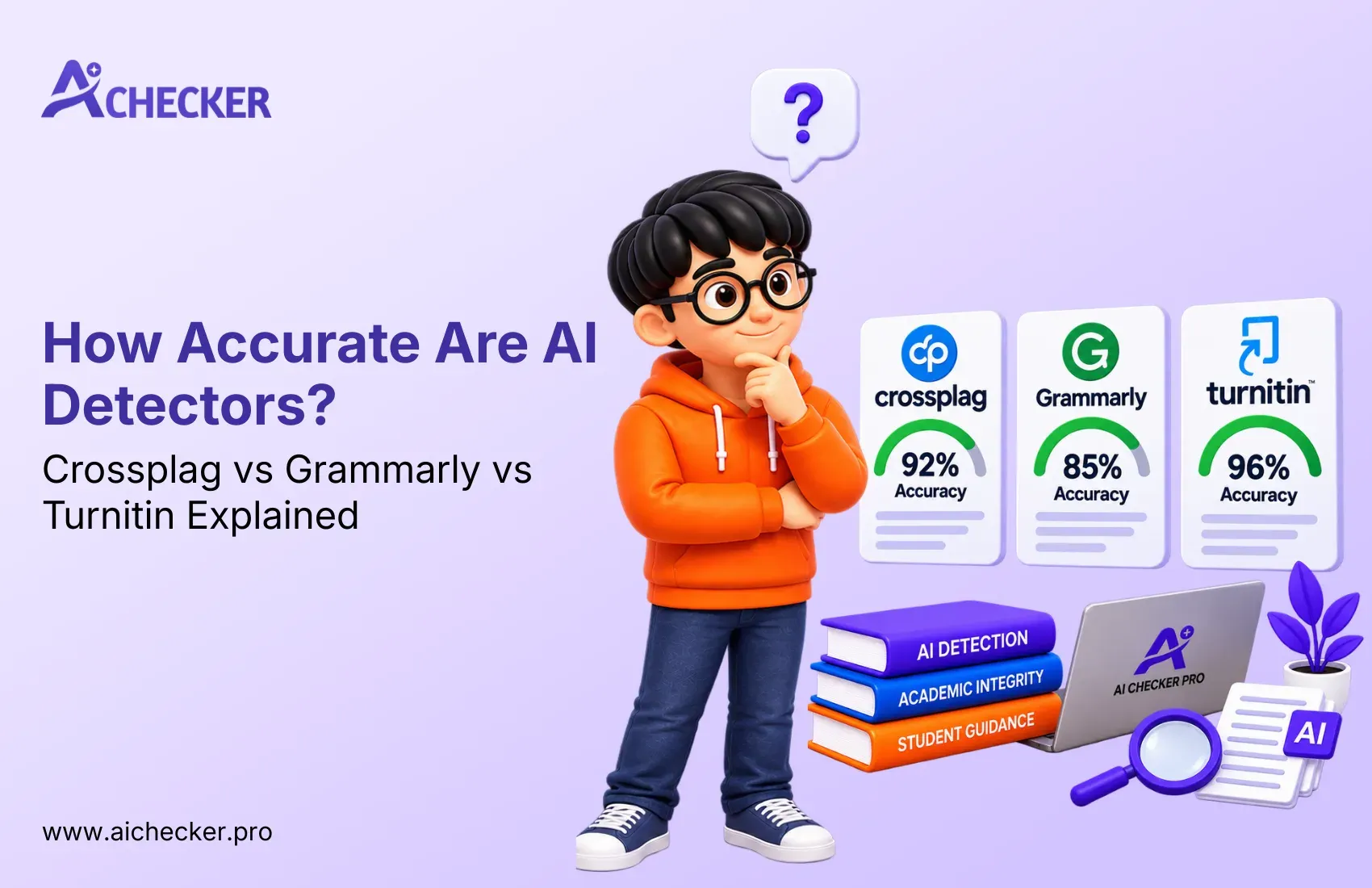
If you have ever completed a submission for a class, blog, or even a brief essay and feared that this has used AI to complete, then you are not alone. Students, teachers, and content creators alike ask us the same question: how accurate are these AI content detectors?
The short answer? With each tool, Crossplag, Grammarly, Turnitin and more, have various scoring algorithms, none are completely 100% accurate. There are multiple factors which come into play with each submission and due to different algorithms, one submission can score anywhere from three completely different results across varying detectors. Knowing the science behind how these tools actually work can help you avoid false positives, or in some cases, false negatives.
Through my own personal testing of a variety of AI detection tools over the course of the last year, I personally find most are not as accurate as we are led to believe with little room for error. Below I will outline these differences and how each tool is able to make a judgment on your content's origin.
What Is a Crossplag AI Content Detector?
A crossplag ai content detector scans text and estimates the probability that it was written by AI tools like ChatGPT, Gemini, or Claude. It works by analyzing sentence patterns, word predictability, and structure rather than checking against a database of known text.
Crossplag was originally built as a plagiarism checker before adding AI detection features. This matters because the tool is not purely designed for AI detection the way some newer platforms are. It combines both plagiarism scanning and AI probability scoring in one dashboard, which I break down further in my full Crossplag AI detector review.
When I ran this test last month using a batch of student essays, Crossplag flagged a few pieces of genuinely human writing as "likely AI." This is a known issue with detectors built on older plagiarism engines. They tend to struggle with formal academic writing, even when a real student wrote every word.
A few things to know about Crossplag:
- It gives a percentage score rather than a simple yes or no answer
- It works reasonably well on raw, unedited AI text
- It is less reliable on content that has been lightly edited or paraphrased
- It is popular with smaller schools and independent educators, not just large institutions
If you are a blogger or SEO writer double-checking your content before publication, tools designed for content creation experts, such as our dedicated AI detector for content writers, are more reliable in spotting similarities than plagiarism-focused tools that have been re-purposed for detecting AI content.

Get Lifetime Access with 60% OFF
Stop guessing which detector to trust. Check your writing against the same sentence level accuracy AI Checker Pro is known for, with unlimited detection and humanizing access forever.
- One-time payment
- Unlimited access forever
- All future updates included
Is Grammarly AI Detector Accurate as Turnitin?
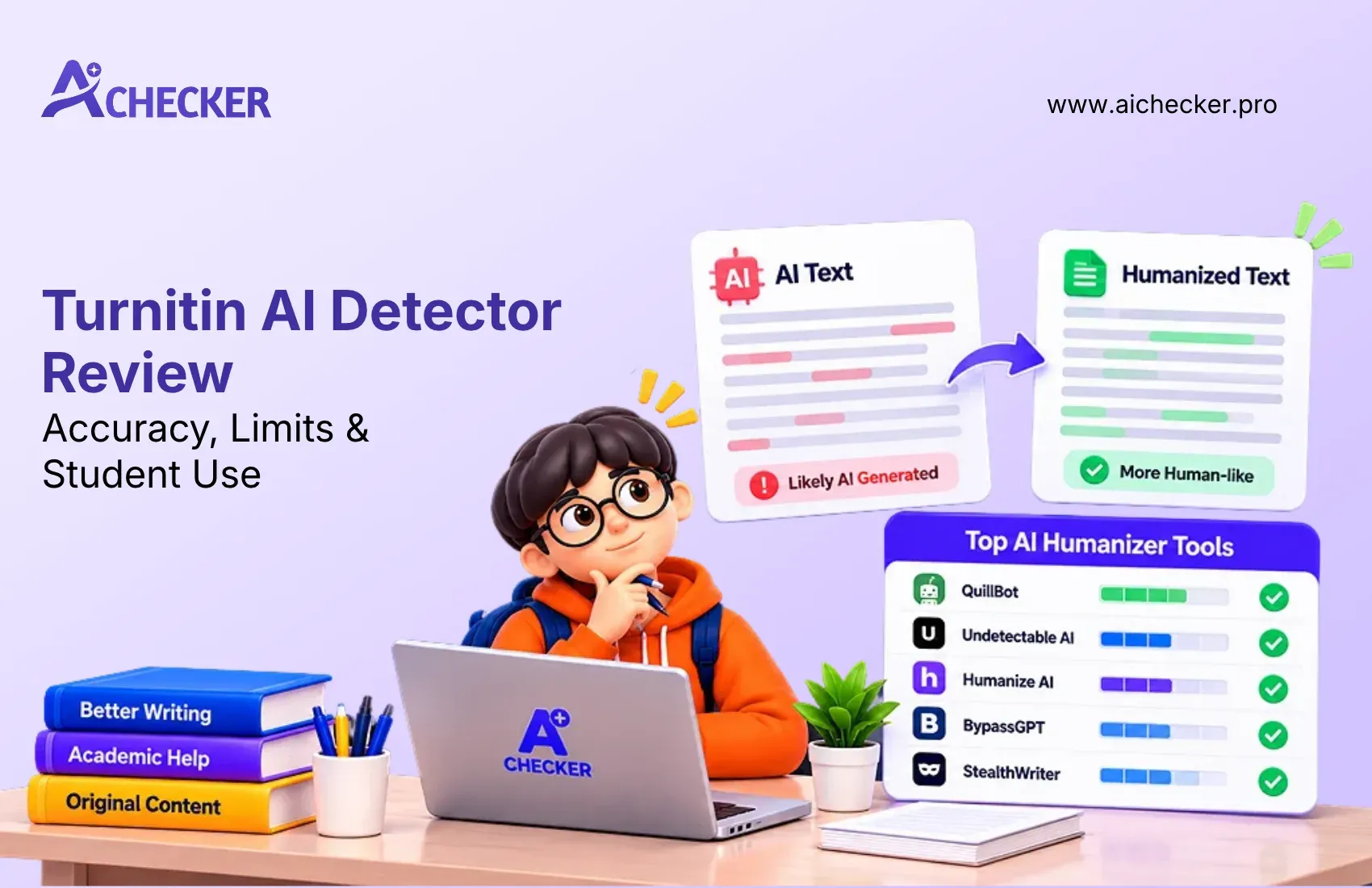
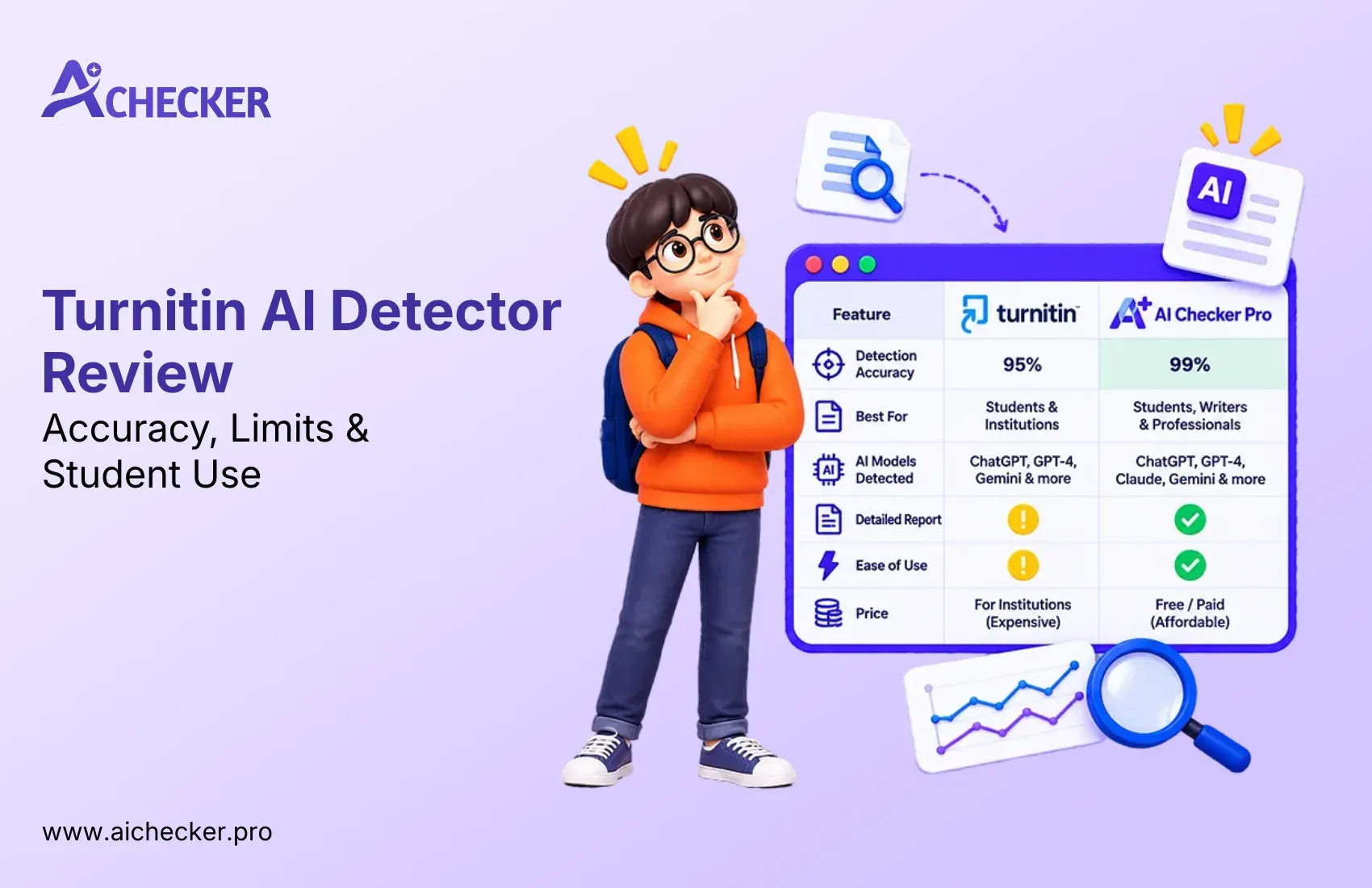
Is grammarly ai detector as accurate as Turnitin? Partly, as Grammarly's AI detection feature is generally less strict than Turnitin and is built for casual writers rather than academic integrity enforcement, thus flagging less content but also missing more AI generated text. You can see how it holds up in more detail in this Grammarly AI checker review.
Grammarly added their AI detection feature as part of their wider writing assistant, not as a standalone product. This is an important difference as Turnitin was built specifically for academic integrity checking and has years of data from real classroom submissions behind it.
Here is what actually works in 2026 when comparing the two:
- Grammarly tends to give softer, less punishing scores on borderline content
- Turnitin is more aggressive and more likely to flag paraphrased AI writing
- Grammarly is easier to access since many students already use it for grammar checks
- Turnitin integrates directly with school learning management systems like Canvas and Blackboard, which gives it more institutional weight
Neither tool releases an exact accuracy level for all to see. Testing them on a regular basis during the last two years has revealed that both tools create false hits, especially when it comes to non-native English speakers or writers who prefer a more elaborate style of writing.
As a matter of fact, if someone's writing style is closer to academic or repetitive, chances are that they will receive a positive identification, even if the text was not created by an AI.
Key Takeaway: Neither Grammarly nor Turnitin should be treated as a final verdict. Both are probability tools, not lie detectors, and both have documented histories of flagging human writing incorrectly.
What AI Detector Does Edgenuity Use?
Edgenuity, now part of Imagine Learning, primarily relies on Turnitin's AI detection integration for flagging AI generated coursework, since Turnitin is one of the most widely adopted detection systems across US school districts and online learning platforms.
This matters a lot if you are a student using Edgenuity for online coursework. Because Edgenuity leans on Turnitin's detection layer, the same accuracy concerns that apply to Turnitin also apply here. That includes the risk of false positives on formal writing and reduced accuracy on content that has been paraphrased or lightly rewritten.
Some school districts also layer in their own review process on top of the automated score, meaning a flagged assignment does not always mean an automatic penalty. Teachers often review flagged content manually before making a final decision, which is worth knowing if you are stressed about a flag showing up.
If you are a student using Edgenuity, here are a few practical steps:
- Keep your drafts and notes in case you need to prove your writing process
- Avoid submitting text that was generated and never edited
- Write in your own natural voice instead of an overly formal or generic tone
- If you did use AI for brainstorming, be transparent with your instructor about your process
Students working through this process regularly may also benefit from checking their work with an AI detector built specifically for students before they hit submit.
Why Do AI Detectors Give Different Results for the Same Text?
AI detectors disagree since they are trained on different data sets with different thresholds. This means that one paragraph could be 15% AI according to one program and 68% AI according to another program. There is no agreed upon value across the industry of what is considered AI-writing.
This is the part where most people get confused. One would expect that a program designed to find AI-written text would be pretty accurate in its calculations. But what these programs actually are are pattern analyzers. They analyze text for indicators such as:
- Sentence length variation
- Word predictability (also called perplexity)
- Repetitive structure (called burstiness)
- Common AI phrasing patterns
The issue is that skilled human writers can produce extremely predictable structured text, particularly within academic or technical writing, while AI generated text that has been paraphrased or humanized can often slip under the radar completely. If you want a deeper technical breakdown, this guide on AI detector accuracy covers the underlying mechanics in more depth.
Detection accuracy plummets significantly when it comes to humanized or paraphrased AI content compared to raw, unedited AI output. This is one of the most consistent observations I've made across every detector I've tried.
Crossplag vs Grammarly vs Turnitin: Side by Side Comparison
| Feature | Crossplag | Grammarly | Turnitin | AI Checker Pro |
|---|---|---|---|---|
| Built primarily for | Plagiarism + AI scan | Writing assistant | Academic integrity | AI detection + humanizing |
| Detection strictness | Moderate | Lower | Higher | Sentence level, adjustable |
| False positive risk | Moderate to high | Lower | Moderate to high | Lower, sentence level review |
| Humanizer included | No | No | No | Yes |
| Best for | Small schools, editors | Casual writers, students | Universities, schools | Students, bloggers, agencies |
| Free tier | Limited | Limited | Rarely available directly | Yes |
This table reflects general public reporting and hands on testing, not official accuracy statistics released by these companies, since most of them do not publish exact numbers.
How to Reduce the Risk of False Positives
If you are worried about being falsely flagged as an AI writer, even though your work is genuinely human, there are a few things you can control.
- Write in your natural voice instead of copying a formal, robotic tone
- Vary your sentence length instead of writing uniform, predictable sentences
- Keep drafts, outlines, and version history as proof of your writing process
- Avoid over polishing your writing with heavy grammar tools right before submission
- Run your work through a detector before submitting so you know your score ahead of time
Tools such as AI Checker Pro let users identify AI content at the sentence level so that they can spot what specific lines are triggering the flags and not simply be presented with a vague overall score.
I have personally seen bloggers use AI Checker Pro's AI Humanizer to clean up flagged sections of text before publishing in order to avoid Google penalties for low quality AI content. For a broader look at avoiding these flags altogether, this guide on tips to avoid AI detection is worth a read too.
Should Bloggers and SEO Writers Worry About AI Detectors Too?
Bloggers and SEO writers should also be concerned with AI detection. Although Google is not penalizing AI-generated content, articles created with the help of software tend to have a lower quality and therefore affect the credibility of the entire website. This ties closely into our AI content and SEO guide if you want a fuller picture of how the two connect.
Google has officially announced that it does not penalize webpages for being AI-generated. The search engine giant is penalizing badly written content that is presented as natural writing. Using AI software carelessly can lead to a generation of hundreds of low-quality articles.
Modern agencies are using software to check every single article for traces of artificial text. They are doing it not to avoid detection but to actual traces of robotic wording. Instead of spending time on rewriting whole paragraphs, bloggers can use an AI detector built for bloggers to spot artificial parts of the text.
Many companies working in the niche generate dozens of articles every single week. Such companies use our blog enhancer alongside AI Checker Pro to detect unnatural language and edit it.
Conclusion
How accurate are AI detectors in 2026? Well, they're better than they used to be, but they're far from being perfect. Crossplag, Grammarly, and Turnitin all employ different algorithms, which is why the same paper can have three different scores.
As a student, you should protect yourself by saving all your drafts and writing in your own voice as a blogger or business, you should prioritize quality over quantity.
And if you're looking for a second opinion before hitting submit or publishing, checking your work over at AI Checker Pro is an easy way to catch errors before they become bigger problems.
FAQs
Which AI detector is most accurate, Turnitin or Grammarly?
Can Crossplag detect AI content in essays?
Why do AI detectors give different results for the same text?
Does Grammarly's AI detector work as well as Turnitin's?
What AI detector does Edgenuity use for assignments?
Can AI detectors give false positives on human writing?
Does Google penalize websites for using AI generated content?
How can I avoid being falsely flagged as an AI writer?
Is there a free tool to check AI content before submitting?
Do humanized or paraphrased AI texts still get detected?

Harshil Barvaliya
SEO Executive & Content Writer at AI Checker Pro
I’m Harshil Barvaliya, an SEO Executive and Content Writer at AI Checker Pro. I focus on improving the website’s search engine visibility through effective SEO strategies, including keyword research, on-page and off-page optimization, and content development.Get Started Free
Create a free account for advanced AI detection and scan history.
Trusted by thousands worldwide.
Recent Blog's
Discover how AI-powered content creation can elevate your website's reach and engage your audience like never before. Explore the real impact of AI on crafting content that connects.