AI Text Detection: How to Check If Writing Is AI Generated
TABLE OF CONTENTS
Why Everyone Suddenly Cares About AI Detection
How AI Text Detection Actually Works
Manual Signs You Can Spot Without Any Tool
Using a Dedicated AI Detector Tool
Comparing the Top AI Detection Tools
The False Positive Problem Nobody Talks About Enough
Why Detection Accuracy Drops on Edited or Humanized Content
A Simple Workflow for Checking Your Own Writing
What This Means for SEO and Google Rankings
Choosing the Right Plan for Your Needs
Conclusion
FAQs
Get an AI summary of this post on:






If you've ever stared at a paragraph and wondered, "Did a human actually write this?" you're not alone. ChatGPT, Gemini, and Claude are producing text that sounds more and more human every month. Learning how to check if writing is AI-generated has become an incredibly valuable skill for anyone who wants to identify AI-generated text.
Why? Well, let's break it down. Whether you're a teacher grading essays, a blogger protecting your Google rankings, or a student facing a false accusation, this guide will show you everything you need to know.
Checking if text was created by an AI boils down to looking for certain telltale signs like repetitive sentence structure, unnatural word choice, lack of personal detail, unnatural grammar and flow, and then confirming your suspicions with a dedicated AI-generated check tool.
Get Lifetime Access with 60% OFF
Stop paying monthly subscriptions. Enjoy unlimited AI detection and humanizer access forever with future updates included.
- One-time payment
- Unlimited access forever
- All future updates included
Why Everyone Suddenly Cares About AI Detection
Two years ago, most people did not give a second thought to how a blog post or essay was put together. Now, chatbot detection is a daily problem for entire industries.
Teachers are grading hundreds of essays and need a quick way to find the ones that don't belong. Bloggers are working to avoid Google penalties due to low-quality, mass-produced AI content.
Businesses want their marketing copy to sound like it came from a real person, not a script.
I've tried many of the AI detectors and can tell you with confidence that most are not reliable with a single score. That is me telling you to be wary of using them. It doesn't help that you need to know how well they can detect certain types of fake content before trusting a single score.
How AI Text Detection Actually Works
Most GPT chat detector tools rely on two core ideas: perplexity and burstiness.
Perplexity measures how predictable the word choices are. AI models tend to pick the statistically "safest" next word, which makes their output more predictable than typical human writing.
Burstiness looks at sentence length variation. Humans naturally mix short, punchy sentences with longer, more complex ones. AI-generated text often has a smoother, more uniform rhythm.
When you run a DetectGPT scan, this is comparing against a large set of known human and AI text patterns and outputting a percentage. This is an estimate, and that's it. I'm going to explain to you why it's impossible for a machine learning algorithm to be able to read intent or watch a person type it in real time. There is no such thing as pattern matching.
Manual Signs You Can Spot Without Any Tool
Before you even open a detector, you can often tell something is off just by reading closely. Here is what actually works in 2026 when you are scanning text manually:
- Overly balanced structure: every paragraph is the same length, every list has exactly three points
- Vague personal claims: "I have always loved this topic" with zero specific memories or details
- Repetitive transition words: heavy use of words like "additionally," "in conclusion," or "it is important to note"
- Generic examples: broad statements with no named person, date, or specific event
- Too perfect grammar: zero typos, zero fragments, even in casual writing where a real person would naturally slip up
None of the above signs necessarily indicate the use of AI in a given piece of writing. However, if three or four of them appear together in the same text, this is usually a good reason to try using an AI generator check.
There is also a tone issue that trained readers pick up on quickly. AI writing tends to hedge everything. It says "it is important to consider" instead of just stating an opinion. It wraps up every section with a little summary sentence even when the topic does not need one.
Real writers, students, and bloggers with a distinct voice tend to commit to a point of view and move on. If a piece of writing feels like it is afraid to say anything, neutrality itself can be a clue worth noticing.
Another thing I look for is transition consistency. Human writers jump around a bit. They might start a paragraph with a question, then answer it with a sentence then follow up with a longer explanation.
AI-generated text often follows a stricter pattern: topic sentence, supporting detail, supporting detail, closing thought, repeated section, after section. Once you train your eye to notice that rhythm, it becomes much easier to spot before running any software.
Using a Dedicated AI Detector Tool
The ability to read between the lines works well unless you need to go through a long document. It is also great to have an advanced detection tool for files that can help you find the most relevant parts of a document.
Many projects like AI Checker Pro offer GPT and other AI detection tools. They work in a different way compared to most available solutions because they analyze each sentence and provide scores on the paragraph level.
When I did this test last month, I submitted thirty student essays, and multiple detectors provided different results.
Some detectors marked the same paragraph as 90% AI, and others showed that the text was written by humans. This is why it is essential to choose the right tool and pay attention to details.
Here is what a solid AI generated check tool should give you:
- Sentence by sentence breakdown, not just one score
- Support for multiple AI models, since text from GPT 4, GPT 5, Gemini, and Claude can each have slightly different fingerprints
- A humanizing option so writers can revise flagged sections instead of starting over
- Clear, plain language explanations of why a section was flagged
Comparing the Top AI Detection Tools
There is no shortage of options when it comes to chatbot detection software, and picking one can feel overwhelming. Below is a quick comparison based on my own testing and general reputation across the industry.
| Tool | Accuracy | Free Tier | Humanizer Included | Best For |
|---|---|---|---|---|
| AI Checker Pro | Strong on sentence level detection | Yes | Yes | Students, bloggers, agencies |
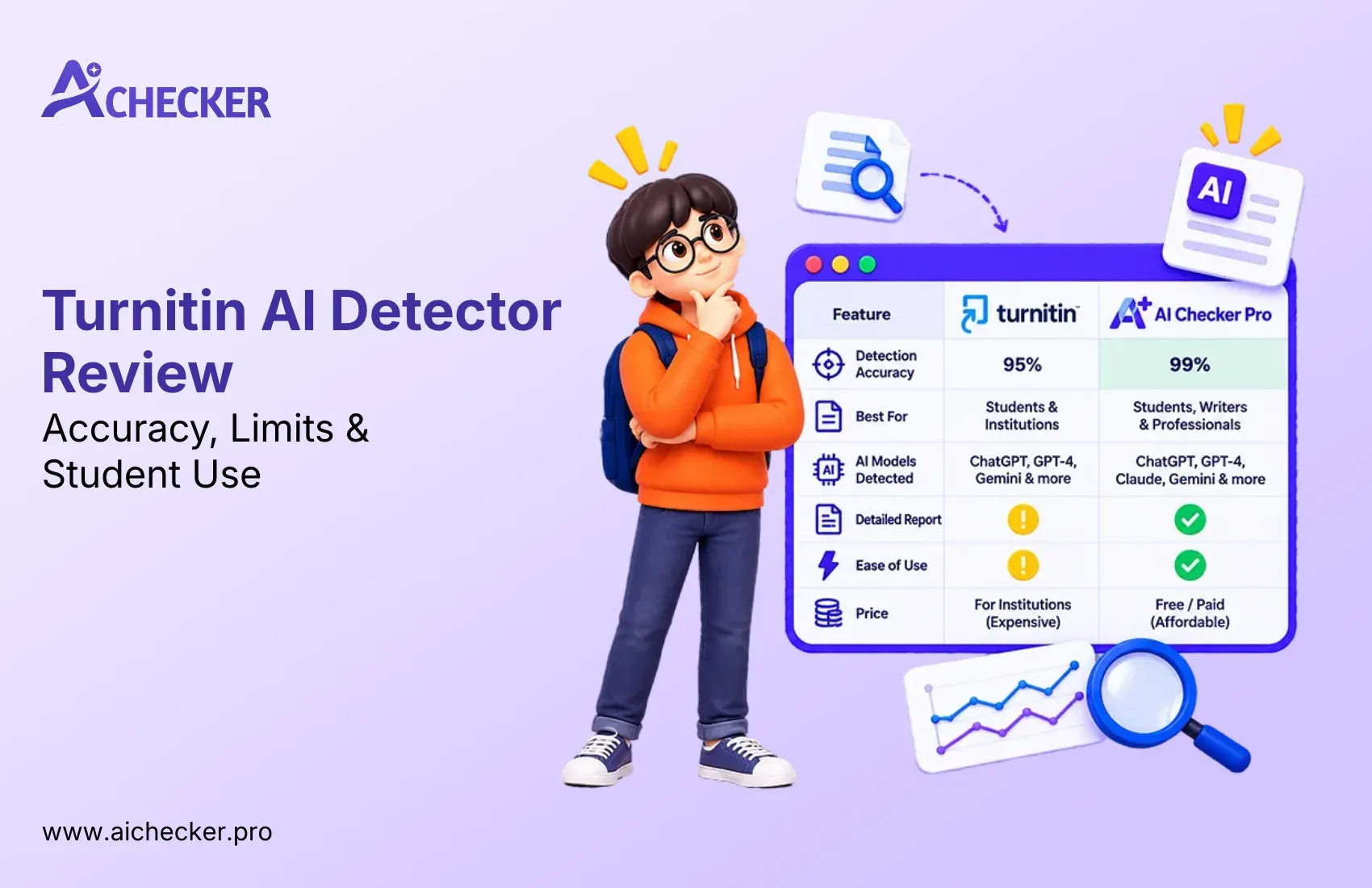
| Turnitin | Strong within academic settings | No (institution licensed) | No | Universities and schools |
| GPTZero | Moderate to strong | Yes, limited | No | Teachers, quick checks |
| Originality.ai | Strong for long form content | No | Limited | SEO teams, agencies |
| Copyleaks | Moderate | Yes, limited | No | Businesses, compliance teams |
None of the AI detectors are 100% accurate, that's a fact even for all the names listed here. Testing done independently in the last couple of years has shown that accuracy varies greatly for different topics, writing styles, and how the text was created in the first place. Detectors like Turnitin and GPTZero have been shown to be much less accurate for smaller texts and texts edited by a human after being generated by an AI.
The False Positive Problem Nobody Talks About Enough
This is probably the point that I feel the need to explain the most. Human written text can and will be flagged as AI generated, and it's more common than you might think.
Formal writing, academic style essays, and non native English writing can all be mistaken for AI generated text, simply because it follows a more structured and formulaic pattern that's easily picked up by algorithms.
If you are a student who got flagged unfairly, here is what actually helps:
- Keep your drafts and version history so you can show your writing process
- Vary your sentence length naturally instead of writing in a uniform style
- Add specific personal details, dates, and examples that an AI would not invent on its own
- Run your own AI generator check for students before submitting so you know what a scanner sees before your teacher does
Teachers and Professors, this applies both ways. One detector score is all it takes to accuse someone, don't use just one to accuse. Check another detector and question the student about their process of writing this before doing anything.
Why Detection Accuracy Drops on Edited or Humanized Content
Here is one crucial aspect that needs understanding: detection accuracy decreases substantially with paraphrased or humanized AI content as compared to raw AI text.
If someone takes the text from ChatGPT and rewrites even 20-30% of it, the sentence structures and statistical patterns will change drastically for the detectors.
That is why AI Checker Pro puts detection and humanization in a single solution.
Instead of rewriting the sentences manually, people prefer using AI Checker Pro to identify what and how to change to make the text pass as human-written while retaining its initial meaning.
A Simple Workflow for Checking Your Own Writing
Whether you are a blogger publishing weekly content or a student turning in a paper, here is a workflow that actually works:
- Write your first draft normally, whether with AI assistance or fully on your own
- Run a full AI generated check using a tool with sentence level scoring
- Review flagged sections individually instead of trusting one overall percentage
- Rewrite or humanize the flagged parts with your own voice, specific examples, and varied sentence rhythm
- Run a second scan to confirm the changes actually reduced the AI score
I have personally seen bloggers clean their content using our blog enhancer this exact way, running a check before publishing rather than finding out after Google has already indexed a low quality page.
What This Means for SEO and Google Rankings
Google has made it pretty clear that they don't penalize content for being AI assisted. They do, however, penalize low-quality and unhelpful texts, regardless of their origin.
Many SEO professionals have grown out of the practice of simply publishing their raw, un-edited AI drafts, due to the inconsistent structure and repetition that can hurt engagement, ultimately reflecting badly on the page's rank.
If you're a blogger or run content-heavy sites for your clients, running your text through a detect GPT scanner for content writers prior to publishing is quickly becoming a must, much like spell check was a decade ago. It has nothing to do with hiding the fact that you use an AI to help write your text, but rather ensuring that the text you publish has been properly proofread and engages the reader.
When you're an agency that fulfills content creation requests for multiple clients, this becomes an even bigger issue. Your client could very easily notice one particularly poorly-written article on their blog that Google has decided to heavily penalize, but there's little you can do about it. Trust between you and your client begins to falter with each new piece that underperforms.
Many SEO professionals I know personally have adopted the practice of running every single draft through not only a detection scanner, but a humanizing tool for SEO content too, as a part of their standard editing process. This ensures nothing slips through that could damage the client's SEO, much like how a proofreader would normally look for typos and grammatical errors.
Choosing the Right Plan for Your Needs
Not everyone needs the same level of detection. A student checking one essay before submission has very different needs than an agency scanning hundreds of articles a month. Most AI generated check tools, including AI Checker Pro, offer tiered plans so casual users are not paying for enterprise level volume they will never use.
Before picking a plan, ask yourself:
- How many documents do you realistically need to check per month
- Do you need the humanizer feature included, or just detection
- Do you need support for multiple AI models like GPT 4, GPT 5, Gemini, and Claude
- Is sentence level detail important, or is a single overall score enough for your use case
Used by 100K+ users, AI Checker Pro is built to cover this entire range, from a student running one free check to an agency processing a full content calendar.
Conclusion
Learning how to check if writing is AI generated is not about catching up with people or being paranoid. It is about understanding a new level of how content is created and evaluated in 2026.
Use manual reading skills and a reliable detection tool, always double-check flagged results before any conclusion, and use humanizing tools to improve genuinely weak writing, not to deceive anyone.
Whether you are grading papers, publishing blog posts, or just curious about a piece of writing, that balanced approach will be much more useful than just taking the score for granted.
FAQs
How can you tell if something is written by AI?
What is the best free tool to check if text is AI generated?
Can teachers really tell if a student used ChatGPT?
Does Turnitin accurately detect AI writing?
Can AI detectors give false positives on human writing?
Does Google penalize content that was written with AI help?
What does it mean to humanize AI content?
How accurate are AI detection tools overall?
Can Grammarly's suggestions get your writing flagged as AI?
What is the difference between perplexity and burstiness in AI detection?

Harshil Barvaliya
SEO Executive & Content Writer at AI Checker Pro
I’m Harshil Barvaliya, an SEO Executive and Content Writer at AI Checker Pro. I focus on improving the website’s search engine visibility through effective SEO strategies, including keyword research, on-page and off-page optimization, and content development.Get Started Free
Create a free account for advanced AI detection and scan history.
Trusted by thousands worldwide.
Recent Blog's
Discover how AI-powered content creation can elevate your website's reach and engage your audience like never before. Explore the real impact of AI on crafting content that connects.