Is It Safe to Upload Essays to AI Detectors? Privacy and Data Retention Explained
TABLE OF CONTENTS
Key Highlights
Introduction
What Happens to Text Uploaded to AI Detectors?
Do AI Detectors Store Essays?
AI Detector Data Retention: What Policies Usually Cover
AI Detection Privacy Risks You Should Know About
AI Detector Student Privacy: What US Students Should Know
Is It Safe to Upload Essays to AI Detectors?
AI Checker Pro and Privacy: A Practical Look
Quick Comparison: Privacy Points to Check Across Popular Tools
How to Protect Your Essays Before You Upload
Conclusion
FAQs
Get an AI summary of this post on:





Most people paste an essay into an AI detector without checking its privacy policy. But the question “Are AI detectors safe?” is important if you are sharing your personal work online.
Different AI detectors handle your text in different ways. Some check your text and delete it after the scan. Others may keep it for some time, while some may use it to improve their systems.
This guide explains what happens to your writing after you upload it, how AI detector privacy works, what risks you should know about, and how you can protect your work in 2026.
Key Highlights
- AI detectors do not all handle your text in the same way. Some delete your text after the check, some keep it for a certain time, and others may keep it until you ask them to delete it.
- Your essay can contain valuable work. It may include your grades, personal ideas, research, or client work. Treat it as important information.
- School and public AI detectors may follow different rules. Tools such as Turnitin may store student submissions in a school database, while public AI checkers may have their own data rules.
- You can take simple steps to protect your work. Remove your name and other personal details, choose tools with clear privacy rules, and avoid uploading work covered by a Privacy agreement.
- No AI detector is 100% accurate. Privacy is one concern, but wrong AI results are another. Treat an AI detection result as a warning, not as final proof.
Introduction
So, are AI detectors safe? Students and bloggers ask this question often. The simple answer is: it depends on the tool you use. Some AI detectors take privacy seriously, while others do not clearly explain what happens to your text.
Here is the short answer: AI detectors can be safe to use when they have clear privacy rules, protect your data, and allow you to delete your text. The risk is higher when a tool does not clearly explain how it stores, shares, or uses your essays.
Before uploading your work, always check the tool’s privacy policy. This can help you understand what happens to your text after you upload it.
What Happens to Text Uploaded to AI Detectors?
When you paste an essay into an AI detector, your text is sent from your browser to the company’s server. The tool checks your writing, gives it an AI score, and shows you the result.
But what happens to your text after the check? What happens to text uploaded to AI detectors depends on the company and its privacy rules. In most cases, there are three possible options.
Path 1: Checked and deleted
The tool checks your text, gives you a score, and deletes the text soon after. This is a safer option when you are checking private or important work.
Path 2: Saved for some time
The company may keep your text for days, weeks, or months. This may be done so you can see old reports, get help from support, or use your account history. It is not always a problem, but you should know how long your text is kept.
Path 3: Saved and used again
Some tools may keep your text and use it to improve their AI systems or for other purposes. A clear privacy policy should explain this. If the policy is hard to understand, you may need to look closely for these details.
One important thing to remember is that not every AI detector clearly explains how long it keeps your text. Before uploading an essay, check the privacy policy and look for information about data storage, data use, and deletion.
Do AI Detectors Store Essays?
This is one of the most common questions people ask. Do AI detectors store essays? Some do, while others may delete your text after checking it. There is no single rule that all AI detectors follow.
Here are some things that can affect how your text is stored:
- Tools with user accounts may save your scan history so you can check old reports later.
- Tools that do not need a login may still keep your text for a short time, even if you cannot see it later.
- School and college tools may store student papers in a school database so they can be checked against other papers in the future.
- Free AI detectors may have different data rules, so it is important to check their privacy policy before using them.
So, if you ask “Do AI checkers save your text?”, the answer is that some may save it for a certain period of time. The important questions are how long they keep it, how they protect it, and whether you can ask them to delete it.
What About Turnitin and School Systems?
If your teacher asks you to submit your work through Turnitin, your school may control how your paper is stored. Depending on the settings chosen by the school, your paper may be added to a database for future checks.
If you are not sure how your paper will be stored, ask your teacher or check your school’s academic rules.
What About GPTZero, Originality.ai, and Copyleaks?
GPTZero, Originality.ai, and Copyleaks are well-known AI detection tools. Each company has its own privacy rules, and these rules can change over time.
Before uploading sensitive work, check the current privacy policy of the tool. Pay attention to how the company stores, uses, shares, and deletes your text.
AI Detector Data Retention: What Policies Usually Cover
Privacy policies can be hard to understand. But AI detector data retention usually comes down to a few simple points. When checking AI checker privacy, look for what the company says about storing, using, and sharing your text.
| What the policy says | What it usually means |
|---|---|
| “We do not store submitted text” | Your text is checked and then removed. |
| “Data is kept for X days” | Your text is stored for a set amount of time. |
| “Data is kept while your account is active” | Your text may stay until you delete it or close your account. |
| “We may use content to improve our services” | Your text may be used to improve the company’s tools or AI systems. |
| “We may share data with partners” | Other companies or service providers may be able to access your data. |
| No clear statement | The policy does not clearly explain what happens to your text. |
What Should You Look For?
The most important thing is clear information. A good privacy policy should explain how long your text is kept, why it is kept, who may access it, and how you can delete it.
If you cannot find clear answers, take a closer look before uploading private essays, personal information, or work that belongs to a client.
AI Detection Privacy Risks You Should Know About
Let me be practical here. The AI detection privacy risks are not scary movie stuff, but they are real. Here are the main ones.
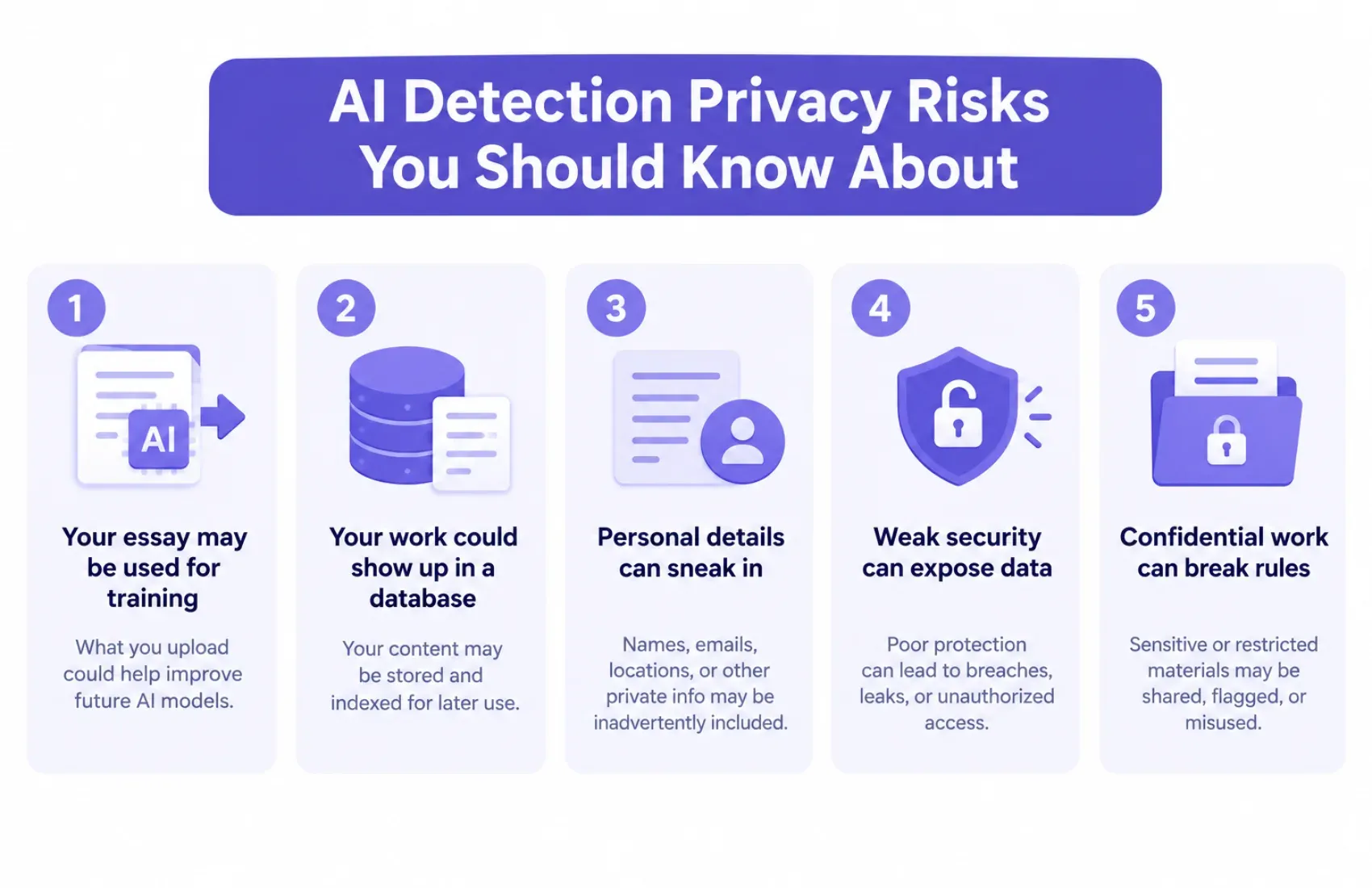
1. Your essay may be used for training
If a tool trains on user text, your original ideas could help improve a product you never agreed to support. For a student, that may feel small. For a blogger with unpublished content, it feels bigger.
2. Your work could show up in a database
If a paper is stored in a school or company database, it can later be compared against new submissions. That is useful for catching copying, but it also means your work lives somewhere long term.
3. Personal details can sneak in
Essays often include your name, student ID, email, class name, and personal stories. A college application essay might include family details or health experiences. Once uploaded, you cannot easily take that back.
4. Weak security can expose data
Even a well-meaning company can be hacked. This is why AI detector data security matters. Look for encryption, secure servers, and a clear statement about how data is protected.
5. Confidential work can break rules
If you write for a client, a company, or a research group, uploading their content to a public tool may break your agreement. This is a common mistake among freelancers and agency writers.
AI Detector Student Privacy: What US Students Should Know
AI detector student privacy is an important topic for students in the US. Students are often asked to show that their work is their own. This may mean using an AI detector before or after submitting an assignment.
Before uploading an essay, students should understand how the tool handles their work. Here are some simple steps to follow:
- Do not upload your student ID or other private details unless they are required.
- Use a school-approved tool when your teacher or college requires you to use one.
- Be careful with your school email. Do not use it on random AI detector websites without checking their privacy policy.
- Keep your drafts and notes. They can help show how you wrote your work if there is a problem with an AI detection result.
What If Your Human-Written Essay Is Flagged?
No AI detector is 100% accurate. A detector may sometimes mark human-written work as AI-generated. This can happen with formal writing and may also affect some students who are not native English speakers.
Because of these limits, an AI detector result should not be treated as the only proof that a student used AI.
If your essay is flagged, your drafts, notes, research files, and writing history can help show how your work was created.
Before uploading an essay to an AI detector, take a moment to check its privacy rules, data storage, and deletion policy. A few minutes of checking can help you make a more
Is It Safe to Upload Essays to AI Detectors?
So, is it safe to upload essays to AI detectors? It can be, but you should check a few things before uploading your work. Do not upload an essay without knowing how the tool handles your text.
You may feel more comfortable using a detector that:
- Has a clear privacy policy that is easy to understand.
- Lets you delete your text or account when you no longer need it.
- Uses encryption to protect your data when it is sent and stored.
- Explains whether your text is used to train or improve its AI systems.
- Does not ask for personal information that is not needed for the check.
Be more careful with tools that do not have a clear privacy policy, provide little information about the company, or ask you to upload your essay before explaining how your data will be handled.
Before using any AI detector, take a few minutes to understand its privacy, storage, and data deletion rules.
AI Checker Pro and Privacy: A Practical Look
AI Checker Pro is a tool that checks text for possible AI-generated content. It also provides sentence-level results, so you can see which parts of your writing may look AI-generated.
The tool also includes an AI humanizer and supports text from tools such as ChatGPT, GPT-4, GPT-5, Gemini, and Claude. It is used by more than 100,000 users.
If you use AI Checker Pro or any other AI detector, it is a good idea to read the privacy policy before uploading your work. Check how the tool stores, uses, protects, and deletes your text.
You can use the AI Detector to check your writing. If some parts are flagged and you want to rewrite them, you can also use the AI Humanizer.
Quick Comparison: Privacy Points to Check Across Popular Tools
Privacy rules can change over time, so it is better to check each company’s current policy before uploading your work. The table below gives you a simple checklist of what to look for.
| Tool | Free Option | Humanizer | Common Users | Privacy Point to Check |
|---|---|---|---|---|
| AI Checker Pro | Yes | Yes | Students, bloggers, agencies | How long text is kept and how you can delete it |
| Turnitin | Usually provided through schools | No | Schools and colleges | Whether submitted papers are saved in a database |
| GPTZero | Yes, with limits | No | Teachers and students | Account history and how user data is used |
| Originality.ai | Paid | No | Publishers and SEO teams | How scan results are stored and shared |
What Should You Look For?
Use this table as a checklist, not a ranking. Before choosing an AI detector, read its current privacy policy and check how it stores, uses, shares, and deletes your text.
The right choice depends on your needs and how comfortable you are with the tool’s privacy rules.
How to Protect Your Essays Before You Upload
You do not need to be a tech expert to protect your writing. A few simple steps can help you keep your essays and personal information safer.
- Read the privacy policy. Look for words such as “retention,” “training,” “sharing,” and “delete.” These can tell you how the tool handles your text.
- Remove personal details. Delete your name, student ID, email address, and other private information before uploading your work.
- Check if you can delete your text. Find out whether the tool lets you remove your uploaded content or account data.
- Try a low-risk sample first. Use a short piece of public writing instead of your full essay. This can help you understand how the tool works.
- Do not upload private or client work. If you do not have permission to share the content, do not upload it to an online AI detector.
- Keep your drafts. Save your earlier versions, notes, and research. They can help show how you created your work if questions come up later.

Get Lifetime Access with 60% OFF
Stop paying monthly subscriptions. Enjoy unlimited AI detection and humanizer access forever with future updates included.
- One-time payment
- Unlimited access forever
- All future updates included
Conclusion
So, are AI detectors safe? They can be safe to use, but you should check how each tool handles your text before uploading it. Do not assume that every AI detector follows the same privacy rules.
A few simple steps can help protect your work: read the privacy policy, remove personal details, avoid uploading private or client work, and keep your drafts.
Remember that privacy and accuracy both matter. AI detectors can make mistakes, so their results should not be treated as final proof.
If you want to check your writing with AI Checker Pro, review its current privacy policy before uploading any private or important work. The same rule applies to any AI detector you choose.
FAQs
Are AI detectors safe to use?
Do AI detectors store essays?
What happens to text uploaded to AI detectors?
Do AI checkers save your text?
Does Turnitin keep student papers?
What should I look for in AI detector data retention and privacy policies?
Can AI detectors use my essay for training?
What are the main AI detection privacy risks?
How can I protect my essay before uploading it to an AI detector?
Can AI detectors flag human-written essays?

Harshil Barvaliya
SEO Executive & Content Writer at AI Checker Pro
I’m Harshil Barvaliya, an SEO Executive and Content Writer at AI Checker Pro. I focus on improving the website’s search engine visibility through effective SEO strategies, including keyword research, on-page and off-page optimization, and content development.Get Started Free
Create a free account for advanced AI detection and scan history.
Trusted by thousands worldwide.
Recent Blog's
Discover how AI-powered content creation can elevate your website's reach and engage your audience like never before. Explore the real impact of AI on crafting content that connects.