What AI Detector Does Schoology Use? A Complete Guide
TABLE OF CONTENTS
Does Schoology Have Its Own AI Detector?
How the Turnitin Integration Works Inside Schoology
Does Schoology Use Copyleaks Too?
How Accurate Is the AI Detection Schoology Relies On?
What About False Positives?
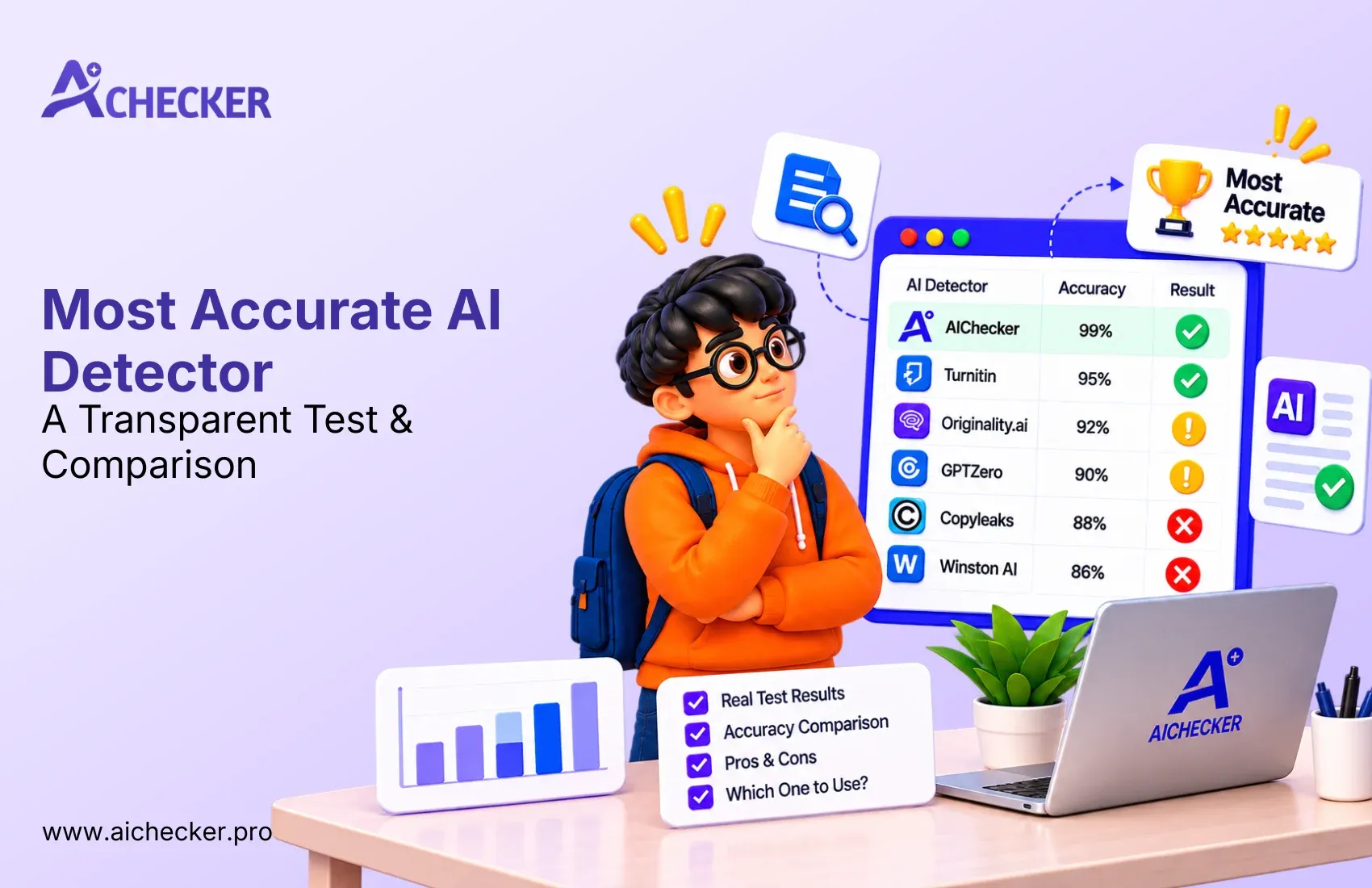
AI Checker Pro vs Turnitin vs Other Detectors
For Teachers: Using Schoology's AI Detection Responsibly
Can You Check Your Writing Before You Submit It to Schoology?
Conclusion
FAQs
Get an AI summary of this post on:

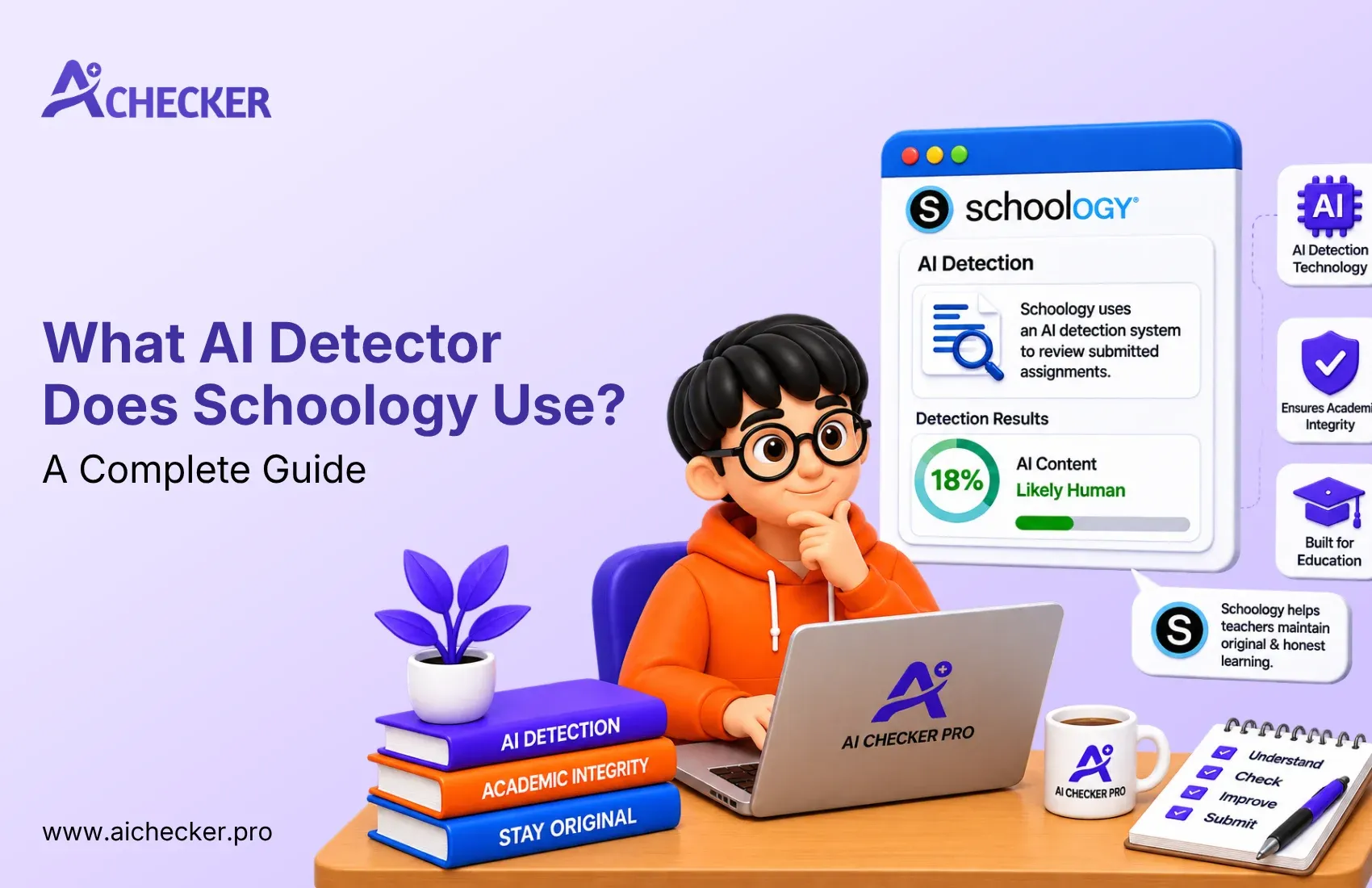
If you are a student, teacher, or parent trying to discover how AI detector does Schoology work, then you're definitely not the only one. Schoology is one of the most widely used learning platforms in the US, and many people believe that Schoology AI detector is its own built-in system. This is not true, it works with outside services to check assignments for AI content.
Short version: Schoology does not have its own detector, but rather uses services such as Turnitin, and to a lesser extent Copyleaks, to identify AI-generated text for their users.
In this post I will detail what this means, why it should matter to you if you're concerned about getting falsely accused, and what you can do about it whether you're a student who did not use any AI assistance in writing your 100% original paper, or a teacher grading papers in 2026 who wants to ensure you aren't unfairly punishing students who used AI tools without realizing how much they're affecting their writing.
Check Your Paper Before Schoology Does
Run your writing through a sentence-level AI checker before you submit, so nothing catches you off guard on your Turnitin report. Lifetime access, one payment, no subscriptions.
- One-time payment
- Unlimited access forever
- All future updates included
Does Schoology Have Its Own AI Detector?
No, and that's what tricks a lot of people in. Schoology, which is powered by PowerSchool, is an open learning management system, meaning it is designed to connect to external tools via LTI, or Learning Tools Interoperability.
Schoology does not have its own AI writing detector, but rather allows schools to connect their own detector software that their district has licensed.
I think it's a good decision that Schoology does not try to create its own AI writing detection system.
Creating a reliable AI writing detector is a task that is difficult and requires constant updating as newer and more advanced AI models are created every few months.
By leaving the task of detection to other companies, like Turnitin, Schoology can avoid designing their own detection system and let other companies that specialize in how AI detection actually works handle it.
So when your teacher says "Schoology caught this," what they usually mean is that Turnitin's AI writing report, running inside the Schoology assignment tool, flagged something in your submission.
How the Turnitin Integration Works Inside Schoology
Here is what actually happens in 2026 when a student submits a paper through Schoology:
- The student uploads or types their assignment into a Schoology assignment box
- If the teacher has enabled the Turnitin AI detection integration, the text gets sent to Turnitin's servers
- Turnitin runs its similarity check and, if enabled, its AI writing detection model
- A report comes back into Schoology showing a similarity percentage and, separately, an AI writing percentage
- The teacher reviews the flagged sections before deciding whether to talk to the student
I've reviewed several of these reports previously while assisting a friend of mine, who teaches high school English, and something jumped out at me right away.
A paper can show up as zero percent similar and then get flagged for high AI content, or vice versa. And teachers who don't recognize the difference can cause issues for students.
Does Schoology Use Copyleaks Too?
In some districts, yes. Some PowerSchool and Schoology accounts have implemented Copyleaks as an alternative plagiarism checking service, over which some school districts had already contracts before the rise of AI detection software.
It works in a very similar manner, as the text is also sent via an LTI link to the plagiarism checking website, from which it returns a report in the Schoology gradebook or assignment area. If you want to know more about how reliable this option really is, we broke it down in our piece on whether Copyleaks' AI detector is accurate.
As a student, the answer to the question "what AI detector does Schoology use", unfortunately depends on what tools your school district has subscribed to. There is no universal detector integrated into every Schoology account.
How Accurate Is the AI Detection Schoology Relies On?
This is the part where people get picky about what they actually want to hear. The fact of the matter is that no AI detector is 100 percent accurate. Period. Not Turnitin, not Copyleaks, not Originality. AI, not GPTZero.
Multiple companies have independently tested these claims and found them to be consistently false.
These products have been proven to give both false positives and false negatives when detecting AI-generated text. We go into more depth on this in our guide to which AI detectors are actually accurate.
This is the brutal truth, but it is a statistical reality that any system designed to guess which of two possible outcomes is more likely to be correct will always have an error rate of some sort.
A few things are worth understanding here:
- Detection accuracy is highest on raw, unedited AI text straight out of a chatbot
- Accuracy drops significantly once that text has been paraphrased, edited, or run through a humanizing tool
- Formal writing style, especially from non native English speakers, tends to get flagged more often because it can statistically resemble AI patterns
- Short submissions under a couple hundred words are harder for any detector to judge accurately
Some universities and school districts have actually scaled back how much weight they put on AI detection scores because of these accuracy concerns. It is not that the tools are useless; it is that they are best used as one signal among many, not a final verdict.
What About False Positives?
Let's address this head-on, as it stands out as a particularly daunting aspect of the current scenario for students. Written content composed by humans can be incorrectly identified as AI-generated, and this occurs more frequently than many acknowledge.
If you express your thoughts in a clear, structured, and somewhat formal manner, particularly if English isn't your native language, detection systems may confuse that clarity with machine-generated text. I've encountered this issue with genuinely skilled writers whose natural style is clean and well-organized, a pattern we've documented in our piece on AI Checker Pro and false positives on human writing.
If you are worried about getting falsely flagged, here is what actually helps:
- Save your drafts and outlines as you go; this gives you proof of your writing process
- Use Google Docs or a similar tool with version history turned on
- Avoid writing your entire assignment in one uninterrupted sitting with no revisions, since a flat, unedited pattern can sometimes read as more machine-like
- If you did use AI for brainstorming only, keep a record of that so you can explain your process honestly
Tools like AI Checker Pro help here too. Running your own writing through a checker before you submit lets you see if anything might get flagged, sentence by sentence, so there are no surprises when your teacher's report comes back.
AI Checker Pro vs Turnitin vs Other Detectors
As Schoology relies on external detectors instead of developing its own, it's beneficial to understand how the leading alternatives stack up against one another. Below is a comparative overview.
| Tool | Accuracy | Free Tier | Humanizer Included | Best For |
|---|---|---|---|---|
| AI Checker Pro | Strong, sentence-level detection | Yes | Yes | Students, bloggers, and writers who want detection and humanizing in one place |
| Turnitin | High on raw AI text, weaker on edited text | No, institution-licensed only | No | Schools and universities using LMS integrations |
| GPTZero | Moderate, known for false positives on formal writing | Limited free scans | No | Teachers doing quick spot checks |
| Copyleaks | Solid on plagiarism, moderate on AI detection | Limited free tier | No | Districts already using it for plagiarism |
| Originality.ai | High, popular with SEO teams | No | No | Agencies and content teams checking bulk articles |
I've evaluated numerous AI detection tools, and, to be frank, most lack the reliability needed to serve as a sole reference point. What sets AI Checker Pro apart is its comprehensive analysis; instead of providing just a vague percentage, it delves into the detection process at the sentence level.
This feature enables you to identify the exact portions of your text that may trigger concerns, allowing for targeted revisions rather than requiring a complete overhaul of your work. If English editing is part of your revision process, our AI humanizer tool can also help smooth out flagged sections naturally.
Moreover, it is compatible with various content generated by ChatGPT, GPT-4, GPT-5, Gemini, and Claude, which is crucial, as students and writers frequently utilize multiple chatbots today. If you want a breakdown of how different models compare on detectability, check our guide on AI detectors for ChatGPT, Claude, and Gemini.
For Teachers: Using Schoology's AI Detection Responsibly
If you are on the teaching side of this, a little caution goes a long way. Here is what I would suggest based on how other educators have handled it:
- Treat any AI flag as a starting point for a conversation, not proof of cheating
- Look at the specific flagged sentences rather than just trusting the overall percentage
- Consider the student's writing history and whether the flagged style matches their usual work
- Give students a chance to explain their process before assuming the worst
Upholding academic integrity is essential, and the advent of generative AI has undeniably complicated the grading process. For a deeper look at building a fair, defensible policy, see our AI detector guide for teachers.
However, relying solely on a Turnitin or Copyleaks score as a definitive judgment, without further examination, can unjustly implicate innocent students.
During a review of flagged essays with a teacher colleague last semester, we discovered that at least two out of ten were genuine false positives upon closer scrutiny of the content.
Can You Check Your Writing Before You Submit It to Schoology?
Absolutely, it's advisable to take this step if you're feeling apprehensive. Rather than submitting your work without any insights and crossing your fingers for a favorable outcome, many students are opting to use their own AI detector built for students prior to submission.
Instead of manually revising flagged segments, numerous users now utilize AI Checker Pro to evaluate their drafts, identify potential false positives, and refine their phrasing before their work reaches their teacher's Turnitin report. The same approach works well for homework assignments beyond just essays.
This approach is particularly beneficial for those who tend to write in a formal or structured manner, as that type of writing is more likely to be mistakenly flagged.
Conclusion
Which AI detector does Schoology utilize? The straightforward answer is that Schoology does not create its own; instead, it relies on the integration chosen by your district, typically Turnitin and, in some instances, Copyleaks.
Both of these tools have their limitations, and the possibility of false positives is a significant concern, particularly for meticulous, formal writers.
Whether you're a student looking to safeguard your work with a reliable AI detector for essays or an educator aiming for fair assessments in 2026, the best approach is to consider any AI detection score as merely one factor in the evaluation process. It's advisable to review your writing in advance whenever possible.
FAQs
Does Schoology have its own AI detector?
What AI detector does Schoology use?
How does Turnitin work inside Schoology?
Can Schoology's AI detector give false positives?
Is Turnitin's AI detector accurate?
Does Copyleaks work the same way as Turnitin in Schoology?
Can I check my writing before submitting it on Schoology?
Why does formal writing get flagged as AI on Schoology?
Should teachers fully trust the AI detection score on Schoology?
What should students do if falsely flagged for AI writing?

Harshil Barvaliya
SEO Executive & Content Writer at AI Checker Pro
I’m Harshil Barvaliya, an SEO Executive and Content Writer at AI Checker Pro. I focus on improving the website’s search engine visibility through effective SEO strategies, including keyword research, on-page and off-page optimization, and content development.Get Started Free
Create a free account for advanced AI detection and scan history.
Trusted by thousands worldwide.
Recent Blog's
Discover how AI-powered content creation can elevate your website's reach and engage your audience like never before. Explore the real impact of AI on crafting content that connects.