Brightspace AI Detector: Does Brightspace Check for AI Content?
TABLE OF CONTENTS
Does Brightspace Have a Built In AI Detector?
What AI Detector Does Brightspace Use?
How Accurate Is Brightspace AI Detection?
Does Brightspace Check All Submissions or Just Some?
Does Brightspace Detect ChatGPT Specifically?
What Should Students Do Before Submitting?
Conclusion
FAQs
Get an AI summary of this post on:





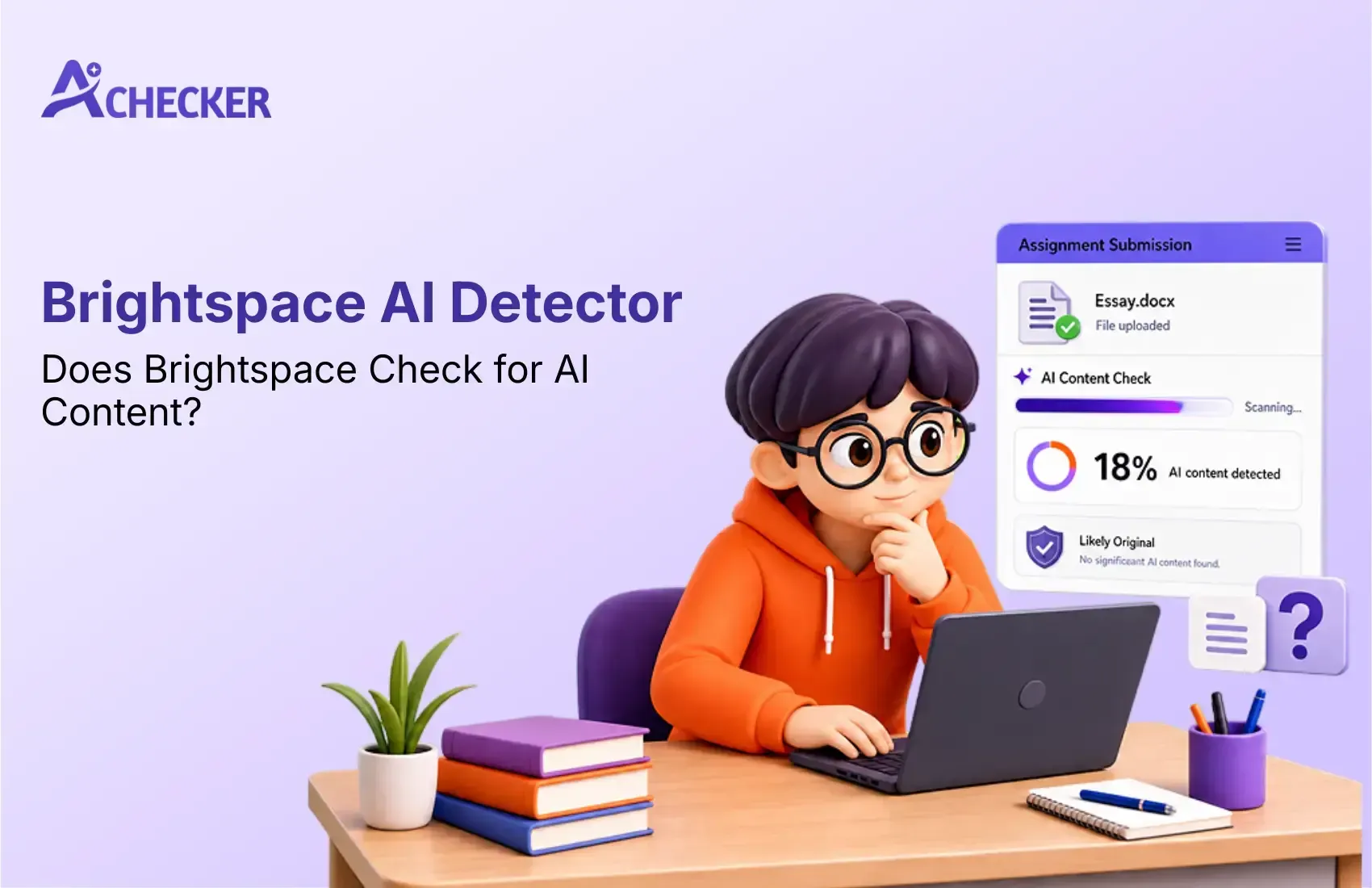
You have now finished your task and uploaded it to Brightspace, but then this thought keeps bugging you in your mind: Has Brightspace detected any AI used in this paper?
Well, don't worry. As universities around the world are becoming stricter regarding their academic integrity policies, and the use of AI tools is also increasing among students, this has become the number one question that students usually ask. In short, Brightspace itself is not an AI detector; however, we will discuss the complete details in the latter sections of this article.
Your work could have been automatically checked by Turnitin or Copyleaks, depending upon how your university has configured its Brightspace settings.
This article will give you detailed information about how Brightspace AI detection works, which third party software is involved, how accurate it is, and what you must do before uploading anything to Brightspace.
Does Brightspace Have a Built In AI Detector?
What Brightspace Actually Is
First, let's clear up a common misconception. Brightspace is a Learning Management System (LMS) built by D2L (Desire2Learn). It's designed to help schools manage courses, distribute assignments, host discussions, and track student progress not to detect AI generated content.
Think of Brightspace as the classroom itself. It's where your professor posts readings, where you submit essays, and where your grade lives. But Brightspace doesn't read your submissions for signs of AI writing any more than a physical classroom can.
As of 2026, Brightspace has no native AI detection feature. It does not automatically flag ChatGPT generated content, analyze writing patterns, or produce AI similarity scores on its own.
What AI Detector Does Brightspace Use?
In light of the fact that Brightspace does not have any built in detector, academic integrity tools from third parties are integrated within the institution through a process referred to as Learning Tools Interoperability (LTI). The most common academic integrity tools connected to Brightspace include:
Turnitin
However, Turnitin is the most commonly used tool to detect plagiarism in universities, and it is also the most frequently employed AI detector that Turnitin uses in Brightspace. This technology initially served for the purpose of detecting plagiarized work; however, in 2023, it acquired the functionality of AI detection as well. It detects writing that seems to be written with the help of such programs as ChatGPT, Gemini, or Claude.
In case Turnitin has been enabled by an educator for a particular assignment in Brightspace, all the papers are automatically sent there to undergo analysis.
Important update for 2026: Turnitin is currently rolling out its "Asset Processor" feature, which will eventually allow AI and plagiarism detection on Brightspace Discussion posts and Quizzes, not just traditional file submissions. As of early 2025, this feature is live for assignments and is still being expanded.
Copyleaks (Now Natively Integrated)
Copyleaks is yet another popular AI and plagiarism detection tool, and in September 2025, it was officially integrated into the Brightspace Assignments application. This is an important step since earlier Copyleaks had some extra steps that needed to be taken in order to retrieve the results. If you're curious about how reliable this tool actually is, you can read this breakdown of whether Copyleaks AI detector is accurate.
Copyleaks is capable of detecting AI generated material created by ChatGPT, Gemini, Claude, and other large language models. The second feature is the detection of paraphrased AI content.
Compilatio
The Compilatio platform is a combination of plagiarism software and an artificial intelligence content analyser. The platform is mainly popular in European universities. Compilatio is compatible with the Brightspace platform and has an accuracy rate of about 92% in identifying AI content.
SafeAssign
SafeAssign is the built in tool of Blackboard, but at the same time, there are schools that switched from Blackboard to Brightspace but still use SafeAssign because of its integration capabilities. It should be mentioned that SafeAssign as an AI detector is designed to detect plagiarism only.
Which Tool Is Active at Your School?
What is important to understand here is that the AI detector provided in your Brightspace completely relies on your institution. There can be different agreements with licenses, different tools, and even different settings at the course level. While one course may have the AI detector turned on, the other may not.
| Tool | Primary Focus | AI Detection Accuracy | Native Brightspace Integration |
|---|---|---|---|
| Turnitin | Plagiarism + AI | ~98% (unedited AI) | Via LTI |
| Copyleaks | AI + Plagiarism | 95%+ | Native (Sept 2025) |
| Compilatio | Plagiarism + AI | ~92% | Via LTI |
| SafeAssign | Plagiarism | Limited | Via LTI |
If you're unsure which tool your course uses, check the assignment details in Brightspace or your institution's academic integrity policy page.
How Accurate Is Brightspace AI Detection?
The detection capabilities offered by Brightspace are actually quite effective, but that does not make them foolproof. You need to know about their AI detector accuracy to put the detection findings into the right context.
According to Turnitin, their detection capability for AI written texts that have not been altered is over 98% accurate. But once the AI text is revised or altered in any way, the detection rate drops drastically to just 70%.
Copyleaks' detection capability for AI texts from leading language models is above 95%. These are impressive numbers, but there is an important caveat attached to them.
False Positives: What Students Need to Know
Every AI detector produces false positive cases where human written content is incorrectly flagged as AI generated. This is one of the bigger AI detection problems students run into, and it disproportionately affects certain groups:
- Non native English speakers who write in structured, formal patterns
- Students who follow rigid essay formats (five paragraph essays, formulaic academic writing)
- Students who write in a consistent, polished style that statistically resembles AI output
No AI detector is right 100% of the time. Being flagged does not automatically mean you used AI, and most institutions recognize this. If your work is flagged, save your drafts, notes, and research materials, and speak with your instructor about the appeal process.
Does Brightspace Check All Submissions or Just Some?
This is an important distinction that many students don't fully understand.
What Gets Scanned
AI detection in Brightspace is not universal. Whether your submission gets scanned depends on:
- Whether your school has licensed an AI detection tool
- Whether your instructor has enabled detection for that specific assignment
- Which tool is configured (some are assignment only, some are expanding)
As of 2025, Turnitin's AI detection is active primarily on file based assignment submissions in Brightspace. The expansion to Discussion posts and Quizzes is still underway through the Asset Processor rollout.
What Brightspace Does NOT Monitor
Brightspace on its own does not track the following:
- Tab switching or browser activity during an assignment (this requires separate proctoring software like Respondus Monitor or Proctorio)
- Copy paste behavior (again, requires a third party tool)
- Time spent writing vs. time elapsed between login and submission
This means that if your school is not using a third party proctoring tool, Brightspace itself is not watching how you write, only what you submit.
Does Brightspace Detect ChatGPT Specifically?
In short, no, but yes, through the integrations it uses. The broader question of whether ChatGPT is detectable comes down to which tool your school has connected.
All of Turnitin, Copyleaks, and Compilatio use detection systems that have been specially trained to detect AI written text using AI tools such as ChatGPT, GPT 4/GPT 4o, Gemini, and Claude.
This detection system looks for writing characteristics that include things like predictable language use, even sentence lengths, and low linguistic diversity.
What Should Students Do Before Submitting?
Knowing how the system works puts you in a much better position. Here's a practical approach to protect yourself, whether you use AI as a writing tool or not.
1. Check Your Own Work Before You Submit
What you can do as the first step is to use a free AI detector tool prior to hitting the submit button. Thus, you get an insight into how your content would be seen by Copyleaks and Turnitin.
In case your grade ends up being quite high, it may mean that either you have used AI writing tools or your content is written formally.
You can do this for free at AIChecker.pro: paste your text, get an instant AI probability score, and revise with confidence.
2. Add Personal Voice and Specific Examples
Content detected by AI is perfect. Including your own examples, class discussions, or personal analysis of sources will make it much more difficult for such tools to detect it, and improve it considerably. If you want help refining tone without losing your own voice, this guide on how to humanize AI text walks through the process step by step.
3. Vary Your Sentence Structure
Sentences that AI produces are quite similar in length and structure. One way to ensure that your writing sounds human is to read it out loud while varying sentence lengths and rhythms.
4. Keep Your Drafts
Whether you are writing in an unorthodox style or not, always keep the draft copies of your research, notes, brainstorming, and everything in between. When your work gets into trouble, that will be your best evidence.
5. Know Your School's Policy
Others, however, have official policy positions regarding the use of AI: some allow the use of AI in the brainstorming process, while others completely ban its use. This matters even beyond coursework too, since many schools now check for AI in application essays as part of admissions review.
Conclusion
Brightspace itself does not have an AI detector; however, that's just part of the story. The external systems your school attaches to Brightspace, such as Turnitin and Copyleaks, are already screening your submission for any AI written pieces.
If the AI detection is turned on for your particular task depends on the specific configuration of your college, but this feature has become quite widespread in many universities and colleges around the world.
The best strategy here is to check your piece against one of the best free AI detector tools before submitting it. Run a quick and free check on AIChecker.pro and receive your instant AI detection score.
FAQs
1. Does Brightspace have an AI detector?
2. What AI detector does Brightspace use?
3. Is Brightspace's AI detector built in or third party?
4. What do students say about Brightspace AI detection on Reddit?
5. Can Brightspace detect ChatGPT content?
6. How accurate is Brightspace AI detection?
7. Does Brightspace check all submissions for AI?
8. Can Brightspace AI detectors give false positives?
9. What is the best free AI checker for students?
10. How can I humanize AI text before submitting?

Harshil Barvaliya
SEO Executive & Content Writer at AI Checker Pro
I’m Harshil Barvaliya, an SEO Executive and Content Writer at AI Checker Pro. I focus on improving the website’s search engine visibility through effective SEO strategies, including keyword research, on-page and off-page optimization, and content development.Get Started Free
Create a free account for advanced AI detection and scan history.
Trusted by thousands worldwide.
Recent Blog's
Discover how AI-powered content creation can elevate your website's reach and engage your audience like never before. Explore the real impact of AI on crafting content that connects.