SafeAssign AI Detector: Can SafeAssign Detect AI Writing?
TABLE OF CONTENTS
What Is SafeAssign and How Does It Work?
Can SafeAssign Detect AI-Generated Content?
Why a 0% SafeAssign Score Doesn't Mean You're Safe
Did SafeAssign Add AI Detection in 2024?
SafeAssign vs Dedicated AI Detectors
Common Myths About SafeAssign AI Detection
What Should Students and Educators Do Instead?
Conclusion
FAQs
Get an AI summary of this post on:



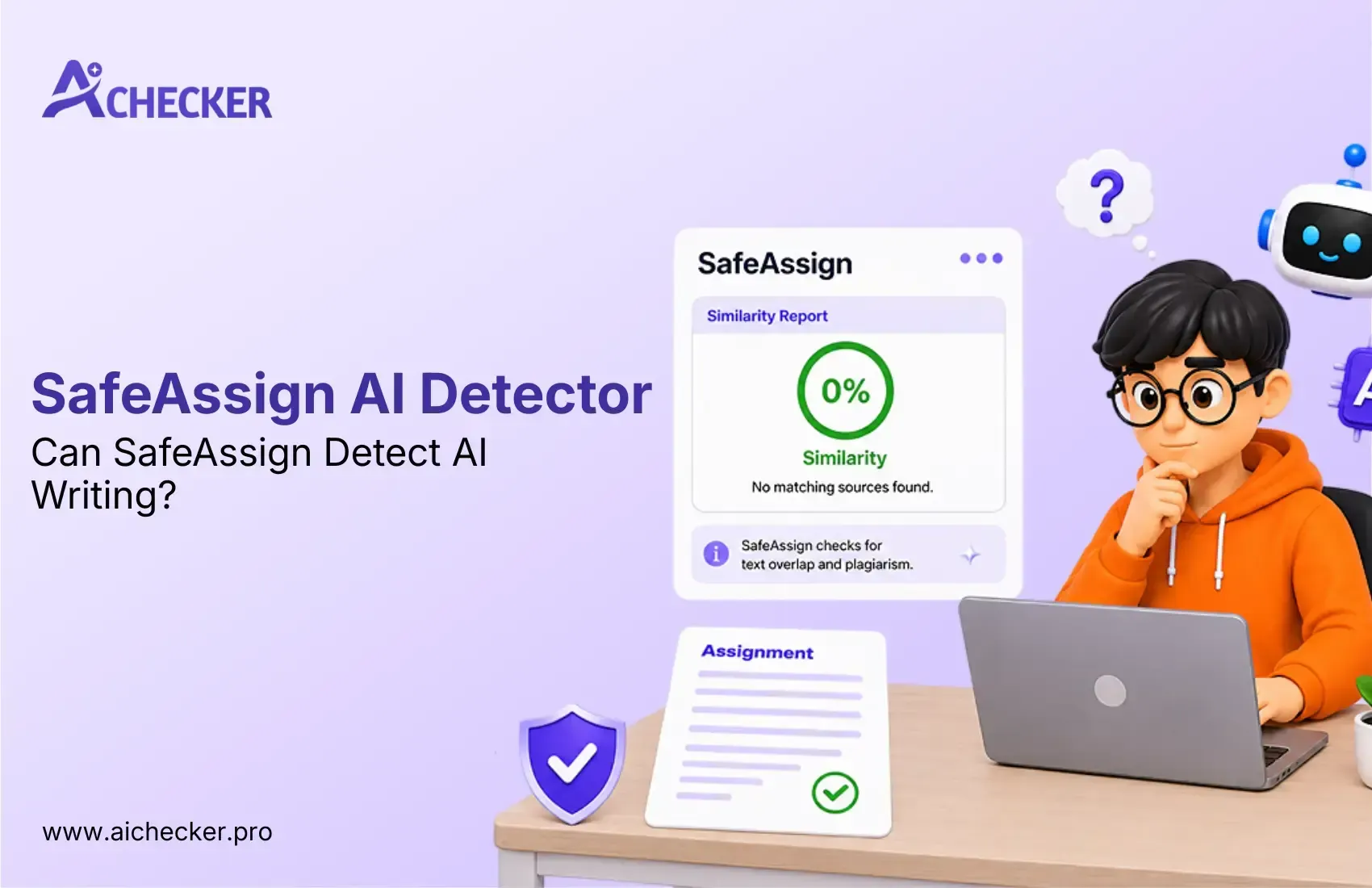
You have just submitted your paper via the Blackboard portal, and the SafeAssign score is 0%. Looks like all is fine.
Hold on!
Many students believe that a 0% SafeAssign score ensures that their work does not include plagiarism, AI assistance, or anything else. However, the issue is that SafeAssign is not an AI detector tool, and it never has been one. If your professor needs to detect AI-generated papers, he/she will hardly use SafeAssign.
Here we explain how SafeAssign works, why it cannot detect AI assistance, what really happened to it in 2024, and which tools actually identify AI writing.
What Is SafeAssign and How Does It Work?
SafeAssign is the plagiarism detector embedded in Blackboard. The tool has existed for many years now, and it is one of the most popular plagiarism detectors among institutions using the Blackboard (previously named Anthology) learning management platform.
Once you upload your paper to SafeAssign, it scans it by comparing strings of text known as "shingles" within your document to its database.
How SafeAssign's Similarity Score Works
SafeAssign compares your submission against three main sources:
- Its Global Reference Database: a large pool of previously submitted student papers
- Institutional archives: papers submitted to your own university
- Web and academic sources: publicly available content and selected academic publishers
After completing this analysis, you receive a similarity score, which is basically expressed as a percentage that reflects the amount of your text matching existing documents. In case the similarity score is high, it shows the presence of either plagiarism or excessive paraphrasing. A low similarity score shows that SafeAssign detected very few similarities to any documents in its database.
That's all. This is the full extent of SafeAssign analysis. It checks for similarities to the existing documents; it neither analyzes the authorship nor generates a score of AI likelihood.
Can SafeAssign Detect AI-Generated Content?
No. SafeAssign cannot detect AI-generated writing.
This is the key point to bear in mind: plagiarism and AI detection are two distinct processes, and SafeAssign detects the first of them.
The explanation is simple enough. Plagiarism detection systems operate through identification: the system looks for any matches of your text in its database. An AI text generation system does not copy any text. Instead, it uses language statistics to build a unique piece. As there are no references of such kind in the database, there is no match.
This is why SafeAssign detects 0% similarity in your essay written by the AI. It does not mean that your paper is original per se. Rather, there is simply no matching as AI has created the content out of nothing.
Specialized AI detectors perform a completely different function. To understand how AI content detectors work, they analyze several linguistic parameters of your paper: predictability (perplexity) and variation of sentence lengths (burstiness). Language used by the AI is more predictable and less diverse than the language written by humans.
Why a 0% SafeAssign Score Doesn't Mean You're Safe
This is where students frequently go wrong. A zero-percentage SafeAssign similarity score means only one thing: that your text is not similar to anything within their database. However, it tells you absolutely nothing regarding whether the text was created by a human being or an AI.
Where your university or your lecturer is also running an additional AI checker along with SafeAssign, you cannot be safe simply because your SafeAssign similarity score is zero. Your work could easily be detected by the AI checker.
Did SafeAssign Add AI Detection in 2024?
The question arises often enough and deserves a direct answer.
Indeed, back in 2024, there were some talks about Blackboard and AI detection features. But SafeAssign itself did not acquire any native capabilities for recognizing AI-generated content. Rather, Blackboard resorted to mentioning third-party services such as Copyleaks for dealing with the issue separately from SafeAssign itself.
Interestingly enough, in their official guidelines, Blackboard states that according to research, there is a multitude of problems with using AI detection systems themselves, which can be perceived as a cautionary note that AI detectors are not perfect. You can read more about common AI detection problems that affect accuracy across platforms.
It should be mentioned: no AI detector, regardless of how good and efficient it might be, is able to provide completely accurate results. A situation where the AI detector mistakenly identifies a paper written by people as the product of an AI tool may happen.
This is what we can expect for 2026: SafeAssign works as a plagiarism detector. And for any institution interested in AI detection, it would use a different service, which might or might not be active in a particular class.
SafeAssign vs Dedicated AI Detectors
Here's a simple breakdown of what each tool actually does:
| Tool | What It Detects | AI Detection? |
|---|---|---|
| SafeAssign | Text similarity/plagiarism | No |
| Turnitin | Plagiarism + AI writing patterns | Yes (since 2023) |
| Copyleaks | Plagiarism + AI content | Yes |
| Dedicated AI checkers | AI-generated content only | Yes |
Turnitin deserves special mention due to the reason that it is more commonly compared with SafeAssign. However, unlike SafeAssign, Turnitin uses artificial intelligence detection, in which they analyze the sentence structures, writing styles, and linguistic features to provide the probability score for AI detection. If you want a deeper breakdown, this guide on what AI detector Turnitin uses explains the full process.
The system may have some limitations, but it is designed for the task, unlike SafeAssign.
In conclusion, if one wants to know what score their paper will receive from an AI detector, he/she should submit their document to an AI detector rather than SafeAssign.
Common Myths About SafeAssign AI Detection
It should be noted that there is much confusion regarding SafeAssign since the advent of AI writing software among students. Students think that SafeAssign can detect AI-generated papers. However, SafeAssign does not do this. The function of SafeAssign is to detect text similarities and plagiarism. The following myths are common misconceptions among students about SafeAssign.
Myth 1: A 0% SafeAssign Score Means No AI Was Used
This is the biggest misconception. A 0% SafeAssign score only means that your paper did not match the sources available in SafeAssign's database. It does not mean the paper was not written with AI assistance. AI-generated text can be original in wording, so it may not match any existing website, article, or student paper.
Myth 2: SafeAssign and AI Detectors Work the Same Way
SafeAssign and AI detectors use different methods. SafeAssign looks for copied or similar text from existing sources. AI detectors look for writing patterns, sentence predictability, structure, and language style that may suggest AI involvement. So, a paper can pass SafeAssign and still get flagged by a separate AI detector.
Myth 3: If SafeAssign Does Not Flag My Paper, My Professor Cannot Detect AI
This is also not true. Professors may use other AI detection tools, compare your paper with your previous writing, check draft history, or ask you to explain your work. SafeAssign is only one part of the academic integrity process. A clean SafeAssign report does not guarantee that your paper will not be reviewed further. It is worth knowing how colleges detect AI in essays beyond just plagiarism tools.
Myth 4: AI-Written Content Always Shows Plagiarism
AI-generated content does not always copy text directly from the internet. Most AI tools create new sentences based on patterns in language. Because of this, AI-written content can show very low or even 0% similarity in SafeAssign. That is why plagiarism detection and AI detection should not be treated as the same thing.
Myth 5: SafeAssign Gives a Final Decision on Academic Honesty
SafeAssign does not make the final decision. It only provides a similarity report. The instructor still has to review the results, understand the context, and decide whether there is an issue. A high score does not always mean plagiarism, and a low score does not always mean the paper is fully safe.
Myth 6: SafeAssign Can Detect ChatGPT Content Automatically
SafeAssign does not directly detect ChatGPT, Gemini, Claude, or any other AI writing tool. If ChatGPT-generated content does not match existing sources, SafeAssign may not flag it. To check AI writing, students or educators need a dedicated AI detection tool, not just a SafeAssign similarity report.
In simple terms, SafeAssign is useful for checking plagiarism, but it should not be treated as an AI detector. Students should understand what the score actually means instead of assuming that 0% similarity equals 100% safety.
What Should Students and Educators Do Instead?
SafeAssign is useful for checking plagiarism, but it should not be the only tool used to judge academic integrity in 2026. Since SafeAssign does not work as a dedicated AI detector, both students and educators need to understand its limits and use the right approach for AI-related concerns.
For Students: Check Your Work Before You Submit
Students should not depend only on a 0% SafeAssign score. A low similarity score means your content did not match SafeAssign's database, but it does not prove that your paper is free from AI-generated writing.
Before submitting your assignment, read your university or professor's AI policy carefully. Some professors allow AI for brainstorming, grammar correction, outlining, or editing. Others may not allow any AI assistance at all. If AI use is allowed, make sure you use it responsibly and mention it if your course requires disclosure.
Students can also use a free AI detector for students before submitting their work. This can help identify sections that may look AI-generated. However, do not treat the AI score as a final truth. Use it as a guide to improve clarity, originality, and natural writing.
For Educators: Pair SafeAssign with Better Review Methods
Educators should use SafeAssign for what it does best: plagiarism and similarity checking. It can help identify copied text, poor paraphrasing, missing citations, and content that overlaps with existing sources. But it cannot fully detect AI-generated writing.
If AI writing is a concern, educators should combine SafeAssign with a dedicated AI detection tool or a broader review process. This may include checking drafts, asking students to submit outlines, reviewing writing history, or conducting short oral discussions about the submitted work. This AI detection tools guide for educators covers exactly how to build a more complete review process.
Educators should also be transparent about AI rules. Students should clearly know whether AI tools are allowed, how they can be used, and whether AI assistance must be cited or disclosed. Clear instructions reduce confusion and help students avoid accidental academic misconduct.
If a student's paper still needs to be improved after detection, using a reliable AI humanizer tool can help rewrite AI-generated sections to sound more natural and human before the final submission.
Conclusion
To be very clear, SafeAssign checks for plagiarism, not for AI. It was designed to identify plagiarized content, and that's exactly what it does. However, it cannot detect AI-written text, analyze writing patterns, or determine the probability of AI usage.
A 0% SafeAssign similarity score doesn't mean that there's nothing to worry about as far as detecting AI use is concerned. If your college uses other tools for evaluation, and many colleges do, then you can rest assured that those tools check for what SafeAssign will never evaluate.
Knowing the differences between these two technologies will help you make better choices when submitting your writing.
And if you wonder what your text's AI probability score is, the best way to get an answer is to run a test using the appropriate tool.
Before submitting, check your content with AI checker Pro the smarter way to detect AI writing that SafeAssign can't catch
FAQs
1. Can SafeAssign detect AI-generated content?
2. Does a 0% SafeAssign score mean my paper is AI-free?
3. What is SafeAssign used for?
4. Did SafeAssign add AI detection in 2024?
5. Which AI detector tools actually work in 2026?
6. What is the difference between SafeAssign and Turnitin?
7. How do AI detectors identify AI-generated text?
8. Can my professor detect ChatGPT writing if I use SafeAssign?
9. Should I run my paper through an AI detector before submitting?
10. Can AI-generated text be humanized to avoid AI detectors?

Harshil Barvaliya
SEO Executive & Content Writer at AI Checker Pro
I’m Harshil Barvaliya, an SEO Executive and Content Writer at AI Checker Pro. I focus on improving the website’s search engine visibility through effective SEO strategies, including keyword research, on-page and off-page optimization, and content development.Get Started Free
Create a free account for advanced AI detection and scan history.
Trusted by thousands worldwide.
Recent Blog's
Discover how AI-powered content creation can elevate your website's reach and engage your audience like never before. Explore the real impact of AI on crafting content that connects.