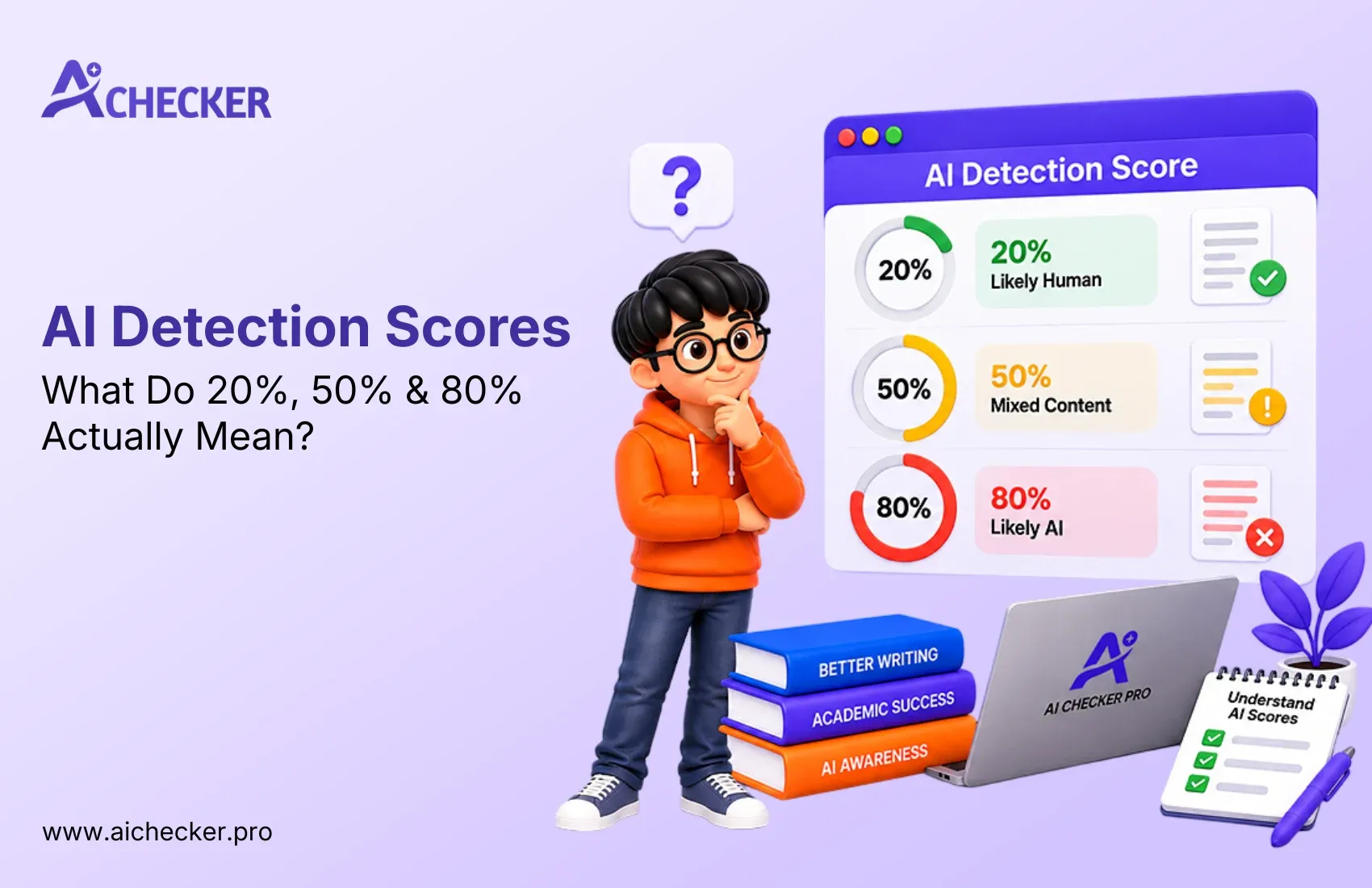
What Does a 20%, 50% or 80% AI Detection Score Actually Mean?
TABLE OF CONTENTS
What an AI Detection Score Actually Measures
AI Detection Score Explained: Why It Is a Range, Not a Verdict
Breaking Down the Numbers: 20%, 50%, and 80%
How to understand AI Detection Results Without Losing Your Mind
Understanding AI Content Detection Percentage Across Different Tools
Why No AI Detector Is 100% Accurate
False Positives Are a Real Problem, Not a Rare Exception
Where AI Checker Pro Fits In
AI Checker Pro vs Other Popular Detectors
A Real World Scenario
Conclusion
FAQs
Get an AI summary of this post on:




If you have ever seen an AI score and felt uncomfortable, then you are not alone.
Students, bloggers, and teachers get this number thrown at them all the time, and no one seems to give a straight answer about what it all means.
Here is what I have found in my research. An AI detection score is basically a confidence score, so 20% would most likely mean it is 20% AI generated with human-like qualities, 50% would probably be uncertain between the two, and 80% would be mostly certain. Nothing is one hundred percent accurate.
What an AI Detection Score Actually Measures
An AI detection score is a percentage that shows how confident a detection model that uses AI is that some text was created by an AI instead of a human.
This is all that it is. To clarify, it is not a lie detector test nor a plagiarism test.
Detectors like Turnitin, GPTZero, and Originality.ai work by scanning writing for patterns such as:
- how predictable your word choices are
- or how much your sentence length and rhythm vary
- Repetition patterns that show up often in AI-generated text
- Sentence similarity, meaning whether every sentence follows a similar shape
AI writing tends to be smooth and predictable. Human writing is choppier, has some extremely long sentences with others that are short, while not having the same level of natural flow. The detector model was trained to know the difference, however, it is giving an informed estimate, not a fact.
AI Detection Score Explained: Why It Is a Range, Not a Verdict
When students search for "what is the ai detection score explained," they usually want to know if their score is safe. I completely understand
but the fact is that no score can give you a clear answer.
Like a weather forecast that states a 30 percent chance of rain, that doesn't mean it will rain or that it will not happen at all.
It just says that according to the information available, there's a 30 percent chance of rain. The same goes for an AI detection score. It can only give a probability based on the information given.
This is an issue because many schools, government agencies, and companies have begun treating these scores as if they are an complete truth.
If you take a paragraph that you wrote by hand and run it through three different detectors, you will most likely not get the same result twice, which is why it helps to understand which AI detectors are actually accurate before trusting any single number.
I did this test last month with one of my paragraphs and got twelve percent on one website, thirty-eight percent on the second, and sixty-one percent on the last.
Breaking Down the Numbers: 20%, 50%, and 80%
Let's get specific, since this is probably why you clicked in the first place.
20% AI Detection Score
A 20% AI detection score indicates that the AI detector suspects that 20% of the text has artificial intelligence characteristics.
In most cases, this means that a few sentences were written too simply or in a way that the AI detectors recognize as typical for text generated by artificial intelligence. Common transitions or sentence constructions frequently used by AI can contribute to such suspicions.
Students and bloggers should be safe at a 20% detection level. This score falls within the low-risk category. However, if the content being checked is of great importance, it may still be worth reviewing the text.
50% AI Detection Score
A 50% chance of AI detection is the most frustrating result one can get, as it simply means failure. Being right in the middle might come from a more formal writing style of the essay, technical words (the more tech-related the topic is, the higher the percentage tends to be), or sentence structures typical for non-native English speakers.
A 50% detection rate suggests that the software couldn't tell for sure whether your paper was written by a human or an AI, so it's safer to assume the worst and consider the result to be positive.
80% AI Detection Score
An 80% AI detection score means that the tool is pretty sure that the text it is checking is AI-generated or at least helped by AI.
That's the area where things can start to get worrying, especially if you were expecting completely original content.
But 80% isn't 100%, so there is always room for error, and there have been cases of genuinely human-written text getting flagged at this level, especially if the writing is very formal or repetitive.
How to understand AI Detection Results Without Losing Your Mind
If you want to know how to understand AI detection results the right way, treat the score as a starting point for review, not a final grade. Here is a simple way to break it down:
- Under 30% usually reads as low risk, though it is still worth a glance for important content
- 30% to 60% is a unclear range that needs human judgment, not complete trust in the number
- Above 60% deserves a closer look, especially checking exactly which sentences got flagged
- Any single tool's score should be checked against at least one other detector before you make conclusions
Good detectors, including AI Checker Pro's detector for documents, highlight sentence-level flags so you can see exactly what triggered the score instead of handing you one confusing number. Context matters far more than the overall percentage.
Understanding AI Content Detection Percentage Across Different Tools
Here is something that not many people seem to understand about percentages of AI content detection. The rate is not standard for each tool.
A 40 on one test is not a 40 on the other.
This is due to different companies training their own data and giving more importance to down certain aspects of the text, such as perplexity and burstiness, differently.
This is why it is dangerous to only run the text through one detector, whether you are a teacher grading essays or a blogger wanting to ensure your writing is not robotic.
Run it through multiple detectors and take an average on what the percentage is, rather than using one number.
Why No AI Detector Is 100% Accurate
I want to note this upfront because many blog posts about the tools are overrated, as they claim that the tools are flawless, which is simply not true. None of the detectors, be it Turnitin, GPTZero, Originality.ai, or Copyleaks, are perfect.
The tools are pattern recognition systems that often do an impressive job, but pattern recognition is naturally statistical and should not be mistaken for definite proof about authorship. There are several important observations to make about these kinds of AI detectors:
- Detection accuracy drops significantly on paraphrased or humanized AI content compared to original, unchanged AI text
- Formal academic writing and non native English writing tend to get flagged more often, simply because that style overlaps with how AI models write
- Several major universities have reduced how heavily they rely on a single detection tool for grading decisions, because wrong accusations have become a real problem
- Detectors are constantly updated to catch newer AI models, so older detection data can go outdated fast
None of this makes detectors useless. It means the score should be one input in a bigger decision, not the whole decision.
False Positives Are a Real Problem, Not a Rare Exception
Let's discuss false positives directly, as this is the area that genuinely concerns you as a human writer. Writing done by people gets mistakenly identified as AI-generated more frequently than you think, and it generally happens in a few particular scenarios:
- Very formal, structured writing, like legal writing, technical reports, or academic papers
- Non native English speakers, whose sentence patterns can be read as more easy to predict to a detection model
- Writers who naturally use short, clear sentences without much stylistic variation
- Content that was heavily edited for grammar, which can smooth out the natural natural variation that detectors associate with human writing
If you are in the group that this advice is directed towards, do not immediately assume that you need to do something just because you got a high score. Add some variety in your sentence structure length, include a specific example or two, and double-check with a second plagiarism detector.
Where AI Checker Pro Fits In
I have personally witnessed bloggers using AI checker pro to clean and recheck their content because it provides sentence level breakdown rather than a generic percentage.
The breakdown helps you understand what exactly triggered a certain score and enables you to edit those parts of the text instead of random guessing.
AI checker pro helps you detect AI content accurately while at the same time providing an option to improve the detected text without having to rewrite the entire content from scratch.
AI Checker Pro is designed to detect content created by popular AI models including ChatGPT, GPT 4, GPT-5, Gemini, and Claude, and is trusted by over 100K+ users worldwide to provide quick and accurate second opinions. Instead of spending hours manually altering the sentences in flagged sections, many users choose to let the tool adjust the words to keep the original meaning.
Get Lifetime Access with 60% OFF
Stop paying monthly subscriptions. Enjoy unlimited AI detection and humanizer access forever with future updates included.
- One-time payment
- Unlimited access forever
- All future updates included
AI Checker Pro vs Other Popular Detectors
| Feature | AI Checker Pro | Turnitin | GPTZero | Originality.ai |
|---|---|---|---|---|
| Accuracy | Strong, sentence-level analysis | Good, but more cautious on paraphrased text | Decent, known for false positives on formal writing | Strong on raw AI text |
| Free Tier | Yes | No, school-licensed only | Limited free version | No, paid only |
| Humanizer Included | Yes, built in | No | No | No |
| Best For | Students, bloggers, SEO writers | Academic institutions | Educators and quick checks | Agencies and publishers |
This comparison shows general, widely known differences in how these tools are marketed and used, not private testing data.
A Real World Scenario
Picture this. You are a blogger with ten drafts due this week, and you would like to double-check each one before publishing to avoid Google penalties related to poor-quality AI-generated content. You run them all through a detector.
Two come back under 20%, five land somewhere between 40% and 60%, and three come back over 75%. What do you do?
Examine the flagged sentences in the highest-scoring drafts, revise the most unnatural-sounding statements, replace general AI-sounding statements with more clear points or examples that a real person might have made, and then republish using a blog enhancer to smooth out the final draft.
That is what a lot of bloggers and SEO writers are doing in 2026.
Conclusion
An AI detection score should always be taken as a helpful signal rather than a courtroom verdict.
A 20% score on average speaks of a human-made text, 50% means the tool was just guessing, and 80% is still far from a solid proof of AI-generation.
Knowing what your AI detection score means will help you not panic about one number and instead focus on what sentences need improvement.
Whether you are a student, a teacher, a blogger, or a business owner, the same solution is best for all of you: use multiple trusted AI detector tools, recheck the flagged sentences.
FAQs
What does a 20% AI detection score mean?
What does a 50% AI detection score mean?
What does an 80% AI detection score mean?
Is a 50% AI detection score bad?
Can AI detectors be wrong?
Why do different AI detectors give different scores?
How can I lower my AI detection score?
Is Turnitin or GPTZero more accurate for AI detection?
What AI detection score is considered safe?
Does AI Checker Pro show which sentences triggered the score?

Harshil Barvaliya
SEO Executive & Content Writer at AI Checker Pro
I’m Harshil Barvaliya, an SEO Executive and Content Writer at AI Checker Pro. I focus on improving the website’s search engine visibility through effective SEO strategies, including keyword research, on-page and off-page optimization, and content development.Get Started Free
Create a free account for advanced AI detection and scan history.
Trusted by thousands worldwide.
Recent Blog's
Discover how AI-powered content creation can elevate your website's reach and engage your audience like never before. Explore the real impact of AI on crafting content that connects.