AI Detectors in UK Universities: 2026 Student Guide
TABLE OF CONTENTS
Do UK Universities Use AI Detectors?
Which AI Detection Tools Universities Use
Why No AI Detector Is 100% Accurate
Can AI Checkers Be Wrong? The False Positive Problem
How AI Checker Pro Fits Into This
Comparison: AI Checker Pro vs Other Detectors UK Universities Use
Is Using AI Considered Cheating?
How This Plays Out Across Different Courses
What International and Non Native English Students Should Know
Practical Steps Before You Submit
Conclusion
FAQs
Get an AI summary of this post on:




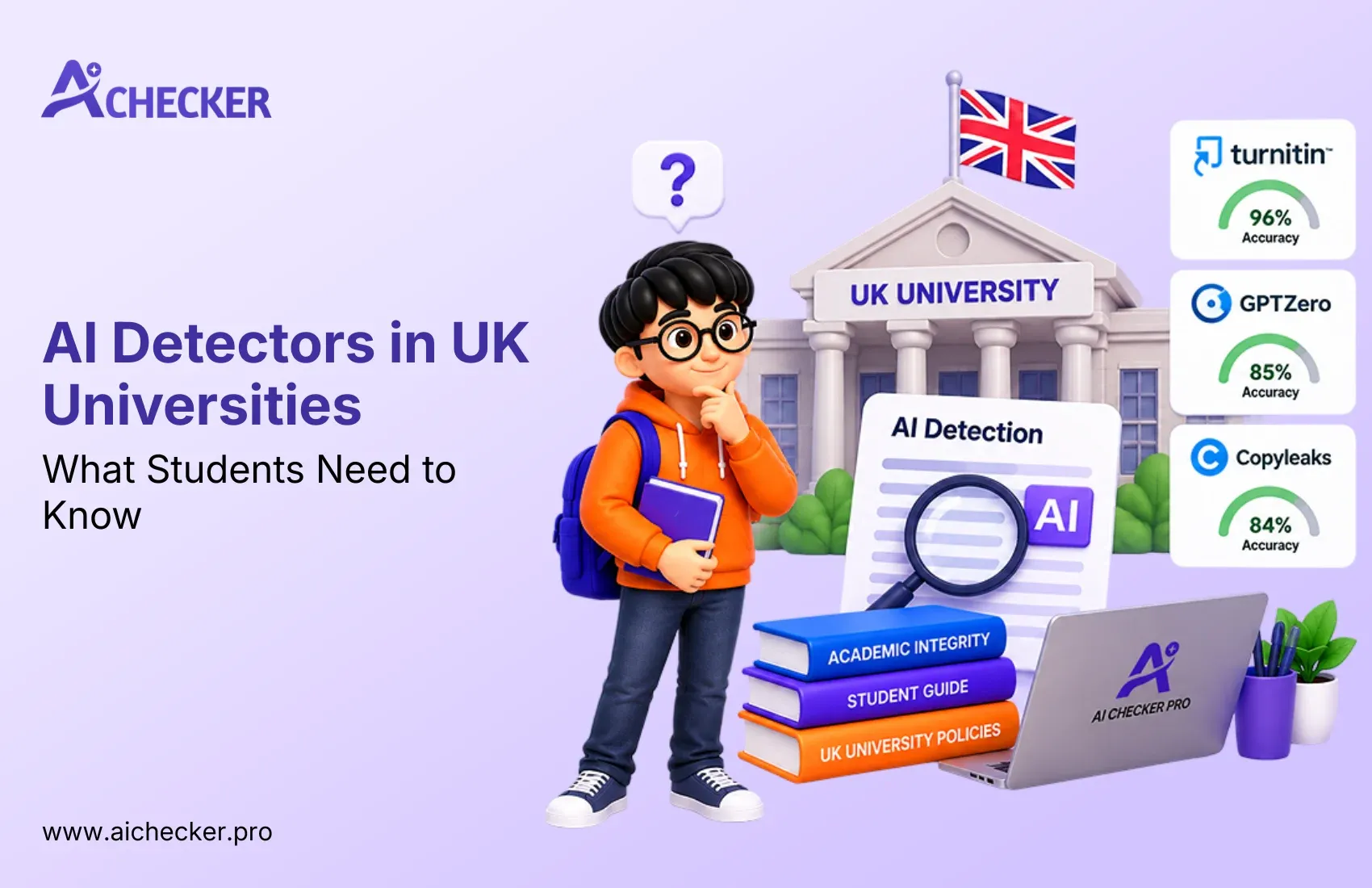
If you are a UK student, one of the burning questions in your head concerns the amount of responsibility universities take for using AI detectors that UK institutions employ to check students coursework.
After all, Turnitin's AI writing check and several other AI content detectors have made their way into UK universities, and an automatic detection of plagiarism may lead to a formal meeting with your tutor.
So, what is the answer to this burning question?
Most UK universities have implemented some form of AI detection as part of academic integrity checks nowadays, usually in the form of Turnitin's AI writing indicator, but rarely do they use an AI detector as a standalone plagiarism-checking tool.
I used various tools to test the accuracy of AI detectors on real student essays, blog posts, and marketing articles, so I have a decent idea of what works and what does not in 2026. Let me share it with you in this article.
Get Lifetime Access with 60% OFF
Stop paying monthly subscriptions. Enjoy unlimited AI detection and humanizer access forever with future updates included.
- One-time payment
- Unlimited access forever
- All future updates included
Do UK Universities Use AI Detectors?
Yes. Do UK universities use AI detectors is one of the most Googled questions by students at the moment, and the answer is that the majority do, in some capacity.
Turnitin's AI detection feature is built into their plagiarism checking software, which the majority of UK universities already use for essay submissions, so it can often be run in the background.
That said, universities differ a lot in how seriously they treat the results:
- Some departments use the AI score only as a flag for a human tutor to review manually
- Others combine it with writing style analysis, comparing your submission to earlier work
- A few universities have scaled back how much weight they give to one detection tool, after concerns about false positives in academic circles
- Postgraduate and research-heavy courses tend to apply more scrutiny than first year modules
When I ran a batch of test essays through several AI detectors for students last month, out of curiosity about how consistent they really are, the scores varied a surprising amount between tools even on the same text. That inconsistency is exactly why most universities don't treat any single detector as final proof.
Which AI Detection Tools Universities Use
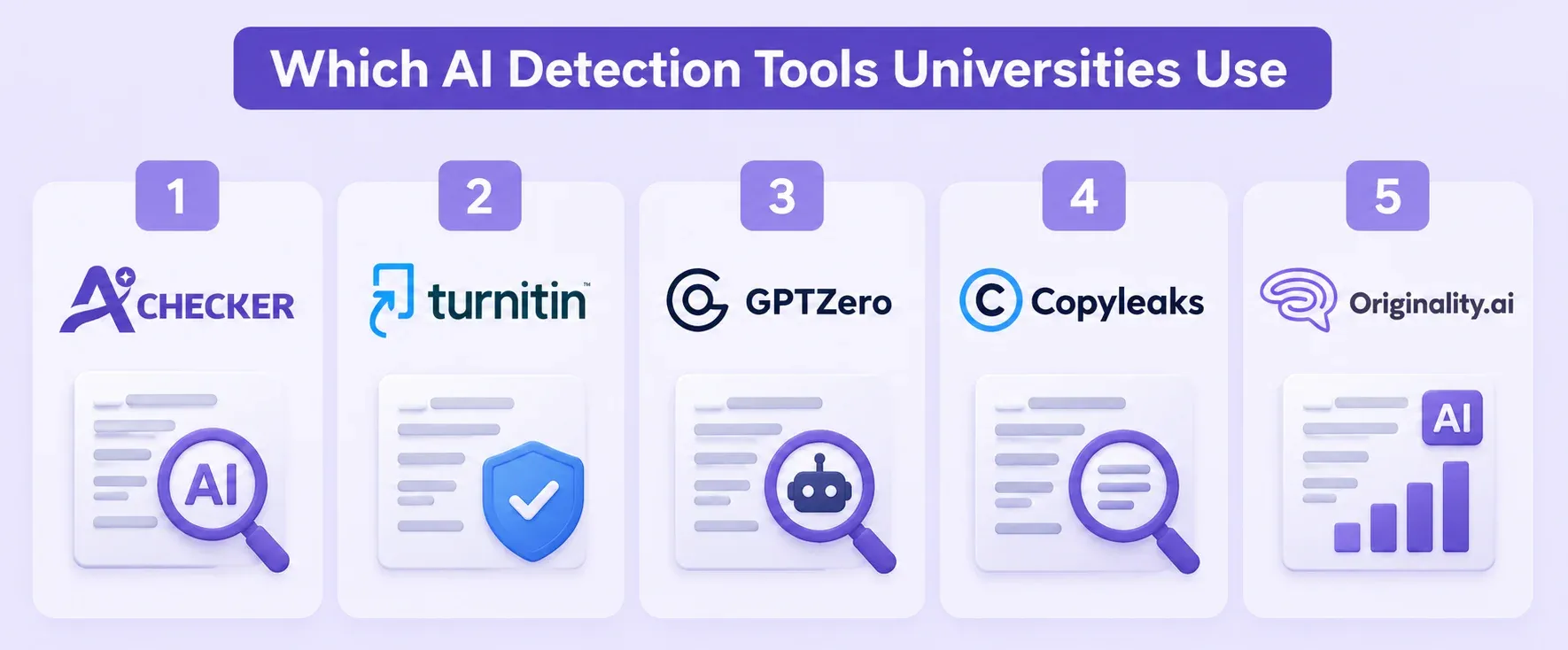
The plagiarism detection software solutions used by institutions of higher education may differ. Depending on the university, course, and professor, the preferred similarity-checking tool may change, with Turnitin being among the most widespread. Other renowned plagiarism checkers include GPTZero and Copyleaks, which are typically utilized to identify AI-generated texts.
Students may also use independent plagiarism checkers such as the AI Checker Pro service to scan their own writings for signs of plagiarism and submit a version of the paper that has passed a similarity test.
1. AI Checker Pro
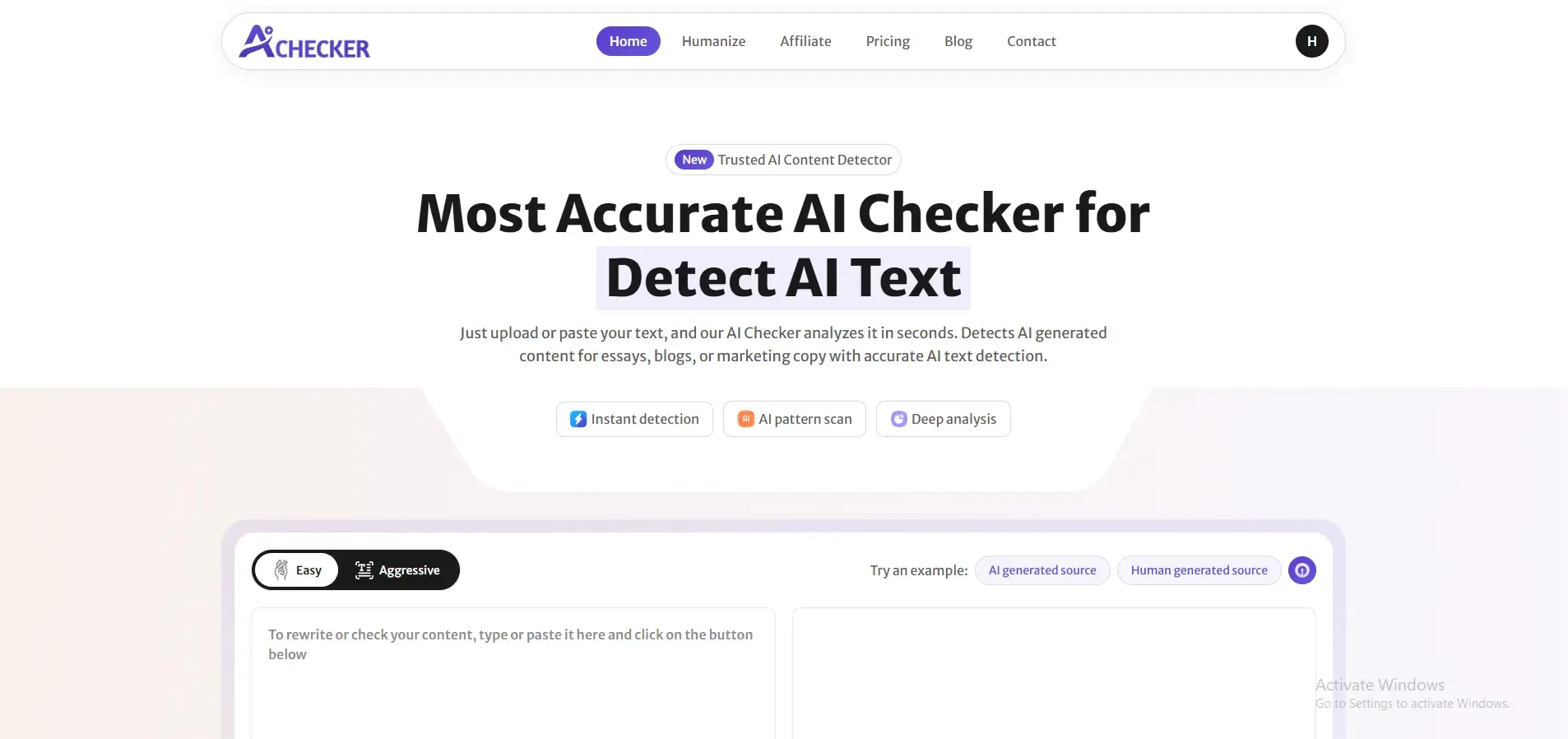
AI Checker Pro is an AI detection and writing-analysis tool designed for students, writers, educators, and content teams. It can analyze text for signs of AI-generated writing and provides detailed results, including sentence-level detection. The platform also offers an AI humanizer for users who want to revise flagged content.
Pros:
- Free AI detection is available, making it accessible for students.
- Provides sentence-level analysis to help identify potentially AI-generated sections.
- Supports detection across content generated by major AI models such as ChatGPT, Claude, and Gemini.
- Includes an AI humanizer alongside its detection tools.
Cons:
- It is not a replacement for the AI-detection system used by a university.
- AI detection results should be treated as an indication rather than definitive proof of AI use.
- Some advanced features require a paid plan.
Pricing: AI Checker Pro offers a free option, while paid plans are available for users who need higher usage and additional features. Its current pricing page also lists an unlimited lifetime option.
Best for: Students and writers who want to check their work before submitting or publishing it.
2. Turnitin
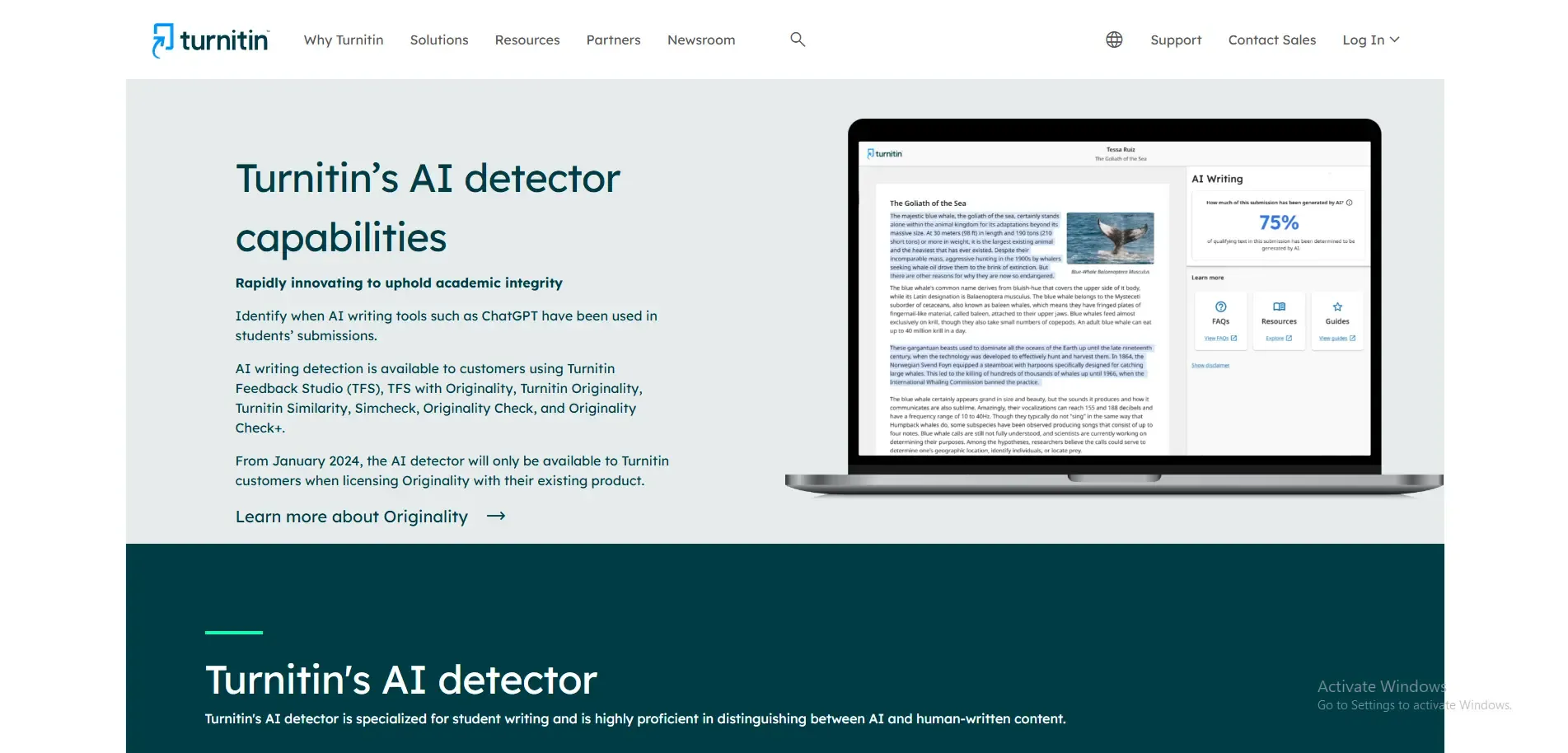
Turnitin is one of the most widely established academic integrity platforms used by universities. Its AI writing detection is integrated into its broader academic workflow, allowing educators to review potential AI-generated writing alongside similarity and other submission information. Turnitin says its AI detection is available through products such as Feedback Studio and Turnitin Originality.
Pros:
- Designed specifically for academic and student writing.
- Integrates with university LMS and submission workflows.
- Combines AI-writing detection with Turnitin's wider academic-integrity tools.
- Used by more than 16,000 institutions globally.
Cons:
- Students generally cannot purchase a Turnitin license directly.
- AI detection can sometimes misidentify human or AI-generated writing.
- Turnitin itself says AI detection should not be used as the sole basis for adverse action against a student.
Pricing: Turnitin does not publish a standard individual subscription price. Universities and other institutions need to request a customized quote based on their requirements.
Best for: Universities, lecturers, and academic institutions.
3. GPTZero
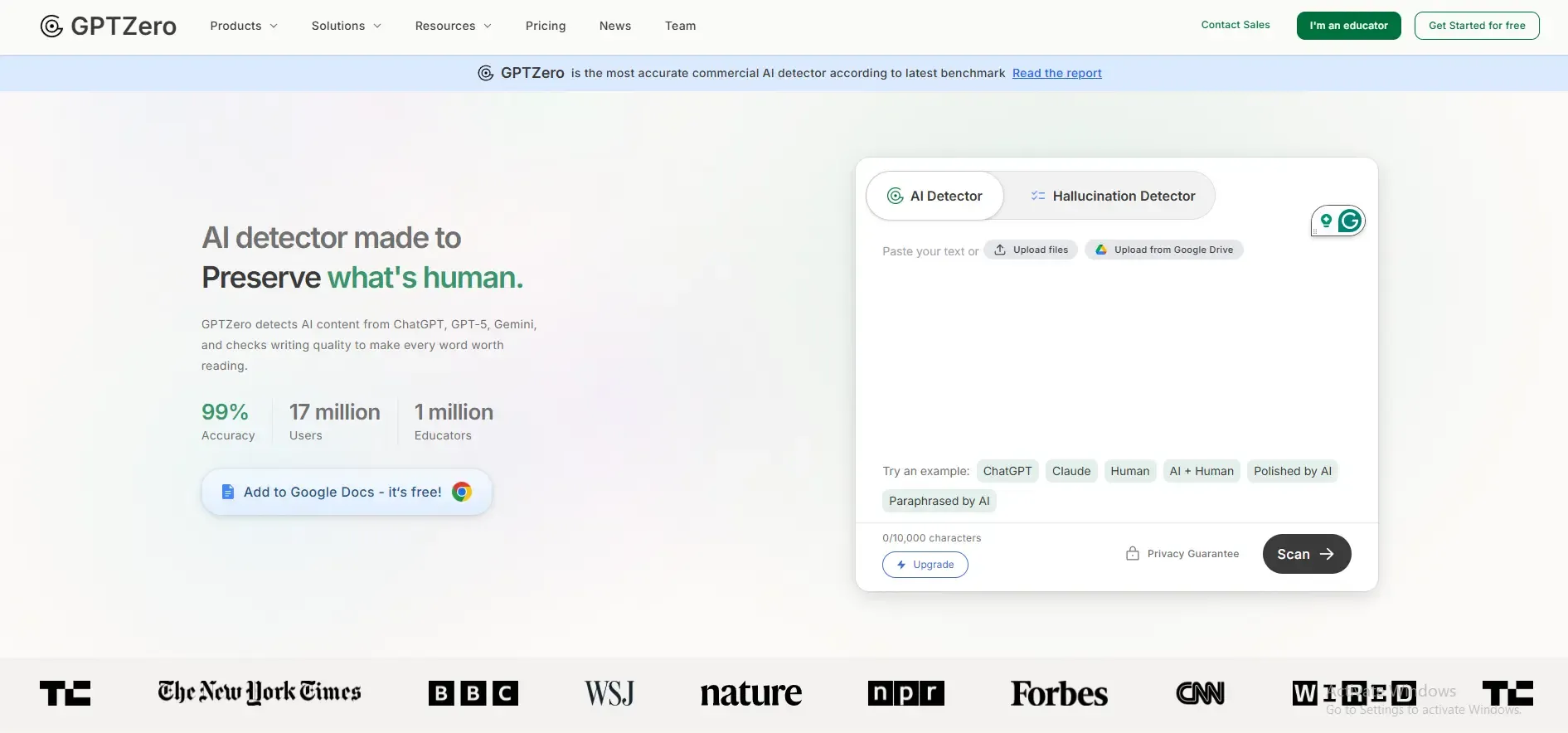
GPTZero is an AI detection platform that focuses heavily on identifying AI-generated writing in educational settings. It provides AI detection and reporting features and has separate options for educators. Its paid education plans use education-specific data and detection thresholds designed around teacher expectations.
Pros:
- Strong focus on education and academic writing.
- Free option available for basic testing.
- Paid plans provide larger scan limits and more detailed reports.
- Educator plans are designed specifically around academic use.
Cons:
- The free plan has limited usage.
- Advanced features require a paid subscription.
- Like other AI detectors, its results should not be treated as conclusive proof of AI use.
Pricing: GPTZero currently offers a free plan with limited scans. Its Pro plan is listed at $19.99/month, with unlimited AI detection and additional features.
Best for: Students, teachers, and educators looking for an independent AI-writing check.
4. Copyleaks
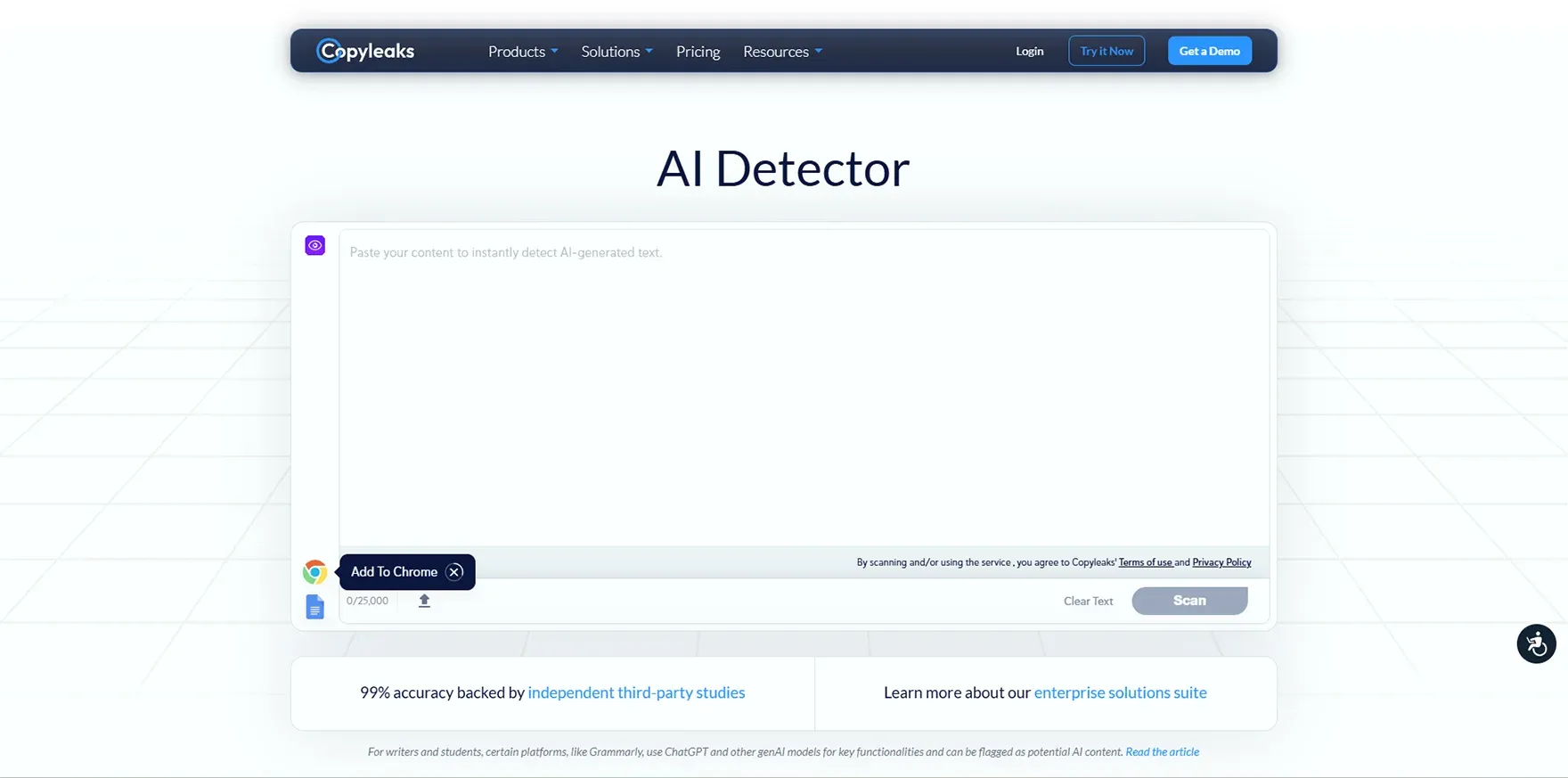
Copyleaks combines AI detection with plagiarism checking, making it useful for institutions and organizations that want to examine content integrity from multiple angles. Its AI detector supports more than 30 languages, while its plagiarism detection supports more than 100 languages.
Pros:
- Combines AI detection and plagiarism checking.
- Supports multiple languages.
- Offers browser and Google Docs integrations.
- Provides education and enterprise solutions with options such as LMS and API integration.
Cons:
- Higher-tier plans can become expensive for individual users.
- Some advanced institutional features require a custom plan.
- Results still need to be reviewed alongside human judgment.
Pricing: The Personal plan is currently $16.99/month when billed monthly or $13.99/month with annual billing. The Pro plan is $99.99/month or $74.99/month with annual billing. Education and enterprise pricing is customized.
Best for: Universities, educators, businesses, and users who also need plagiarism detection.
5. Originality.ai
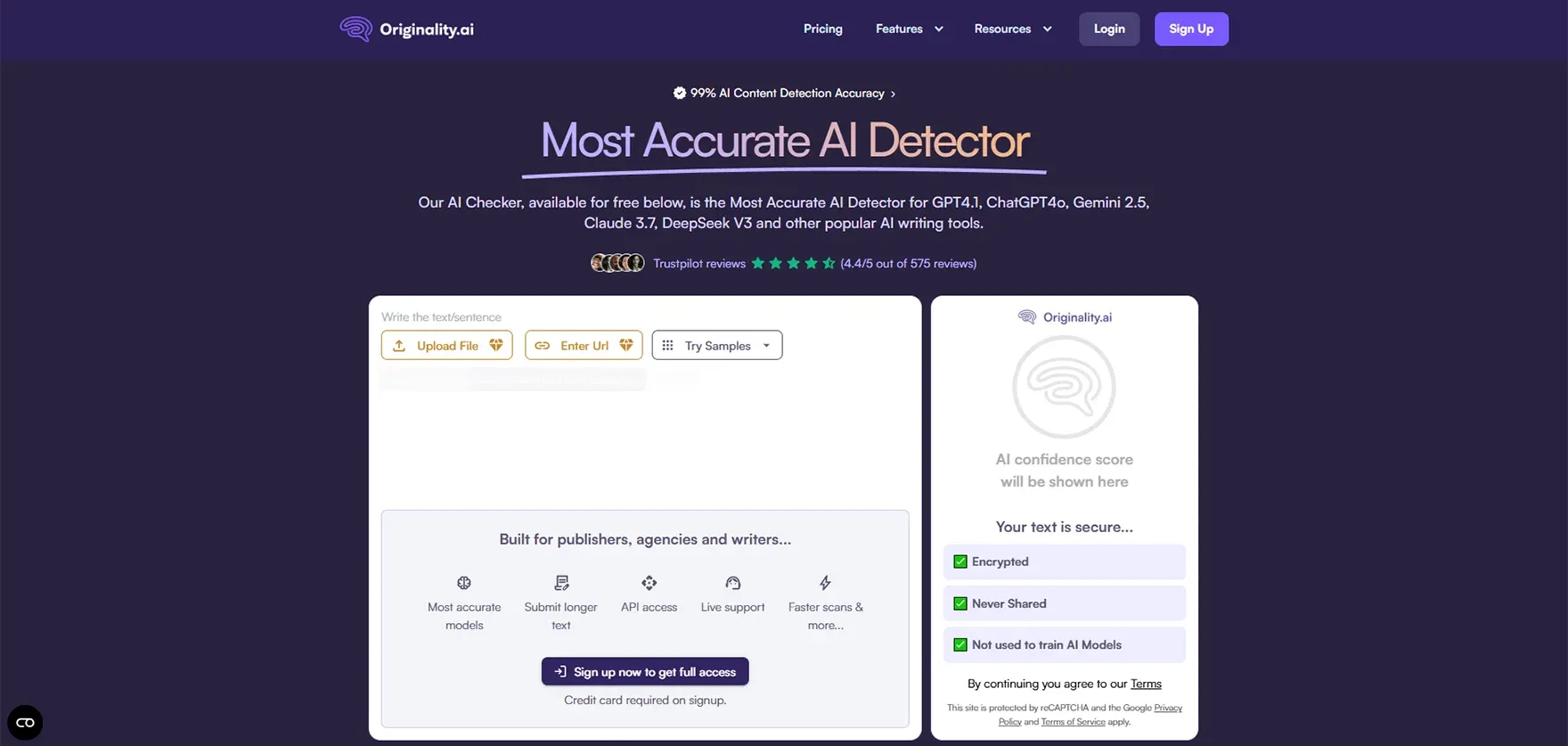
Originality.ai is primarily aimed at content publishers, writers, marketers, and teams, although its AI detector can also be used to evaluate academic-style writing. Alongside AI detection, it provides plagiarism checking, fact-checking features, website scanning, and reporting tools.
Pros:
- Combines AI detection with plagiarism and fact-checking tools.
- Supports document uploads and website scanning.
- Offers team management and shareable reports.
- Provides an API on its Enterprise plan.
Cons:
- More focused on publishers and content teams than university submission systems.
- Paid access is required for the main subscription plans.
- Credit-based usage can make costs harder to estimate for high-volume users.
Pricing: The Pro plan currently costs $14.95/month when billed monthly or $12.95/month with annual billing. The Enterprise plan starts at $179/month when billed monthly or $136.58/month with annual billing.
Best for: Content teams, publishers, marketers, and professional writers.
Why No AI Detector Is 100% Accurate
This is crucial for your grade to know, no plagiarism AI detector is perfect, not even the ones that your university is paying for.
Turnitin, GPTZero, Originality.ai, and Copyleaks have all admitted to having some degree of error, and independent tests have shown that they could be wrong by as much as 50% depending on the type of text being analyzed. You can read more about how accurate AI content checkers really are in our detailed breakdown.
A few things affect accuracy:
- Short pieces of text are harder to score reliably than full essays
- Technical or scientific writing often gets flagged more often than casual writing
- Non native English speakers get falsely flagged at a noticeably higher rate, which is a known and widely discussed limitation
- Detection accuracy drops significantly once AI-generated text has been paraphrased, edited, or humanized compared to raw, unedited AI output
That last point is important. A detector might catch text pasted straight out of ChatGPT, but once that text has been reworded even lightly, the detection rate falls off fast. This is one reason universities are cautious about treating any single score as proof of misconduct.
Can AI Checkers Be Wrong? The False Positive Problem
Yes, and this happens more than universities like to admit. Human-written text can get flagged as AI-generated, and it happens especially often with:
- Formal academic writing, since it can read as "too structured"
- Non native English writers, whose sentence patterns sometimes resemble AI phrasing
- Students who use grammar tools like Grammarly, which can smooth out writing in a way that trips up detectors
- Writing on very common essay topics, where phrasing naturally overlaps with training data
If you're worried about a false positive, keep drafts. Seriously. Save your outlines, early versions, and notes in Google Docs or Word with version history turned on. If you ever need to prove the work is yours, having a visible writing process is the strongest evidence you can offer, stronger than arguing with a percentage score. For a closer look at this issue, see our piece on AI Checker Pro and false positives on human writing.
How AI Checker Pro Fits Into This
I have witnessed individual students and bloggers using the AI Checker Pro tool to scan their work before submission to ensure that nothing in their material could be misconstrued as AI-generated. It is about knowing where you stand before submitting your documents, not about beating a university's system at its own game.
Tools such as AI Checker Pro help in identifying whether certain content was generated by an AI at a sentence level by showing which particular parts trigger a suspicion, rather than giving some overall confusing score.
And if a given passage gets flagged as AI-assisted even though it's not, most students will now go to AI Checker Pro's humanizer tool to rephrase the text in a way that would appear natural and not AI-generated.
A few reasons it's worth having in your toolkit:
- Sentence-level detection, so you can see exactly what's being flagged
- Built-in AI humanizer, no need for a separate tool
- Works across ChatGPT, GPT 4, GPT 5, Gemini, and Claude-generated text
- Used by over 100,000 users, including students and content writers
Comparison: AI Checker Pro vs Other Detectors UK Universities Use
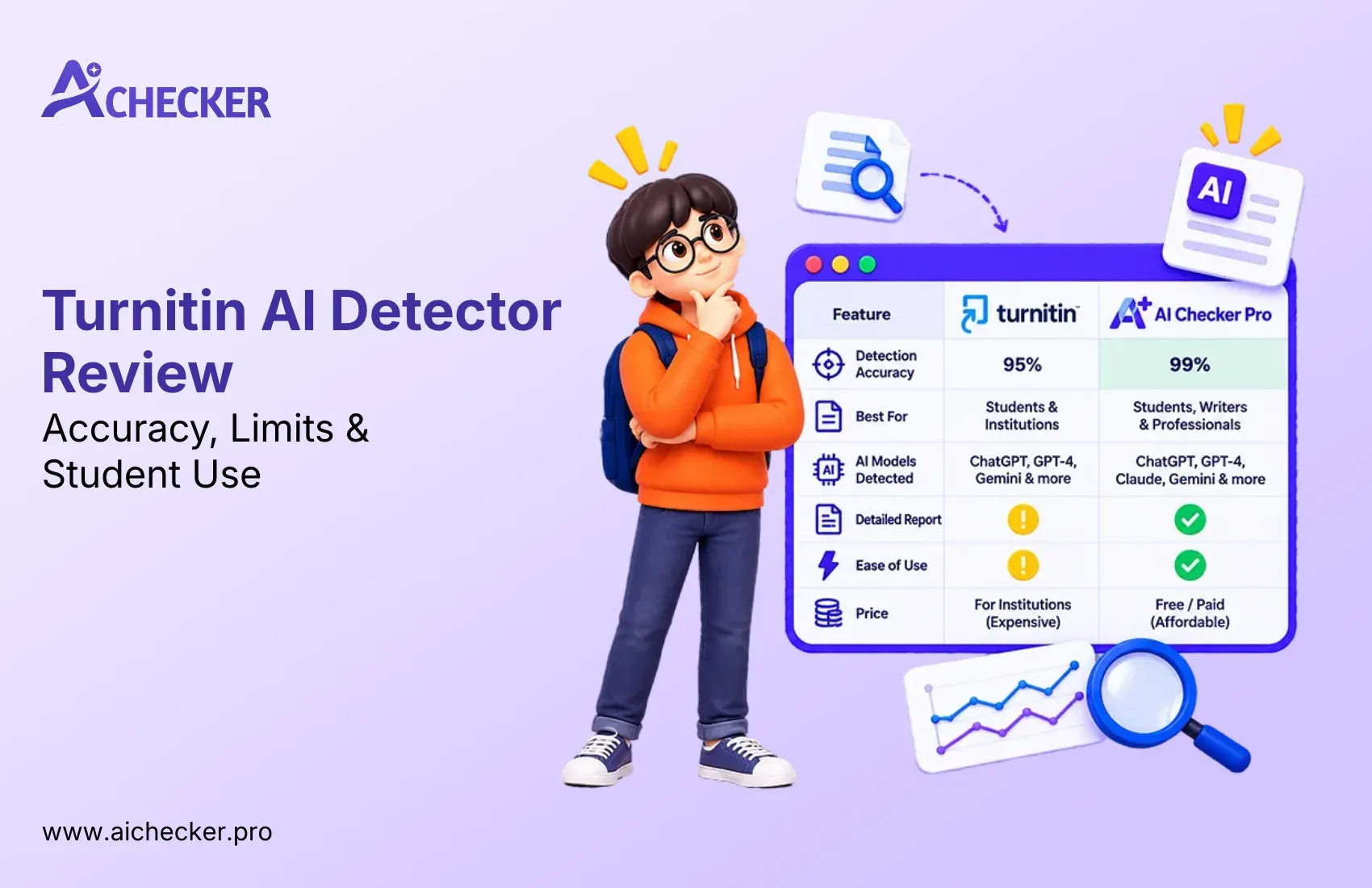
| Feature | AI Checker Pro | Turnitin | GPTZero | Originality.ai |
|---|---|---|---|---|
| Accuracy | Strong on sentence-level checks | Widely used, but known false positive issues | Mixed, better on longer text | Strong on raw AI text, weaker on edited text |
| Free Tier | Yes | No (university licensed only) | Limited free scans | No, paid only |
| Humanizer Included | Yes | No | No | No |
| Best For | Students checking work before submission | University-wide plagiarism and AI checks | Quick individual spot checks | Content and marketing teams |
This is a good moment to mention that AI checker for university students UK searches have risen sharply in recent months is true. Students are not trying to cheat the system. Most are probably simply double-checking their work before a detector flags something that, in fact, is not an issue.
Is Using AI Considered Cheating?
It depends on your university's academic integrity policy and how you used it. Using AI to brainstorm ideas or check grammar is usually fine, but using AI text as your own original work, and not disclosing that fact in submission, is where most UK universities draw the line. Always check your course handbook to see what they consider acceptable use of AI, as it can vary significantly between courses at the same university, a topic we cover in more depth in our guide on AI's role in protecting academic integrity.
How This Plays Out Across Different Courses
Not all subjects deal with the AI detection tools that universities employ in the same manner, which can come as a surprise to some students.
If you're studying an essay-intensive field such as history, English literature, or law, your writing is likely to be benchmarked against your own previous submissions more closely, due to sudden changes in lexical choices and syntactical patterns being immediately apparent to a tutor familiar with your work.
Science and engineering courses, however, do not tend to use such tools to the same degree. Lab reports and other forms of technical writing often have a rigid structure, and so detectors may pick up on this consistency by default and mark otherwise legitimate papers as AI-generated.
A paper flagged by an AI detector will always be received with greater suspicion the higher the stakes of the submission are, so a dissertation chapter will always be of more concern than a two-thousand-word seminar essay.
What International and Non Native English Students Should Know
This is a category that I think deserves a separate section, as the false positive issue applies to it even more strongly.
Non-native English speakers' texts are more likely to contain sentence structures and phrase formulations similar to those used by large language models, as they are generated using similar underlying principles.
If you're an international student at a UK university, a few things can help reduce your risk:
- Write in your natural voice first, then edit lightly, rather than over-polishing every sentence to sound "perfect"
- Avoid running your entire essay through a grammar tool right before submission, since heavy smoothing can shift how a detector reads the text
- Keep your research notes and outlines in your first language if that's how you naturally think through ideas, since it's useful proof of your own process
- Talk to your academic support office early if you're ever flagged, rather than waiting until it becomes a formal case
I interviewed several international students on this issue. They said that they were once caught for writing text completely in their own words, but a plagiarism detector recognized the language patterns as characteristic of software-generated writing. This is an important issue that universities are trying to address, and it's part of why we put together a set of tips to avoid AI detection in writing for students who write naturally but still get flagged.
Practical Steps Before You Submit
- Read your university's AI policy in full, not just the summary
- Keep drafts and notes as proof of your process
- Run your essay through a detector like AI Checker Pro for assignments before submission, just to see what it flags
- If something is flagged and it's genuinely your own writing, don't panic; gather your drafts and talk to your tutor directly
- Avoid over-editing with grammar tools right before submission, since heavy last-minute polishing can sometimes shift how a detector reads your text
Conclusion
AI detectors which UK universities employ are an integral element of the student experience, yet they possess a myriad of shortcomings.
Becoming informed on AI detection in UK universities, preserving evidence of your work process, and conducting a simple test with a tool such as AI Checker Pro are all the best ways to protect yourself from a false flag.
No AI detection software is completely foolproof, so it's always good to be educated on the subject.
FAQs
Do UK universities check for AI writing?
Which AI detector do UK universities use the most?
Can AI detectors be wrong about your essay?
What happens if Turnitin flags your work as AI generated?
Is using ChatGPT for university work considered cheating?
Why do non native English speakers get flagged more by AI detectors?
Does paraphrasing AI text avoid detection?
How can students prove their essay is not AI generated?
Are AI detectors used differently across subjects?
Is AI Checker Pro useful before submitting a university essay?

Harshil Barvaliya
SEO Executive & Content Writer at AI Checker Pro
I’m Harshil Barvaliya, an SEO Executive and Content Writer at AI Checker Pro. I focus on improving the website’s search engine visibility through effective SEO strategies, including keyword research, on-page and off-page optimization, and content development.Get Started Free
Create a free account for advanced AI detection and scan history.
Trusted by thousands worldwide.
Recent Blog's
Discover how AI-powered content creation can elevate your website's reach and engage your audience like never before. Explore the real impact of AI on crafting content that connects.