Can AI Detectors Detect Translated AI Content? What Students Should Know in 2026
TABLE OF CONTENTS
Key Highlights
Can AI Detectors Detect Translated Text?
How AI Detectors Actually Work
Does Translation Affect AI Detection?
Can Translated ChatGPT Text Be Detected?
AI Detection After Translation: What Changes and What Stays
AI Detector for Multilingual Text: Which Tools Support It?
AI Detector Translation Accuracy and False Positives
Translated AI Content Detection for Teachers and Bloggers
How to Check Translated Content With AI Checker Pro
Use AI Detectors as a Guide
Conclusion
FAQs
Get an AI summary of this post on:





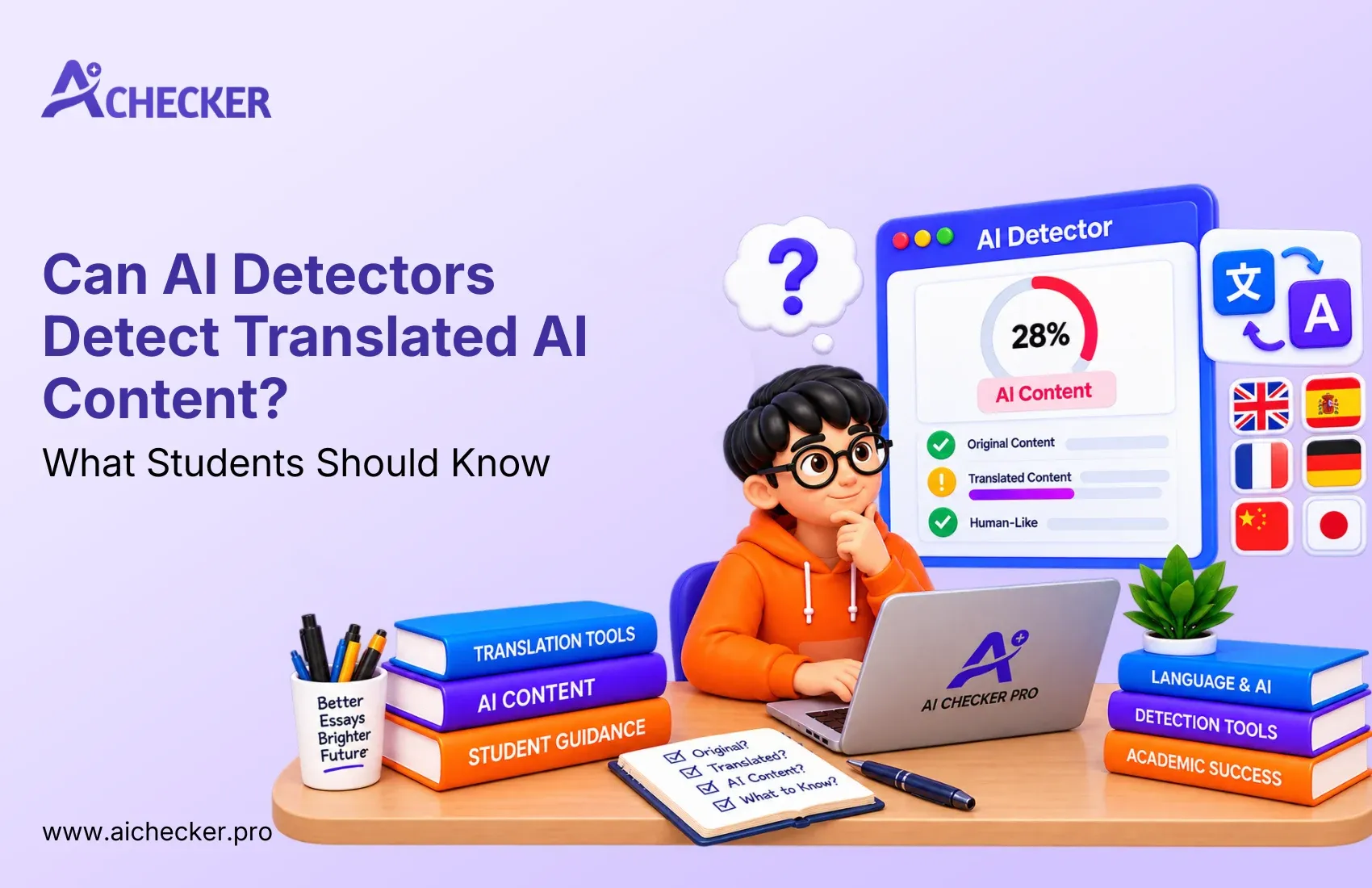
Sometimes, but not always correctly. When text is translated, the sentence structure and wording often change. This can make some AI detectors give a lower AI score.
However, some detectors may still notice writing patterns, sentence structure, and word choices that remain after translation. Results can vary depending on the AI detector, language, and translation tool used.
No AI detector is 100% accurate. There is also a risk of false positives, especially when students write in a language that is not their first language.
Key Highlights
- Translation can lower an AI score, but it rarely wipes out the patterns detectors look for.
- Most popular detectors are trained mainly in English, so accuracy on other languages is less consistent.
- Text that goes through translation and then gets edited by a human is much harder for any tool to judge.
- Non native English writers face a higher risk of false positives, even when every word is their own.
- Use detection results as one signal, never as final proof, and keep drafts and notes to protect yourself.

Get Lifetime Access with 60% OFF
Stop paying monthly subscriptions. Enjoy unlimited AI detection and humanizer access forever with future updates included.
- One-time payment
- Unlimited access forever
- All future updates included
Can AI Detectors Detect Translated Text?
You wrote a paper in your first language or used a translator to improve your draft. Now you may be wondering: can AI detectors detect translated text?
It is a common concern for students, teachers, and bloggers in 2026, especially with tools like AI Checker Pro, Turnitin, and GPTZero becoming more common.
The short answer is: sometimes. The result depends on the AI detector, the language, and how much the text was changed after translation.
Translation can sometimes lower an AI score, but it does not always remove AI detection. Also, no AI detector is 100% accurate, so both false positives and false negatives can happen.
How AI Detectors Actually Work
AI detectors check patterns in writing to estimate whether text may have been written by AI. Tools such as AI Checker Pro, Turnitin, GPTZero, Originality.ai, and Copyleaks use different methods, but they generally look at how words and sentences are written.
AI-generated text can sometimes use common words, similar sentence patterns, and a steady writing style. Human writing can be less consistent, with different sentence lengths, word choices, and personal writing habits.
Many AI detectors have been trained using large amounts of both human-written and AI-generated text. Since a lot of this data is in English, results can change when text is written in another language or translated.
What Do AI Detectors Look For?
They may check things such as:
- Word choices: How predictable the words are
- Sentence patterns: How much sentence length and structure change
- Repeated phrases: Whether the same transitions or filler words appear often
- Writing flow: Whether the text follows a smooth and common pattern
Does Translation Affect AI Detection?
Yes, translation can affect AI detection. However, the effect is not always the same or easy to predict.
When a translator such as Google Translate, DeepL, or ChatGPT changes text from one language to another, it may change the words, sentence order, and sentence structure. This can make it harder for some AI detectors to find the patterns they usually look for.
Think of it like shuffling a deck of cards. The cards are still there, but they are in a different order.
However, some writing patterns may remain after translation. For example:
- Simple and regular paragraph structure
- Common or generic introductions
- Similar sentence lengths
- Repeated transition words
- A smooth and predictable writing style
Because of this, translation may change an AI detection score, but it does not guarantee that the text will avoid detection.
Translating AI text versus translating human text
There are two very different situations, and people mix them up all the time.
Situation one: Someone generates text with ChatGPT in English, then translates it to another language or through a few languages and back. The detector has to judge a text that has been reshaped by a machine twice.
Situation two: A student writes an original essay in their first language and translates it to English with a tool. The text is human, but machine translation can make it sound smoother and more uniform than normal human writing. That is exactly the kind of pattern that can trigger a false flag.
Both cases are messy, and both are why I tell people never to treat a single score as the truth.
Can Translated ChatGPT Text Be Detected?
Yes, translated ChatGPT text can sometimes be detected. The result often depends on the AI detector, the language, and whether the text was edited after translation.
For example, I tested short ChatGPT-written essays by translating them into Spanish and German and then translating them back into English. I checked the different versions with several AI detectors.
The results were different across the tools. Some gave the translated text a lower AI score, while others showed little change. Some also gave different results when the same text was tested again.
What Did the Test Show?
- Original ChatGPT text was detected more consistently.
- Translated and translated-back text produced mixed results.
- Translated text edited by a person was harder for detectors to classify.
- Translation mistakes or unusual wording sometimes changed the detection result.
The key point is that AI detectors do not understand the meaning of your writing like a human does. They mainly look for writing patterns. Because of this, translation can change the result in different ways.
Translation may affect an AI score, but it does not guarantee that ChatGPT text will avoid detection.
AI Detection After Translation: What Changes and What Stays
To understand AI detection after translation, it helps to look at what changes during translation and what often stays the same.
What Usually Changes?
- Word choices: Words and phrases may be replaced with different ones.
- Sentence structure: Sentence order and length can change.
- Idioms and phrases: Some common expressions may not translate in the same way.
What Usually Stays?
- Main ideas: The overall message and argument usually remain the same.
- Paragraph structure: The size and balance of paragraphs may stay similar.
- Writing tone: The text may still have a neutral and polished style.
- Transitions: The way ideas connect may remain predictable.
This is why AI detection after translation can give different results. Some detectors may focus more on individual words and sentences, while others may look at the overall writing style and structure.
The important point is that translation does not guarantee a different AI detection result. A translated text can still show patterns that an AI detector may flag.
AI Detector for Multilingual Text: Which Tools Support It?
If you need an AI detector for multilingual text, keep in mind that language support can vary from one tool to another. Some tools support many languages, while others work mainly with English.
Even when a tool supports multiple languages, its results may vary by language and type of text. Language support can also change over time, so it is a good idea to check the tool's latest information before using it.
| Tool | Translated Text Results | Free Option | Humanizer | Best For |
|---|---|---|---|---|
| AI Checker Pro | Shows sentence-level results and highlights text that may look AI-written | Check the current pricing page | Yes | Students, bloggers, agencies |
| Turnitin | Works strongly with English; results may vary in other languages | Usually provided through schools | No | Universities and colleges |
| GPTZero | Works well with English; results can vary by language | Limited free use | No | Teachers and individual writers |
| Originality.ai | Commonly used by publishers; results can vary with translated text | Paid credits | No | Publishers and SEO teams |
| Copyleaks | Supports multiple languages, but results can still vary | Limited free use | No | Schools and businesses |
No AI detector is perfect. Results can change based on the language, writing style, translation method, and type of text.
Company claims about accuracy should also be checked carefully. For important work, test the tool with your own content and check its current language support and features before relying on the result.
AI Detector Translation Accuracy and False Positives
To understand AI detection after translation, it helps to look at what usually changes and what often stays the same.
What Usually Changes?
- Word choices: Words and phrases may change during translation.
- Sentence order and length: The translator may arrange sentences differently.
- Idioms and common phrases: Some expressions may change or may not translate exactly.
What Usually Stays?
- Main ideas: The central message usually remains the same.
- Paragraph structure: The overall size and order of paragraphs may stay similar.
- Writing tone: The text may still sound neutral and polished.
- Transitions: Words and phrases that connect ideas may remain similar.
This is why AI detection after translation can be inconsistent. Some detectors may focus more on individual words and sentences, while others may look at the overall structure and writing style.
Translation can change an AI detection score, but it does not guarantee a lower score or prevent detection. The result can vary based on the detector, language, translation tool, and the amount of editing done after translation.
Translated AI Content Detection for Teachers and Bloggers
Translated AI content detection is not only a concern for students. Teachers, bloggers, and website owners may also need to deal with it.
For Teachers and Professors
If you are wondering whether AI detectors can detect translated text well enough to make a decision, it is better not to rely on one AI score alone.
Teachers can also:
- Compare the work with the student's previous assignments.
- Ask to see notes, outlines, or earlier drafts.
- Talk with the student about the topic and their ideas.
- Ask the student to explain how they developed their argument.
A detector can show a possible pattern, but it cannot prove who wrote the content by itself.
For Bloggers and SEO Experts
Google focuses on helpful, original, and useful content, rather than simply how the content was created. However, publishing large amounts of raw, AI-generated translated content can still lead to quality problems.
Translated content may become repetitive, too general, or lacking in useful details. Adding real examples, local information, and a natural writing style can make the content more useful and easier to read.
The main goal should be quality and value for the reader, not simply trying to change an AI detection score.
How to Check Translated Content With AI Checker Pro
AI Checker Pro can help you check whether translated content may contain patterns that an AI detector could flag. It also provides sentence-level results, so you can see which parts of your text may need a closer look.
Here is a simple way to check translated essays or blog posts:
- Paste your translated text into the AI Detector.
- Check the sentence-level results, not just the overall score.
- Look at sentences that seem too general, repetitive, or predictable.
- Review those sentences and rewrite them in a natural way when needed.
- Run the text through the checker again to compare the results.
The sentence-level view can be useful because you do not have to review the entire document at once. You can focus on the parts that the tool highlights.
You can also use the AI Humanizer to improve the flow of text, but any changes should still reflect your own meaning and writing style. For current plans and limits, check the AI Checker Pro Pricing page.
Use AI Detectors as a Guide
An AI checker for translated content is best used as a guide, not as final proof. A detection score can show how text may appear to a particular tool, but it cannot confirm who wrote the content.
If you use AI for brainstorming, translation, or editing, check your school's or workplace's rules first. Different institutions have different policies, and an AI detection score does not replace an honest explanation of how the tool was used.
Conclusion
So, can AI detectors detect translated text? Sometimes. Translation can change words, sentence patterns, and other parts of the text, but the overall structure and writing style may remain. At the same time, human-written content can also be flagged by mistake.
No AI detector is 100% accurate, so treat its score as one signal rather than final proof. If you are a student, teacher, or blogger, keeping your drafts and checking your work can help you understand and explain how the content was created.
Want to see how your translated text appears to an AI detector? Try AI Checker Pro to review your content and see sentence-level results.
If some sentences need improvement, you can also use the AI Humanizer to make the writing clearer and more natural.
FAQs
Can AI detectors detect translated text?
Can AI detectors detect translated ChatGPT text?
Does translation lower an AI detection score?
Can AI detectors flag human writing that was translated?
Are AI detectors accurate on non-English text?
Which AI detector works best for multilingual text?
Is an AI detection score proof that someone used AI?
How can students protect themselves from false AI flags?
Does editing translated text change AI detection results?
Can I check translated content with AI Checker Pro?

Harshil Barvaliya
SEO Executive & Content Writer at AI Checker Pro
I’m Harshil Barvaliya, an SEO Executive and Content Writer at AI Checker Pro. I focus on improving the website’s search engine visibility through effective SEO strategies, including keyword research, on-page and off-page optimization, and content development.Get Started Free
Create a free account for advanced AI detection and scan history.
Trusted by thousands worldwide.
Recent Blog's
Discover how AI-powered content creation can elevate your website's reach and engage your audience like never before. Explore the real impact of AI on crafting content that connects.