AI Detectors in German Universities: What Students Need to Know
TABLE OF CONTENTS
Why German Universities Started Using AI Detection
How AI Detector for University Students Tools Actually Work
The False Positive Problem Nobody Talks About Enough
No AI Detector for University Students Is 100 Percent Accurate
Comparing the Main AI Checker Options for University Assignments
What This Means for Your Academic Papers and Essays
How to Use a ChatGPT Detector for University Students the Right Way
Conclusion
FAQs
Get an AI summary of this post on:





If you are a student in Germany, chances are that your professor has already mentioned Turnitin, GPTZero, or some other AI scanning software before you have to hand in your first seminar paper.
AI detectors in German universities have become a thing in the last two years, and many students feel like they do not have an understanding of what these programs can and cannot do.
Here is the short version of this article: AI detectors in German universities are programs that scan your papers and give a percentage of how likely it is that your text was produced by ChatGPT or other forms of AI. They are not always accurate, can produce false positives and false negatives, and are nothing like a lie detector.
I have tested many AI detectors on student texts, and I am confident in saying that none of them are as accurate as they are made out to be by German universities.
Why German Universities Started Using AI Detection
When the ChatGPT revolution came on the scene in late 2022 as well as in 2023, German higher education had to adapt rapidly.
Universities all throughout the country, from technical universities all the way to old Humboldt seminaries, had to come up with novel ways in which to address an influx of essays, Hausarbeiten, and Abschlussarbeiten that may or may not be a tiny bit too polished.
I'll explain this in a very simple way: a professor grading 80 seminar papers has no time in the world to read every piece through and through to see if it contains traces of artificial intelligence.
Therefore, universities started using artificial intelligence detection for academic papers as a first test, similar to Turnitin, which has been used to detect plagiarism in student research papers for more than a decade.
The main difference is that artificial intelligence detection for academic papers is a far newer and less developed technology than plagiarism matching algorithms.
Some of the common reasons German universities give for using these tools include:
- Protecting the value of a German degree, which is still seen as rigorous worldwide
- Responding to pressure from faculty senates worried about grade inflation
- Trying to be consistent with what US and UK universities are already doing
- Wanting a paper trail before accusing a student of academic misconduct
When I ran this test last month across a batch of sample essays written by native and non-native English and German speakers, the results surprised me. Some fully human written essays scored higher on "AI likelihood" than essays that were actually partly AI-assisted.

Get Lifetime Access with 60% OFF
Stop paying monthly subscriptions. Enjoy unlimited AI detection and humanizer access forever with future updates included.
- One-time payment
- Unlimited access forever
- All future updates included
How AI Detector for University Students Tools Actually Work
Most of the tools designed to identify the use of AI by university students are based on such metrics as perplexity and burstiness.
In simpler words, the language generated by an AI tends to be too smooth and consistent in its flow of ideas. Human writing, on the other hand, is more likely to contain choppiness and use a mix of sentence lengths and stylistic elements that are not found in the texts written by ChatGPT and similar tools.
It is also important to note that the detector does not actually "know" that you used ChatGPT. It simply makes statistical assumptions, on which it bases all of its conclusions. This nuance is often overlooked by students and even professors who are not familiar with the intricacies of statistical analysis.
Here is what actually works in 2026 when you are trying to understand your own risk level:
- If your writing is naturally very structured and formulaic, you are more likely to get flagged, even if you wrote every word yourself
- If English or German is not your first language and you write in a more formal, textbook style, detectors flag this at a noticeably higher rate
- If you used ChatGPT and then lightly edited it, most detectors will still catch a large amount of that text
- If you used a genuine humanizing pass on AI text, detection accuracy drops significantly compared to raw, unedited AI output
That last point matters a lot, and universities do not always talk about it openly. Detection accuracy on paraphrased or humanized AI content is meaningfully lower than on raw AI text straight out of a chatbot.
The False Positive Problem Nobody Talks About Enough
This is the part of the task that causes the most stress to the students, and it should, because human-written text sometimes has certain characteristics that can make it seem similar to text generated by artificial intelligence, and this occurs more often for certain groups of students
The detection rate for AI-generated text in German universities has several caveats, however, that concern the same group of students at German universities
A lot of students in German universities are writing papers in another language; for them, the detection rate is lower compared to students who write their papers in their language of instruction, because writing in a foreign language, even carefully and formally, still has a different statistical profile than writing in a language someone speaks daily and natively.
The formal and slightly stiff style common to many non-English languages' academic writing still has a trace of burstiness, which the AI writing detectors then latch onto as a signal for human writing.
If you're an international student in Germany, writing a HA for an international class in English, you have a higher chance of experiencing a false positive than a native English speaker in the same situation, writing casually in their native language.
A few ways to reduce that risk:
- Use varying lengths for sentences in the paper, rather than writing every sentence close to the same length
- Leave in some of your personality, and small mistakes, rather than trying to make everything perfect
- Save drafts and outlines along the way, for proof that you actually did all the work on your paper that you claim to have done
- And finally, run your own paper through a checker before turning it in, so you aren't surprised by what your professor is seeing
This is where a tool such as AI Checker Pro becomes genuinely useful, not as a way to cheat the system, but as a way to see your paper the way an academic detector might see it, before it becomes a formal accusation
I've even seen students catch a false positive risk in their own writing and change it before turning it in, saving them an awkward conversation with their Prüfungsausschuss.
No AI Detector for University Students Is 100 Percent Accurate
I want to be very direct about this since most blog posts beat around the bush. No AI detector for university students is 100 percent accurate at this point in time, and this includes the big names your university may be using.
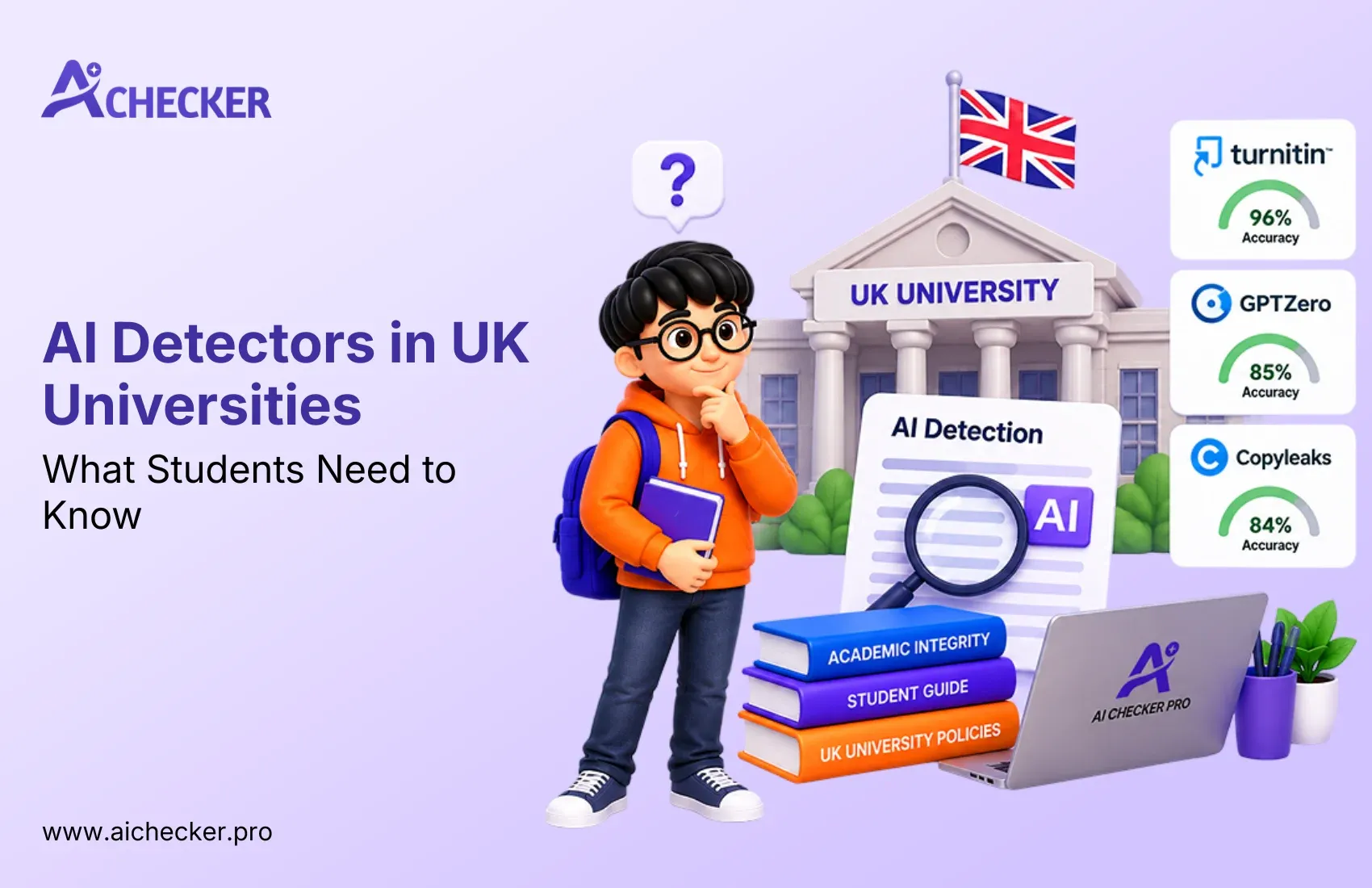
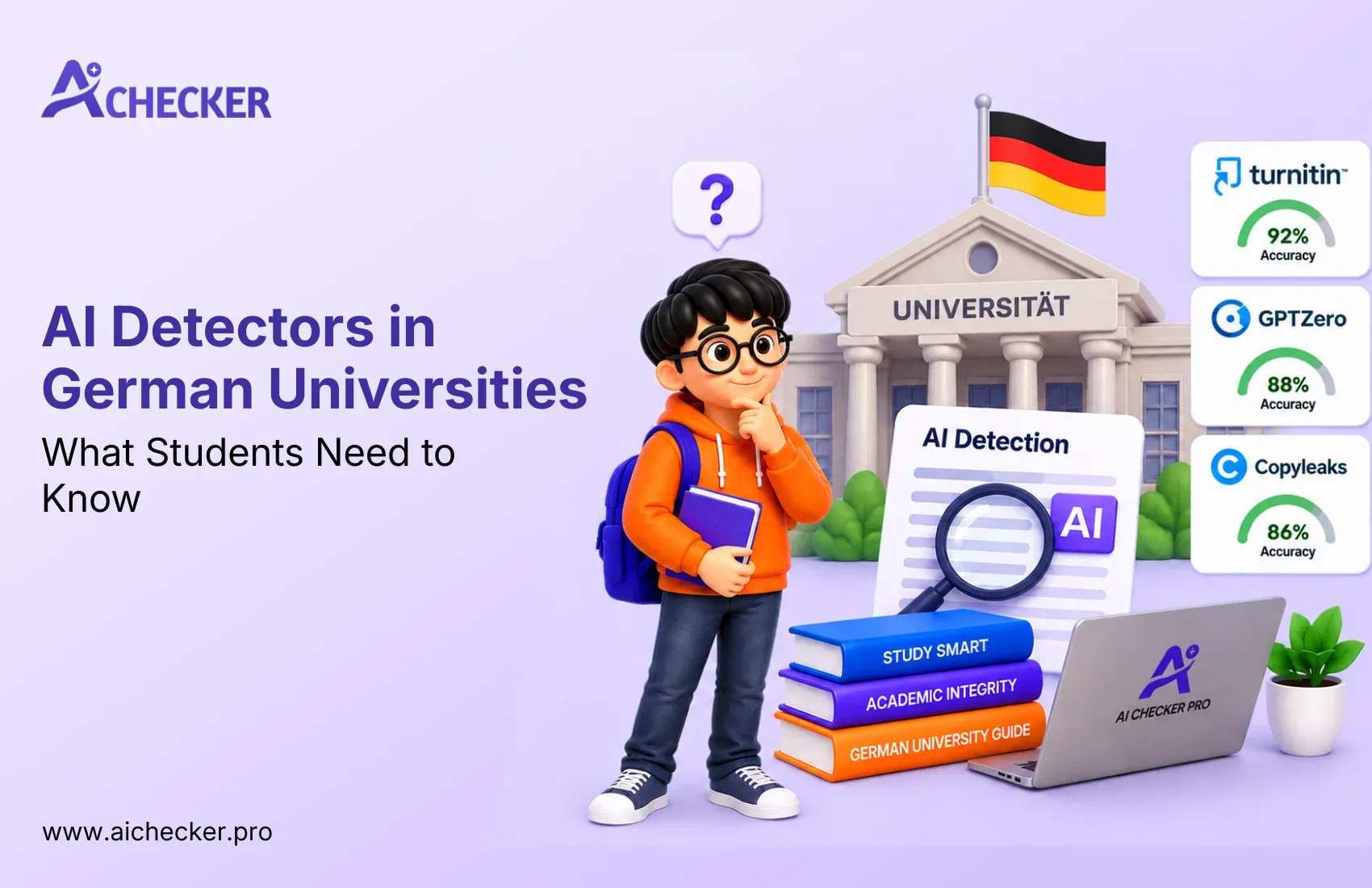
Turnitin has admitted publicly that their feature for detecting AI writing has limitations, and independent tests have shown false positive and negative rates that are nowhere near 0 percent
GPTZero, Originality.ai and Copyleaks all work on the same underlying logic which means they all have the same flaws. None of the companies behind these tools claim to be completely accurate in their documentation, likely due to the fact none of them actually are.
This is not an argument for not following academic integrity rules, but it is an argument for understanding that a high AI probability is just that, a probability, and German universities that handle this well tend to treat it as such, weighing it alongside a conversation with the student before jumping to conclusions of misconduct.
Comparing the Main AI Checker Options for University Assignments
If you are looking for an AI checker for university assignments, here is how the major tools compare based on what I have seen testing them side by side.
| Tool | Accuracy | Free Tier | Humanizer Included | Best For |
|---|---|---|---|---|
| AI Checker Pro | Strong, sentence-level detection | Yes, limited free checks | Yes, built-in | Students and bloggers who want detection and rewriting in one place |
| Turnitin | Moderate, institution-controlled | No, university licensed only | No | University-administered plagiarism and AI checks |
| GPTZero | Moderate to strong on raw AI text | Yes, limited | No | Quick individual checks before submission |
| Originality.ai | Strong on raw AI text, weaker on edited text | No, paid only | No | Agencies and content teams |
| Copyleaks | Moderate | Limited free trial | No | Institutions combining plagiarism and AI scanning |
Final rewrite of the given text:
A few honest words about this table. Turnitin is the tool that most German universities use on the backend, and as a student, you often don't have much choice; your university picks the detector, not the other way around.
This is why it's so important to check your own work ahead of time using something like AI Checker Pro or GPTZero, because that way you can get an idea of what percentage you would probably be detected as.
What This Means for Your Academic Papers and Essays
If you have to write an essay for an AI detector in the scope of university work, be it a short Referat or a complete Bachelorarbeit, the practical tips remain the same at all levels of education.
Write your first draft yourself, without the help of an AI, even if it is only a rough version
This way, you have a complete text in your own wording as a solid basis to then work with individual passages through AI support, whether for research, structuring or correcting.
Ask yourself these questions before you submit:
- Did I write the core arguments and analysis myself?
- Would I be comfortable explaining any paragraph out loud if my professor asked me to?
- Have I checked how consistent my sentence rhythm and vocabulary are throughout the paper?
- Do I have earlier drafts saved somewhere, in case my process is ever questioned?
For bloggers and SEO writers who read this in Germany, this also applies to Google. Instead of rewriting by hand, many now let AI Checker Pro analyze a batch of blog posts before they are published because texts with a high AI score may have a negative impact on SEO rankings.
How to Use a ChatGPT Detector for University Students the Right Way
A good ChatGPT detector for university students is not a tool for total reliance but rather a helpful guide along the way. Here is a valuable, simplistic workflow I suggested to several students that has proven effective:
- Write your paper, using AI for brainstorming or grammar only if your program allows it
- Run the finished draft through an AI checker before submission
- If sections get flagged, rewrite them in your own words rather than just swapping synonyms, and you can follow this guide on how to humanize AI text manually
- Keep your outline, notes, and draft history in a folder in case you need to show your process
- Understand your specific university's policy, since rules vary a lot between German institutions and even between departments at the same university
Some German universities have scaled back how heavily they rely on a single detection tool after facing pushback from student unions and faculty about false positive complaints. That trend is worth watching if you are currently enrolled, since policies are still evolving heading into the next academic year.
Conclusion
AI detectors in German universities may be around for a while. But they are still an evolving technology, and that means they are not perfect.
The best course of action as a student is to not even attempt to beat the system. It is best to actually put your own thoughts and writing into whatever you turn in, use AI tools according to your program's guidelines, and double-check your work to ensure you are never caught off guard.
Tools like AI Checker Pro can allow students to look at their work through a detector's gaze and make sure they aren't making any careless mistakes.
FAQs
Do German universities use AI detectors?
How do AI detectors for university students work?
Are AI detectors accurate?
Can AI detectors flag human-written text?
Do international students get flagged more often?
What is the best AI checker for university assignments?
Should I check my paper with an AI detector before submitting it?
Can a ChatGPT detector for university students catch edited AI text?
What should I do if an AI detector falsely flags my paper?
How can I lower my risk of being flagged by an AI detector?

Harshil Barvaliya
SEO Executive & Content Writer at AI Checker Pro
I’m Harshil Barvaliya, an SEO Executive and Content Writer at AI Checker Pro. I focus on improving the website’s search engine visibility through effective SEO strategies, including keyword research, on-page and off-page optimization, and content development.Get Started Free
Create a free account for advanced AI detection and scan history.
Trusted by thousands worldwide.
Recent Blog's
Discover how AI-powered content creation can elevate your website's reach and engage your audience like never before. Explore the real impact of AI on crafting content that connects.