Do Australian Universities Use AI Detectors? 2026 Guide
TABLE OF CONTENTS
Quick answer
Why This Question Matters So Much Right Now
Which Australian Universities Actually Use AI Detectors
How Accurate Are These AI Detectors, Really?
The False Positive Problem Nobody Talks About Enough
AI Checker Pro vs Other Detectors Students Compare
If You're a Blogger or SEO Writer, This Applies to You Too
What Happens If You Get Flagged at an Australian University
Conclusion
Get an AI summary of this post on:




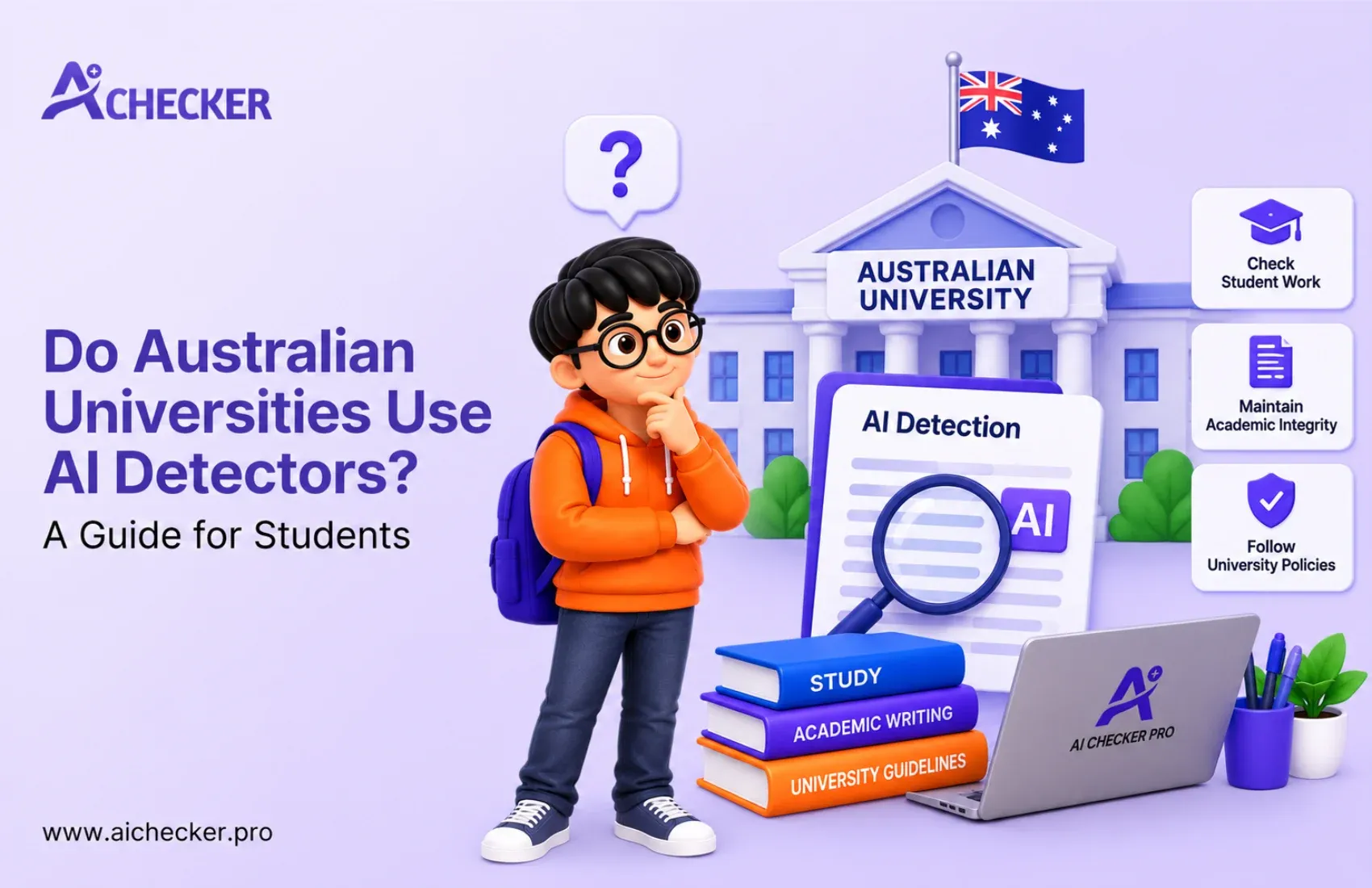
If you're studying in Australia, you've probably asked yourself this question while preparing an assignment: Do Australian universities use AI detectors, and more importantly, how much risk do they pose?
Based on my research and testing of common detectors, I have found that the truth is more complicated than a simple yes-or-no answer. If you want to check your own draft before you submit it, tools built specifically for AI detection for students can give you a quick gut check.
Quick answer
While some Australian universities use AI detection software such as Turnitin's AI writing detection feature software such as the AI writing indicator from TurnitIn, the reality is more more complicated than simply 'yes' or 'no':
Some Australian universities, such as Curtin and ANU, have entirely turned off AI detection technology in their plagiarism detection software due to issues with its accuracy, while other universities continue to use it as evidence for potential plagiarism.
If you're checking whether your university uses Turnitin's AI writing detection, the answer depends on its current academic integrity policy.
Get Lifetime Access with 60% OFF
Stop paying monthly subscriptions. Enjoy unlimited AI detection and humanizer access forever with future updates included.
- One-time payment
- Unlimited access forever
- All future updates included
Why This Question Matters So Much Right Now
Since the rapid increasing of ChatGPT, AI detectors have become a part of every student's life, whether they like it or not. Universities were caught off guard, and by 2026, most of them had formulated an official policy on using AI, and some of them consider any unreported use of AI as academic misconduct. If you want a broader picture of the tools colleges lean on, this rundown of what AI detectors colleges use covers the landscape well.
Others allow the use of AI as a learning tool as long as its use is disclosed. The policies do vary from school to school, and that is why students are still googling this topic.
When I tested several student-written essays last month, I compared how different AI detectors responded to the same content.
I was confused by the results.
One essay, fully written by a student, got flagged as likely AI-generated, but a slightly modified one, created by ChatGPT, went unnoticed.
Which Australian Universities Actually Use AI Detectors
Here's what actually works in 2026, based on how the sector has shifted.
Universities that have scaled back or disabled AI detection:
- Curtin University: Disabled Turnitin's AI writing detection feature from January 2026, citing a focus on "fostering trust and clarity" in assessment.
- Australian National University (ANU): Disabled Turnitin's AI writing detection earlier, citing concerns about false positives, potential bias against certain writing styles, and limited transparency around how AI scores are calculated.
- University of South Australia (UniSA): Turned off AI detection at an early stage, well before its merger with the University of Adelaide.
- Other Universities: Several institutions have reportedly allowed AI detection features to lapse at the department or course level without making a formal public announcement.
- Overall Trend: These decisions reflect growing concerns about the accuracy, fairness, transparency, and reliability of AI-writing detection tools in academic assessment.
Universities that still use AI detection in some form:
- RMIT University: Continues to use Turnitin's AI detection as a supporting tool. Its policy states that AI detection may be used only in units where AI tools are completely prohibited.
- Group of Eight (Go8) Universities: Several Group of Eight (Go8) universities have stricter policies on AI-generated content. In some cases, AI detection scores are treated as one piece of evidence when an academic suspects misconduct, rather than as standalone proof.
- Overall Approach: The emphasis is increasingly on academic judgment and multiple forms of evidence, rather than relying solely on an AI detection score to determine whether a student used AI. For a wider look at how this plays out across the sector, see what AI detectors universities use to check for AI.
Universities that are somewhere in between:
- Limited Disclosure: Many institutions use AI detectors internally without directly showing students the detection scores.
- Multiple Indicators: A formal academic integrity investigation may begin only when an AI detection result is supported by other warning signs, such as a significant change in writing style compared with a student's previous submissions.
- Policies Change Quickly: University AI policies are evolving rapidly, and some institutions update their rules each semester.
- Check Official Policies: For the most accurate and current information, check your university's academic integrity or teaching and learning policy directly.
- Avoid Outdated Information: Don't rely solely on what a classmate says or what was allowed in a previous semester, as the rules may have changed.
How Accurate Are These AI Detectors, Really?
Here is what you need to know before you panic about an assignment flagged by an AI detector: no AI detector is completely reliable, and their own documentation generally acknowledges this limitation.
Turnitin, GPTZero, Originality.ai, and Copyleaks all have some version of this warning in their documentation.
A few things I've noticed personally after testing these tools on real writing samples:
- Detection accuracy is generally much higher on raw, unedited AI text than on anything that has been paraphrased or run through a humanizing tool
- Formal academic writing can sometimes produce false positives because its structured and predictable style may resemble patterns associated with AI-generated text
- Short pieces of writing are harder to score accurately than long ones, simply because there are fewer patterns for the detector to work with
- Detectors trained mostly on older AI models like GPT-3.5 can struggle with newer, more natural-sounding AI writing
Detection accuracy also drops significantly once content has been paraphrased or humanized, which is a big reason why universities are hesitant to treat a single AI score as hard proof of cheating. If you want a deeper breakdown of overall reliability, this guide on AI detector accuracy walks through the numbers.
The False Positive Problem Nobody Talks About Enough
I think that it is important to state my concerns on this matter very directly. Not only do human-written essays have a higher chance of being scored incorrectly by the algorithms, but human writing can also be mistaken for AI writing, and this has happened frequently enough that universities such as Curtin and ANU have chosen to abandon the practice entirely. There's a closer look at this exact issue in how false positives affect human writing.
If you're worried about being falsely flagged, here's what actually helps:
- Keep drafts, outlines, and version history of your work in Google Docs or Word, so you have proof of your writing process if you ever need it
- Avoid overly repetitive sentence structures, since detectors often key in on predictable, even-toned writing patterns
- Write in your natural voice instead of trying to sound "extra academic," which can ironically read as more machine-like
- If your university allows it, run your own draft through a checker like AI Checker Pro before submitting, just to catch anything that reads as suspiciously uniform
Tools like AI Checker Pro can help you check content for possible AI-generated text before you potentially face an awkward meeting with your course coordinator. I have personally seen students use it as a gut check on their own essays and assignments, not to game the system, but just to make sure their honest work doesn't accidentally look machine-generated, whether it's an essay or a longer research paper.
AI Checker Pro vs Other Detectors Students Compare
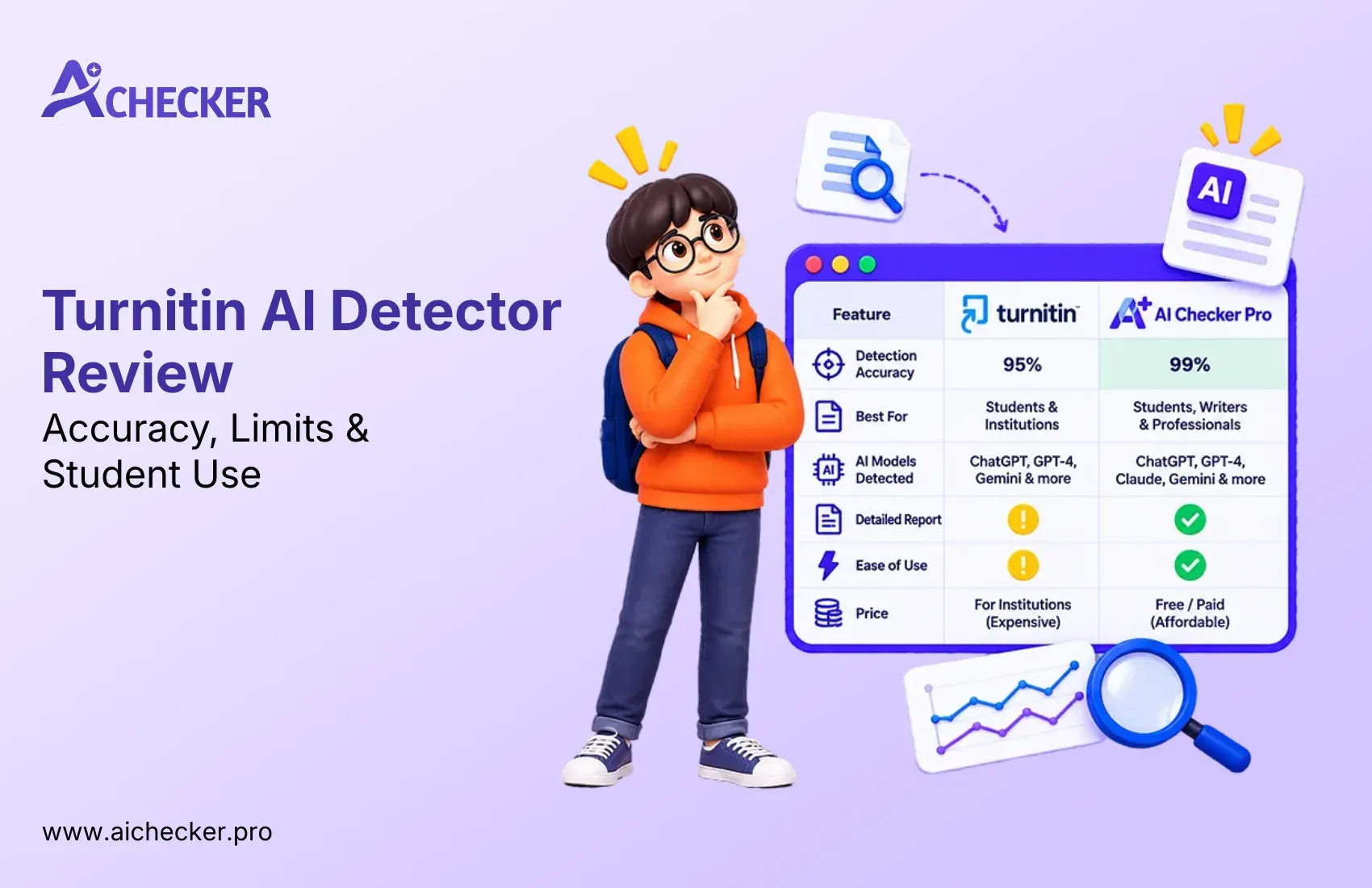
Here's a general comparison of AI Checker Pro with the tools that students and universities tend to reference. Please note that accuracy rates are constantly changing for all of these products as they update their models and features, so take this with a grain of salt.
| Tool | Accuracy | Free Tier | Humanizer Included | Best For |
|---|---|---|---|---|
| AI Checker Pro | Strong, sentence-level detection | Yes | Yes | Students and bloggers who want detection and cleanup in one place |
| Turnitin | Used institutionally, moderate false positive rate reported | No (institution only) | No | University-level integrity checks |
| GPTZero | Decent on raw AI text, weaker on edited content | Limited | No | Quick checks on essays |
| Originality.ai | Strong for long-form content | No | No | Bloggers and SEO teams |
| Copyleaks | Moderate, improving over time | Limited | No | Businesses and agencies |
If You're a Blogger or SEO Writer, This Applies to You Too
This is not only a student issue. Content detection is important for everyone who publishes material on the web, since Google has been gradually penalizing websites with low-quality, unedited AI content. Writers who publish regularly often lean on an AI detector built for bloggers to catch issues before hitting publish.
Thus, if you produce blog content at scale, checking it against a content checker before publishing is now a necessary step in your editing process, akin to a plagiarism check years ago.
Instead of editing the text manually, many people now use AI Checker Pro's blog enhancer to obscure traces of AI-generated text and retain the meaning. Works with ChatGPT, GPT-4, GPT-5, Gemini, and Claude, which is a relief since the majority don't use one writing tool exclusively.
What Happens If You Get Flagged at an Australian University
Getting flagged doesn't necessarily mean that you are doomed, but it does involve a process. Usually, it goes something like this:
- Your coordinator/lecturer looks at the flagged part of your paper alongside your other work
- They might question you about how you wrote it/drafts
- Sometimes, they give you a chance to talk it over informally before it goes to the academic integrity board
- Only if they find consistent evidence, which isn't always the case with AI-scored papers, will they escalate it to the official misconduct hearing
Thankfully, most universities don't take AI scores as proof of plagiarism without additional evidence, so getting a false positive can't hurt you as a writer with good intentions. If you want to understand the mechanics behind these flags before it happens to you, how colleges detect AI in essays breaks down the process in more detail.
Conclusion
So, do Australian universities use AI detectors? Some do, some have turned them off, and most are still figuring out the right balance between catching genuine misconduct and protecting honest students from false positives. The sector is shifting fast, with more universities pulling back from automated scoring throughout 2026 rather than doubling down on it.
If you're a student, your best move is to check your own university's current policy and keep a record of your writing process. And if you ever want a second opinion on your own work before you submit it, tools like AI Checker Pro's assignment checker are built exactly for that kind of peace of mind.
Do Australian universities use AI detectors like Turnitin?
Which Australian universities have turned off AI detection?
How accurate are AI detectors for university assignments?
Can AI detectors give false positives on human writing?
What happens if my assignment gets flagged as AI-written?
Does RMIT University use AI detection?
How can I avoid being falsely flagged by an AI detector?
Do Group of Eight (Go8) universities use AI detectors?
Are AI detectors used outside universities too?
Should I trust a single AI detection score?

Harshil Barvaliya
SEO Executive & Content Writer at AI Checker Pro
Get Started Free
Create a free account for advanced AI detection and scan history.
Trusted by thousands worldwide.
Recent Blog's
Discover how AI-powered content creation can elevate your website's reach and engage your audience like never before. Explore the real impact of AI on crafting content that connects.