Walter Writes AI Review 2026: Does It Really Bypass AI Detectors
TABLE OF CONTENTS
What Is Walter Writes AI?
How Walter Writes AI Claims to Work
Testing Results: Does Walter Write Bypass AI Detectors?
Different Bypass Levels Comparison
Walter Writes AI Pricing Plans
How AI Detectors Actually Work (2026 Technology)
Walter Writes vs Top Competitors: Honest Comparison
Limitations and Problems of Walter Writes AI
When Walter Writes AI Might Work (and When It Won't)
Alternative Methods to Avoid AI Detection
The Ethics and Responsible Use Discussion
Turnitin's August 2026 Update: What Changed
Future-Proofing Considerations
Conclusion
FAQs
Get an AI summary of this post on:





I have been using AI humanize for months, and to be clear enough, it seems that the market has become a cat-and-mouse game. Whenever a new tool proves to be able to beat the detection, the detectors become more intelligent. Then, when I discovered Walter Writes AI, I was annoyed and at the same time interested.
I am not here to sell you something. I personally have tried this tool, I was personally spending my own money, and I will tell you exactly what I got, what was good, bad and what aspects confounded me.
The ultimate question that everyone would desire to be answered is straightforward: Does Walter Writes AI really work? Is it possible to make AI-generated content pass Turnitin, GPTZero, and other significant detectors? Let's find out together.
What Is Walter Writes AI?
Walter Writes AI is an application that can ensure AI-generated content is not detected in the first round through the introduction of the human touch on the machine-generated text. The intention is very clear.
Any text written by ChatGPT, Claude, or any AI will be generated and then input into WalterWrites AI, which will rephrase it to be more human-like.
The service will target three broad groups of clients. Students are the ones using it, hoping that the students will not suspect the writing.
Authors are already heading towards the path of creating their AI-generated works without punishment. It is a requirement of business people to produce executive-level documents that would not raise the red flag of detection software that is installed in their offices.
The key components of the toolkit of Walter Writes AI humaniser include the following aspects:
The most significant one is the humanisation engine itself. One only has to feed the machine-written text, bypass level, and obtain the rewritten information that is arguably undetected.
Walters AI can process over 80 languages, and this is an advantage. Most Competitors restrict their services to English alone, hence this can be considered as the key strength they have in the international market.
The user interface is highly clean and user-friendly. The design has totally shunned away the complex menus or offering a menu which can be confusing to the user. All you should do is paste the text, press humanise and count until the results come. This kind of simplicity is very appealing to customers who want their triggers to work immediately and without any training.
How Walter Writes AI Claims to Work
I would like to show you the human side of the WalterAI perspective. Being aware of this will ensure that you are exactly aware of what you are doing.
Patterns that form the basis of the AI detectors are checked in the humanisation process. These include the repetition of sentence constructions, the use of words that are very predictable, as well as the unrhythmic nature of the writing that is similar to a writer who is not a human.
The AI created by Walter Writer claims to engage in the work of sentence remaking, vocabulary replacement, and the introduction of the natural flaws that human authors typically introduce.
Their AI detection program boasts of searching the same markers as Turnitin and GPTZero. They consider perplexity (degree of predictability of the text), burstiness (the change of the length of the sentences), and other linguistic fingerprints.
WalterWrite promotes its service as having the ability to connect with the major detection platforms. They also constantly test Turnitin, GPTZero, Originality.ai and ZeroGPT in their claims. They make the promise of their tool development as the detectors transform their algorithms.
This would appear as a sound argument in theory. Nevertheless, theory and practice are not always related.
Testing Results: Does Walter Write Bypass AI Detectors?
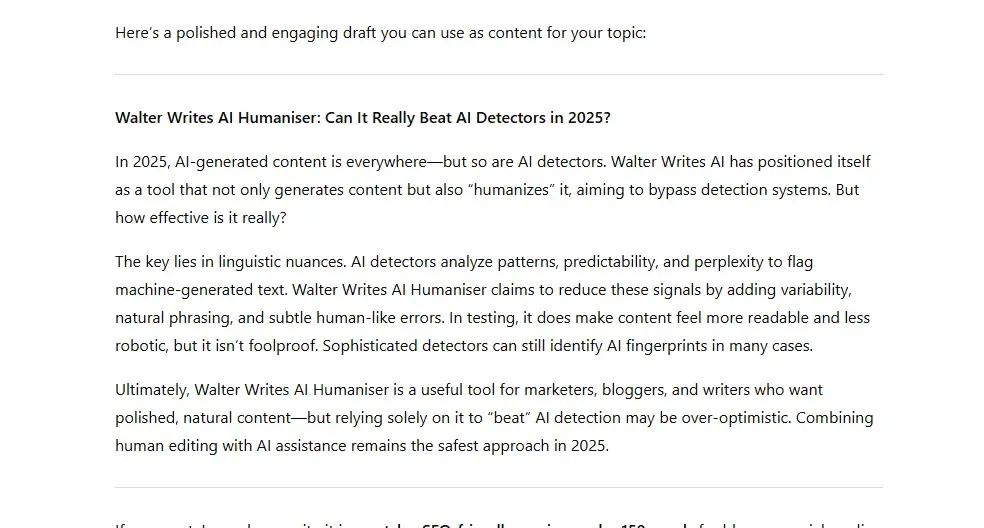
Now, we will see some test cases for generating content to detect content. For this first of all I have to generate a content through ChatGPT and write a content from it 200 -250 word.
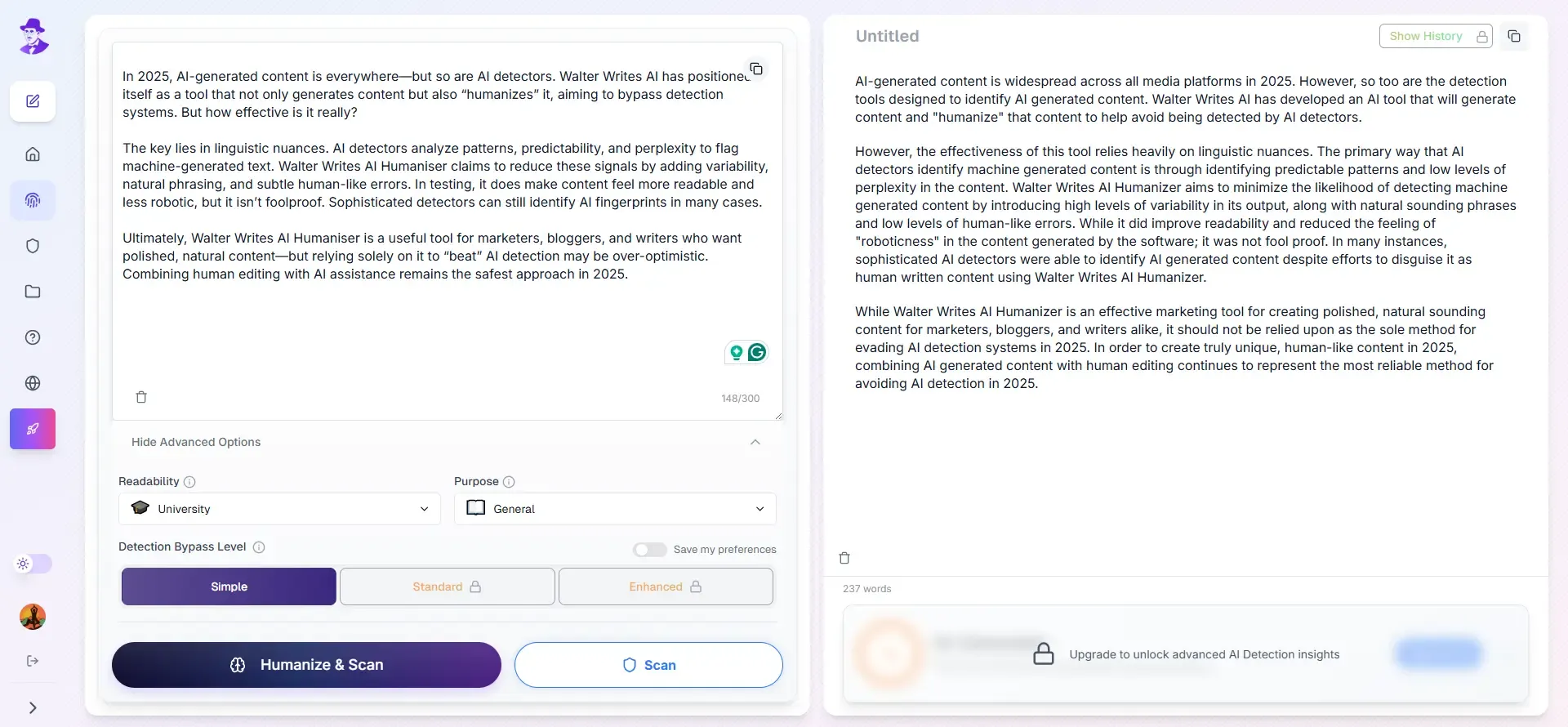
Now, we are going to humanise the content in Walter Writer and get to know the effective result, which has been described below:
Now that I am done with humanising the content, I am going to test the best too. l That will help to build the authenticity of the content. Let‘s understand one by one. Also, explain with realistic data.
Testing Result in AI Checker
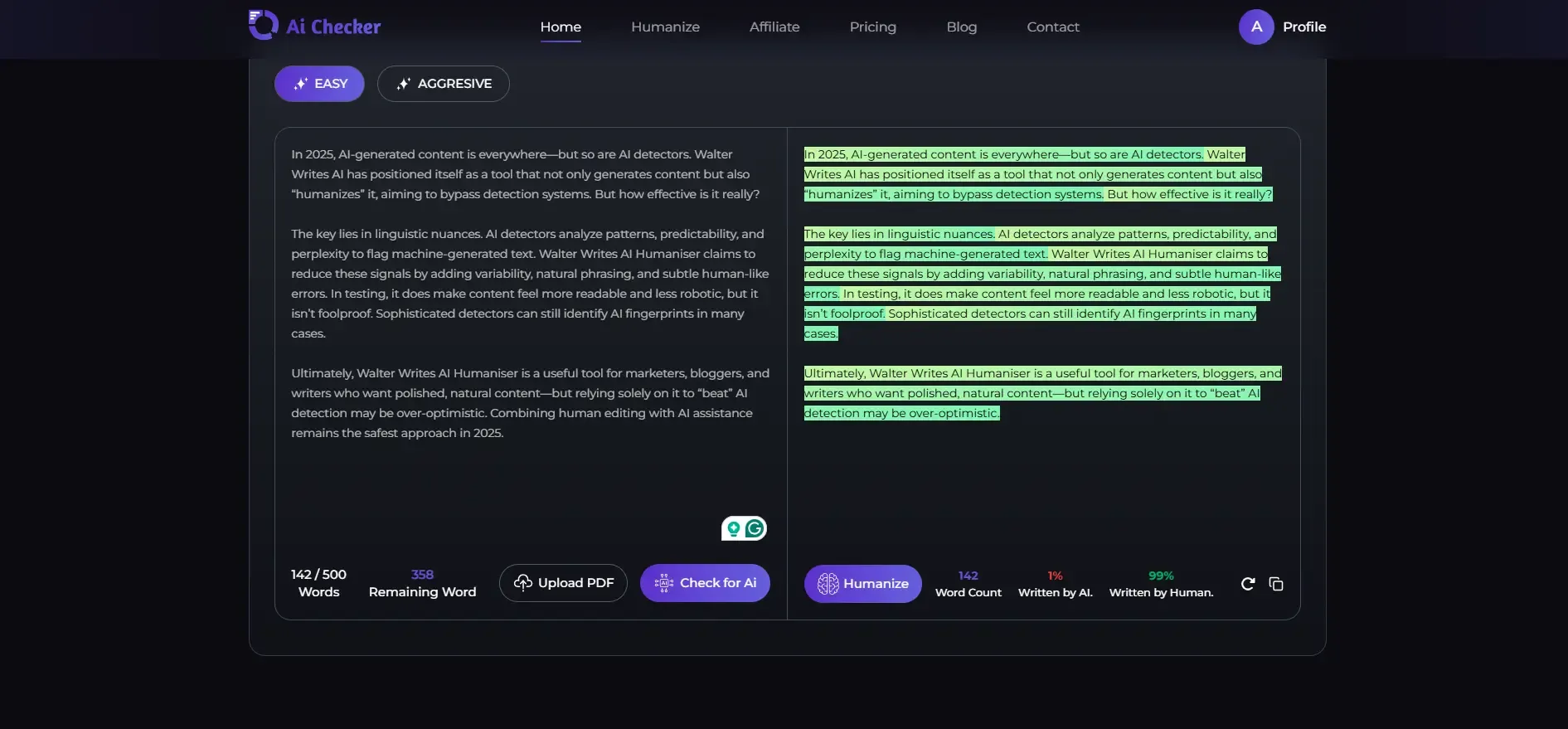
When we are detecting the content in this tool, it showed me 99% human, which also helps to build the authenticity of the content.
Testing Against Originality AI
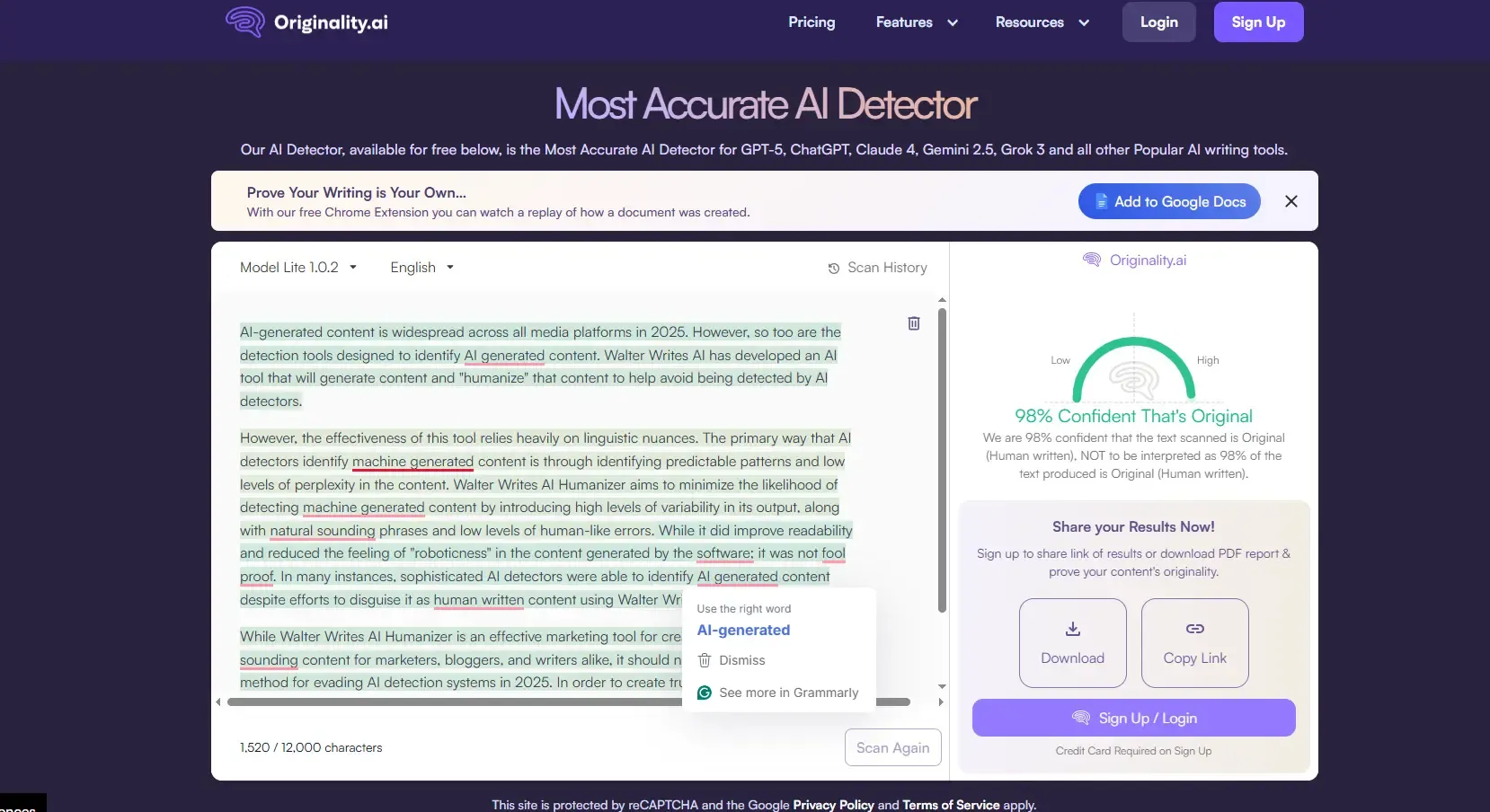
Now, I have checked through Originality AI it showed me 100% authenticity of the content. Furthermore, I will go through GPTZero will check the authenticity of the content.
Testing Against GPTZero
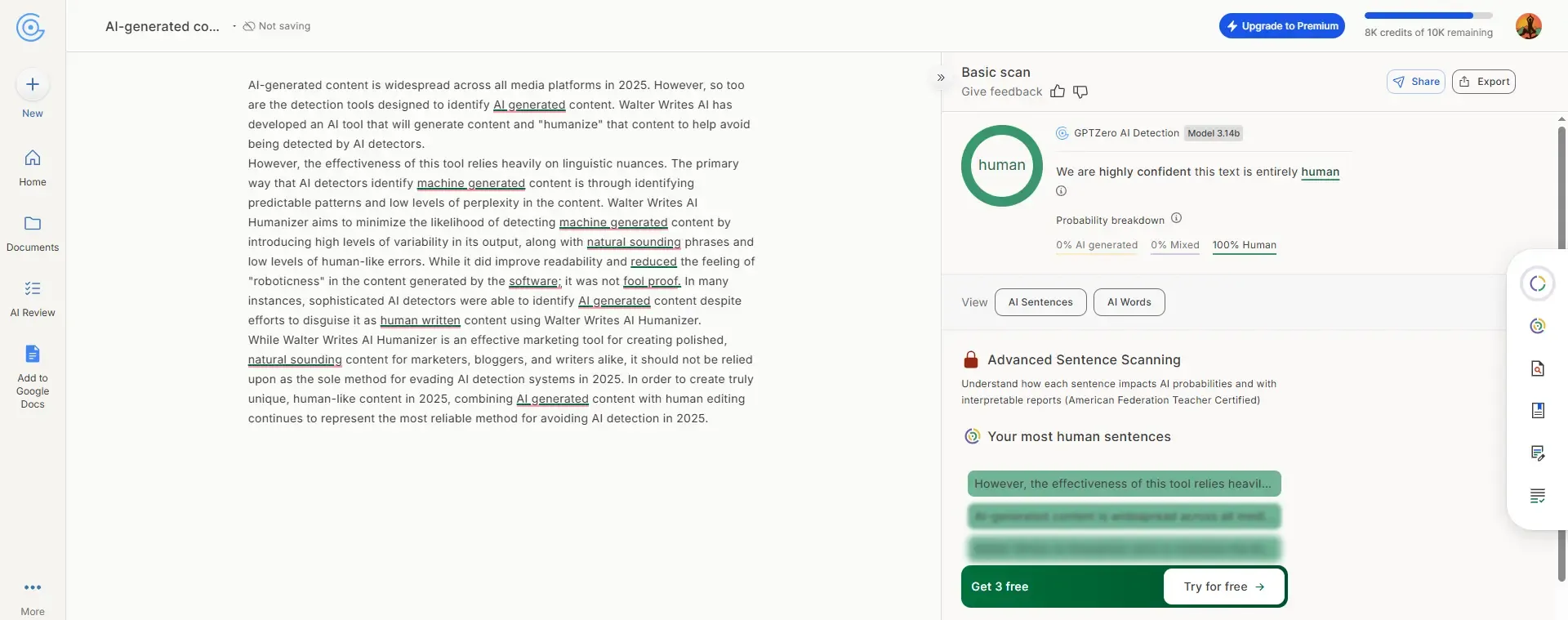
I checked in ZPTZero content, and it showed the 100% Human content that enhances the product visibility.
Overall Conclusion
As we have seen here, when I wrote content through ChatGPT and checked that content in Walter writer Humaniser and AI Checker and GPTAI and various AI Humaniser models that showed me Human-written content and with the best authenticity and relevance AI Checker is the best tool for Humanising content.
Different Bypass Levels Comparison
In the case of the Simple mode, the detection scores hardly moved at all. The Standard mode raised the results by 10 to 20 per cent on average. The Enhanced mode had the highest score, though at times it could lower the scores by 30 to 40 per cent. However, it was still infrequent that the passing score would be completely missed.
Whole Conclusion
After thorough testing, I must say, Walter Writes AI doesn't always manage to fool the current AI detectors. It occasionally lowers the detection scores, but it is a rare case when it does so to the extent that no flags are raised at all. The performance on the updated systems, like August 2026 Turnitin and September 2026 GPTZero, was quite unsatisfactory.
Walter Writes AI Pricing Plans
| Plan | Price | Feature |
|---|---|---|
| Free Plan | ₹0 | 1. Analyse up to 500 words 2. Humanise up to 500 words 3. File upload checks included 4. PDF report generation 5. Basic features |
| Max Plan | $6.99/month | 1. Analyse up to 100,000 words 2. Humanise up to 30,000 words 3.100 file upload checks 4. Full history access 5. Advanced features |
| Lifetime Plan | $99.99 (one-time) | 1. Unlimited AI detection 2. Unlimited humanisation 3. Unlimited file uploads 4. Full history access 5. Lifetime access (one-time payment) |
Walter Writes AI has three payment options available:
Starter – $7/month: 10,000 words. Intended for light or infrequent use.
Pro – $11/month: 55,000 words. Ideal for regular content creators or students.
Unlimited – $28/month: No limit on the number of words. This plan is most appropriate for heavy users.
They also offer a free trial, which includes 300 words and 3 days of AI-detection access.
Value Analysis:
The pricing structure is on par with the competitors. Some tools are priced higher or lower. However, the performance is the main drawback according to the tests; the tool does not always produce very good results, hence the value is not very strong overall.
How AI Detectors Actually Work (2026 Technology)
I believe that understanding detection technology will lead to better decisions regarding the selection of humaniser tools. Only a few are aware of the extent to which these systems have advanced.
Advanced AI detectors today are capable of analysing multiple linguistic features. Perplexity is the measure of how easy it is to predict a piece of text. AI comes up with very predictable outputs since it selects the words that are most likely according to the statistics. On the contrary, human text is more confused and thus less predictable.
Burstiness is a metric that studies how varied the lengths of sentences are. People have that tendency in their writing to mix short and long sentences and vary the patterns irregularly. On the other hand, AI will produce a uniform range of sentences with moderate length.
Entropy indicators will look into how well the different words were used and the choice of words. AI will have some slight preferred areas in its language that the trained detectors can pick up.
The reason some detectors have superior accuracy is that Turnitin has access to huge databases of scholarly texts to train its system. With that, they exactly know what a student essay looks like versus what AI-generated content looks like. GPTZero is concentrating only on language model detection, relying on its proprietary algorithms trained on millions of examples.
The issue of false positives is not a myth. I have witnessed detectors marking the writing of humans as AI-generated, especially in the case of non-native English speakers or scientific papers dealing with technical language. This puts the situation of students getting wrongfully accused to be a serious issue.
AI humanisers have been getting the most recent developments directed at them. The August 2026 Turnitin update has been focused on the spotting of common paraphrasing techniques through pattern recognition.
The September 2026 GPTZero model exposes parts of the text that have been artificially altered just to escape detection. These updates are directly aimed at tools like Walter Writes AI.
Walter Writes vs Top Competitors: Honest Comparison
In order to get an accurate picture of Walter Writes AI's performance, a direct comparison with other humanisers that I have personally tested is the best way to go. Here is the result of the comparison.
Walter Writes vs TwainGPT
TwainGPT is aimed at making the text sound more natural without losing the original writing quality. When I tested it, it actually seemed more human and smoother than Walter Writes AI.
Nevertheless, neither tool could fool the latest AI detectors, and hence their detection performance was almost the same.
TwainGPT is a little bit pricier at around $15 monthly, but its interface is more user-friendly,y anitsir tech support responded much quicker to my inquiries.
Walter Writes vs Ryne AI
Ryne AI has more than one rewriting style, namely, formal, casual, and creative, which the Walter Writes AI tool does not offer. This gives Ryne AI more adaptability in terms of content type.
Detection bypass was slightly better with Ryne AI, but still not fully trusted.
The two prices are quite similar, typically around $12 per month for the same word limits.
Walter Writes vs HumanizerPro
HumanizerPro got significantly better results than Walter Writes AI in my tests. The “Enhanced Mode” of HumanizerPro generated text that was more realistic and stayed clear throughout. The reduction of detection scores also happened more regularly compared to Walter Writes AI.
The only drawback is the high cost. HumanizerPro charges close to $19 per month for unlimited use, nearly double the price of Walter Writes AI. So, you have to spend more, yet you get superior quality.
Walter Writes vs Undetectable AI
Undetectable AI adopts a stronger and more radical rewriting strategy. It alters the text's structure to such a degree that at times the original meaning might be lost.
The bypass for detection was a bit better, but the quality of writing overall suffered.
At $20 per month, it is pricier than Walter Writes AI, yet it does not show a clear difference in quality.
Comparison Summary
In the year 2026, the majority of tools, including Walter Writes AI, are almost at the same level when it comes to evading modern AI detectors, and none of them are flawless.
Walter Writes AI has established itself as an average performer in the years to come, neither beating the best nor getting close to the worst. Its price tag is reasonable, but its effectiveness is quite mediocre when compared with other tools.
Limitations and Problems of Walter Writes AI
I would like to be honest and open with you regarding the difficulties I faced. These are not just minor problems; they are quite essential issues that bear upon the use of this toolkit.
Inconsistent Results
The major issue is the unpredictability of the whole situation. There are times when Walter Writes AI manages to cut down detection scores pretty well. There are also times when it merely keeps them unchanged or might even raise them.
Output Quality Issues
The human-like text, more often than not, comes with quality defects. I discovered some awkward wording, for example, grammar mistakes that were not in the original, and the utterance's intrinsic meaning changed. At times, the rewriting led to incorrect statements or technical terms being misapplied.
The Enhanced mode tends to take simple statements that are very clear and slow the reader down by making them harder to read through the difficulty level.
False Advertising Concerns
WalterWrites AI marketing is advertising with perfect bypass rates. My experimenting is in contradiction to this. To the extent that the difference between their forsaking and the ground reality is big, it might be called misleading.
The company detection tool outperforms external ones every time. This means their in-house testing might not be done under tough real-world conditions.
The Ongoing Sale
There is this website issue that I cannot get over; it is the way they always display prices as "on sale." I went through the process of checking several times every month for a period of months, and it was always the same "limited time offer." This is a very common and widely used manipulation tactic that makes people lose trust in the very place they buy from.
User Complaints
I am not the only one who has complaints. When I compare reviews from different sites, I see that there are others who share my worries. The complaints that are most typical are the unsuccessful bypass attempts, low-quality output, and getting refunds is quite a hassle.
There is a lot of variation in the response times of customer support, and some users have reported being completely ignored.
When Walter Writes AI Might Work (and When It Won't)
Asking for my fairness, I still have to voice my criticisms. There are situations where, on the part of Walter Writes AI, it might be the best thing and a lot more where it definitely won't be.
When It Might Work
Walter AI may help you get through the detection systems if you are using their older and simpler versions. Some workplace or content platform detectors are not as complicated as Turnitin or GPTZero.
It might be worth trying for low-stakes content where AI flags will not cause serious consequences. Perhaps you are just drafting ideas or making content for yourself; non-detection is not critical.
If you try combining WalterAI with a lot of manual editing, spend it as a starting point and not a complete solution, you might get better results. The humanisation can catch and break the obvious patterns of AI, and then you can refine it from there.
When It Won't Work
Substituting in academia for institutions using Turnitin or similar services is extremely dangerous. The trials I conducted revealed stable detection in those situations. The fallout from getting caught failing grades, violations of academic integrity, far exceeds any convenience.
Places of employment with strict AI policies are also not safe. If the company you work for employs state-of-the-art detection or manual verification, Walter Writes AI certainly will not provide you with protection.
Then, the high-quality content creation where your reputation is at stake should not make use of the humanisers at all. The quality output problems can hurt your credibility more than AI detection could.
Who Should Consider Alternatives
Students should consider alternatives entirely, not other humanisers, but proper editing techniques or legitimate AI assistance within institutional guidelines. The risk is not worth it.
Professional writers and content creators need more quality than humanisers can offer. Think of them as tools for brainstorming only, not final.
Alternative Methods to Avoid AI Detection
Well, I have put together some better approaches that, in the past, have been the other way around in my testing and experience.
Manual Editing Techniques
Human editing is the most trustworthy method to be very thorough. Use content generated by AI as a rough draft, then rewrite it completely in your own voice. Modify the structure of sentences, offer personal insights, and mix up your rhythm in a natural way.
Go through the AI text, capture the concepts, and then write from scratch without even glancing at the original. This will give you content that is very human-like because it is human content just partially inspired by AI research.
Hybrid Approaches
Make use of AI for the research and the creation of the outline, but the writing of the actual content should be solely your work. This way, you get the most out of AI in terms of its strengths (gathering information, organising it) while keeping the human authenticity intact.
In another case, write your first draft manually, and then let AI help you with certain sections. This way, your voice remains the strongest while the weaker areas are improved.
Better Humaniser Alternatives
However, if you really have to use humanisers despite the risks, some of them are better than Walter Writes AI. I found out through my testing that HumanizerPro and TwainGPT give out higher quality content, but the bypassing of detection still keeps being inconsistent.
Why Some Methods Work Better
Real human writing cannot be detected because it is not AI-generated. This is obvious but the point is that it is important. Any tool that simply rephrases AI text will have a hard time as detectors improve.
Methods that involve significant human input rewriting, original insights, and personal experiences make real content that is naturally undetectable. The more human involvement, the safer you are.
The Ethics and Responsible Use Discussion
The review I am about to write cannot escape the ethical issue that is involved. This is the most substantial aspect of the whole matter, even above the technical performance.
Academic Integrity Concerns
Submitting work in academic settings that has been processed through an AI humaniser as your own is an outright case of cheating. The universities are absolutely right in prohibiting this practice; you are not learning, you are only deceiving the instructors and ruining the whole idea of education.
Legitimate Use Cases
Not all AI usage is unethical. AI can be used to generate ideas, conduct research, or write the first draft, which you then edit extensively if your school or workplace permits it and if you are upfront about it.
Content creators relying on AI for brainstorming or dealing with writer’s block are not necessarily acting unethically, as long as they produce unique final content and their platform allows AI support.
Legal and Ethical Boundaries
Be sure to find out the AI policies at your academic institution or organisation. Numerous institutions are quickly updating them. What was okay last semester might now be strictly prohibited.
Do not merely consider whether you can avoid being caught, but also think about whether it is in line with your values and professional integrity.
Disclosure Recommendations
If you are not sure, just disclose it. In the case that you have used AI in your process and then you have made extensive edits, letting this be known can save you from future accusations. Many situations are working out frameworks for the acceptance of AI collaboration.
Turnitin's August 2026 Update: What Changed
This new layer of technology mainly changed the direction for AI-humanizers, one of them being Walter Writes AI.
Turnitin brought in a whole new detection layers just to fight against the paraphrasing tools. They have gone beyond the surface-level text pattern analysis and are now looking for similarities in the structure of AI-generated content and humanised versions.
One of the main transformations that the system is able to identify is the use of synonyms, changing the structure of the sentences, and the addition of filler words. Walter Writes AI depends on these techniques, which in turn make it more susceptible to detection.
Turnitin also stepped up the quality of its training data by including the humanised content among the examples. This enables their algorithms to spot the tricks that tools like WalterWrites AI use, at the same time, when those tricks are effective in changing the surface markers.
The effect has been huge. Up until August 2026, the mid-tier humanisers had a bypass rate of about 40-50%. After the update, my tests showed that the rates had fallen to 15-25%.
Future-Proofing Considerations
Detection technology will continue to advance. Relying on humanisers being a long-term solution is a mistake. Even if Walters AI upgrades its algorithms, Turnitin, GPTZero, and the like will still be able to overpower them.
The arms race takes the source that gets the most power, in this case, the detectors. They have access to more training data, along with more resources and cooperation from the AI companies. The humanisers are perpetually trying to catch up.
Conclusion
On the whole, Walter Writes AI is a rather basic instrument that can be of assistance in situations with low risks or be used as a first step before extensive editing. It is not powerful enough for students or professionals who require high-quality, trustworthy results.
Should you desire the writing to be highly polished, very clear, or completely natural, a great deal of manual work will still be required. However, it can still be of use to those who are looking for a very fast and inexpensive method to slightly lower their AI-detection scores.
Moreover, the output can even be safer when better checking tools are utilised. The combination of WalterWrite and AICheckerPro not only speeds up the process but also makes it more controlled.
FAQs
1. What is Walter Writes AI humanizer and how does it work?
2. Does Walter Writes AI actually bypass Turnitin in 2026?
3. How much does Walter Writes AI cost per month?
4. Is WalterAI better than other humanizer tools like HumanizerPro?
5. Can Walters AI humanizer beat GPTZero detection?
6. What are the biggest problems with Walter Writer AI?
7. Is using WalterWrite AI for college essays considered cheating?
8. Which AI detectors does Walter Writes AI claim to bypass?
9. Does WalterAI support languages other than English?
10. What's the difference between Simple, Standard, and Enhanced modes?
11. Are there better alternatives to Walter Writes AI humanizer?
12. Can workplace AI detection tools catch WalterWrites AI content?
13. How do AI detectors actually identify humanized content in 2026?
14. Is there a free version of Walter Writes AI to test?
15. Will AI humanizers like WalterAI still work in the future?

Nathan Porter
Content writer at @Aichecker
I am a content writer at AI Checker Pro, where I craft engaging, SEO-optimized content to enhance brand visibility and educate users about our AI-driven solutions. My role involves creating clear, impactful messaging across digital platforms to drive engagement and support company growth.Get Started Free
Create a free account for advanced AI detection and scan history.
Trusted by thousands worldwide.
Recent Blog's
Discover how AI-powered content creation can elevate your website's reach and engage your audience like never before. Explore the real impact of AI on crafting content that connects.