AI Detector Says My Poem Is AI: Reasons and Fixes
TABLE OF CONTENTS
How AI Detectors Work (And Why They Struggle with Poetry)
Why Your Poem Might Be Flagged (5 Specific Reasons)
How to Rewrite Your Poem Without Losing Its Meaning
When to Challenge an AI Detection Result
Best Free AI Detectors for Poetry (And Their Limitations)
Conclusion
FAQs
Get an AI summary of this post on:

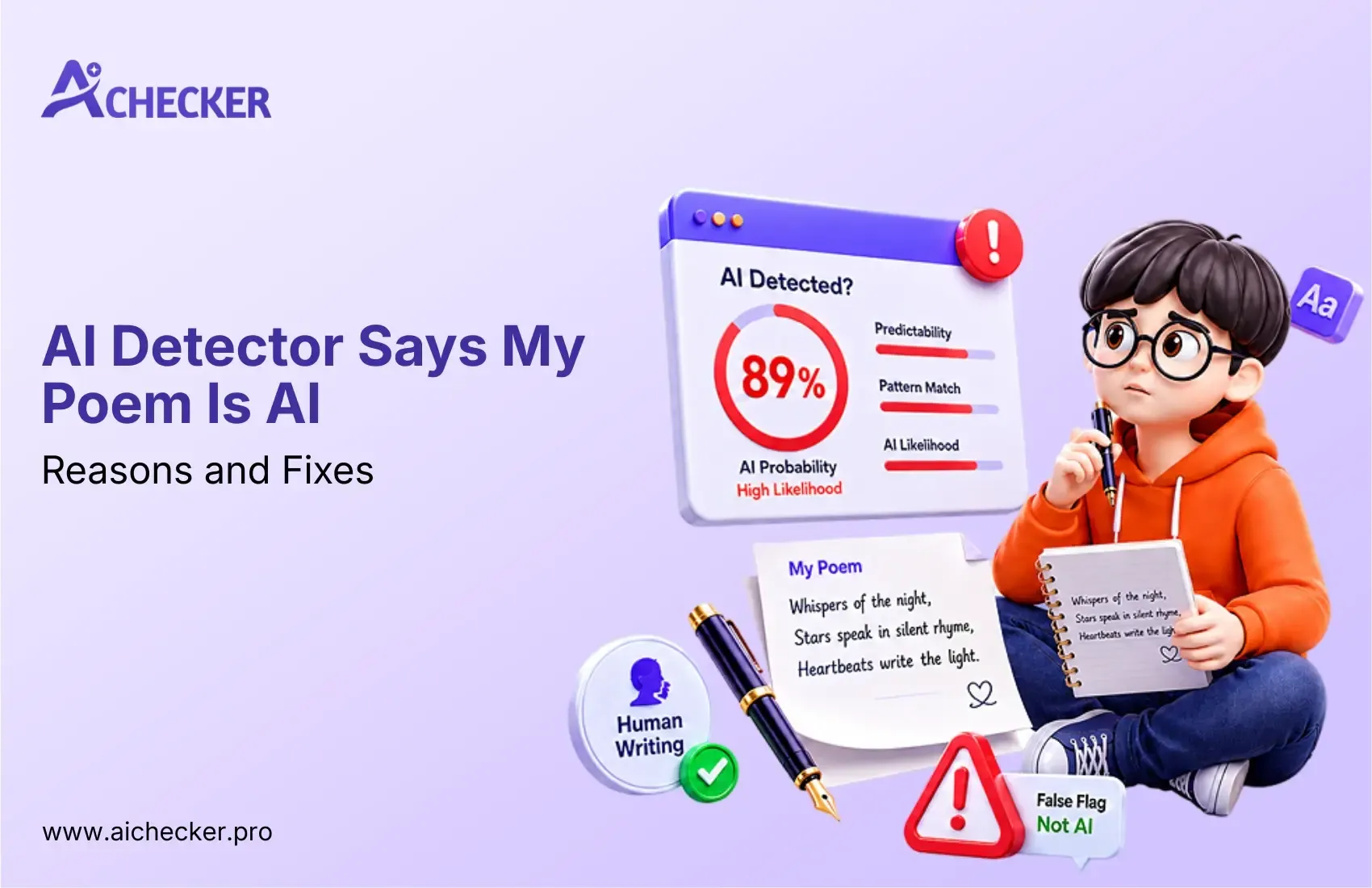
The poem that you've written is wonderful. You crafted it; you invested your emotion and experience in it. But after analyzing it with the help of an AI detector, the conclusion was devastating: "90% AI generated."
It feels like a slap in the face because your personal work has been rejected by some program.
If you can relate to this situation, don't panic. You're not the only one who feels disappointed with the results of an AI detector. Fortunately, there are many cases when an algorithm makes mistakes and returns a false positive conclusion.
In this guide, we'll discuss why exactly your poem was marked with such a result, what exactly happens in the process, and how you can fix it in five steps.
How AI Detectors Work (And Why They Struggle with Poetry)
Before we fix the problem, let's understand it a bit, ok?
AI detectors analyze text by looking at statistical patterns that tend to show up in machine-made content, not always but often. They check out three main factors:
- Perplexity: How predictable is the writing, really? With AI-generated text, it usually falls into predictable patterns. The sentences kind of glide in the expected ways, the vocabulary stays safe, and the thoughts move along in a logical order, almost too smoothly.
- Burstiness: How much variation is there in sentence length and style? In real life, human writers kind of juggle it naturally, like sometimes you get a short, punchy sentence, and sometimes a longer, more flowing one.
- Patterns & Repetition: Are there signs of recycled phrases or repetitive structures? AI models train on billions of texts and naturally reproduce common phrases and structural patterns. Detectors look for these "tells."
Poetry inherently triggers these red flags.
A Shakespearean sonnet, it has this kinda predictable rhyme thing, like ABAB CDCD EFEF GG. And the meter is kept steady in a way that feels kind of fixed, often iambic pentameter, where you're looking at 10 syllables per line, with the beat alternating stressed, then unstressed syllables. The language stays formal, almost courtly like, and the whole structure, well it's rigid by design, no real room to wander.
To an AI detector, this looks exactly like machine output. The detector sees:
- Consistent line length? ✓ Flagged as "low burstiness"
- Predictable rhyme? ✓ Flagged as "pattern repetition"
- Formal vocabulary? ✓ Flagged as "overly polished"
The critical issue: AI detectors are trained mostly on prose essays, articles, and emails. They're optimized to catch ChatGPT essays, not Petrarchan sonnets. Poetry's inherent structure is fundamentally at odds with how these tools measure authenticity.
To understand more about how AI detection works, it helps to know that research shows AI detectors have around 78% accuracy for general text, but only about 62 to 71% for poetry. When you look at highly structured verse forms like sonnets, villanelles, or haikus, the accuracy gets worse further, in a way that kind of makes you wonder.
Why Your Poem Might Be Flagged (5 Specific Reasons)
Now let's get specific. If your poem got flagged as AI-generated, it's likely one of these patterns sort of tripped the detector and made it look suspicious.
1. Consistent Meter or Rhyme Scheme
Iambic pentameter is kind of beautiful, honestly. It feels like the heartbeat of English poetry da-DUM da-DUM da-DUM da-DUM da-DUM. But when an AI detector looks at it, it can feel all mechanical, like something built not breathed. Your line: "Shall I compare thee to a summer's day?"
The detector doesn't hear Shakespeare's genius. It sees: perfect meter, consistent stress patterns, predictable rhythm. It thinks: "This pattern is too structured. AI probably generated this."
The irony? The more intentional your form, the more likely it is to be flagged.
2. Repetition of Words or Phrases
Poets do that repetition thing for emphasis, feeling, and this kind of natural musical flow, you know. It's legit, like a real literary device, not some hack or whatever.
About your poem "Love, love, love that's all we need / Love, love, love what sets us free", well yeah the repeated "love" shows up, and the lines kind of mirror each other in their structure. The detector basically sees the same word over and over, and it also notices the repeat phrasing pattern.
But it doesn't really get that you're aiming for emotional lift. Like an anaphora effect, you're doing it to push the rhythm, not because a machine wrote it. It just treats the repetition as a signal, and then it thinks, "AI pattern detected."
3. Formal Language or Structured Vocabulary
Poetry often leans on fancy, elevated language. Not because you're trying to sound like a machine or anything, but because poetry is a kind of formal art, you know.
Your line: "In twilight's melancholic glow, I wandered solitary paths"
The choice of words here, melancholic, solitary, wandered, is a bit more refined than typical everyday talk. An AI checker might pick up on that kind of elevated phrasing, and then it flags it as "too polished", which is a common AI tell. But it's just poetry.
4. Lack of Personal Details
Abstract universal poetry, y'know, triggers another detector flag: "generic language."
Your poem: "The heart breaks under the weight of loss"
I mean, this is really a beautiful, kind of all-around sentiment. But to an AI detector it looks like a big red light. Those detectors expect the human thing to carry more particular stuff, like specific details, small personal anecdotes and unique nods to real life. If it stays too universal, too evenly smooth, it can read as "bland AI output."
Poetry can be abstract and still be human, yes. But AI poetry also loves being abstract. So the detector just can't tell the difference. It sort of assumes, either way, you're writing from nowhere, not from a person.
5. Short or Highly Structured Poems
Haikus, couplets, these tight little forms, they're kind of the hardest case to "defend" when people yell AI accusations. A haiku is just 17 syllables, so there isn't really enough signal for a detector to chase down "variation" or whatever. And even if haikus are ancient human art forms, they're still so structured that modern algorithms sort of trip and don't properly recognize them as authentic.
The verdict: None of these patterns really prove you used AI. It's just that, well, detectors have picked up on certain signals and they tend to flag them. But since poetry often shows similar rhythms and shapes anyway, false positives in AI detection are super common, like very often. So yeah it doesn't mean much on its own, even if it looks convincing.
How to Rewrite Your Poem Without Losing Its Meaning
Now for the practical bit, how to fix a flagged poem while still keeping what makes it feel like you.
The point isn't to demolish your art. It's more like rewriting it in a way that passes those detectors, without messing with your own vision too much.
1. Vary Your Sentence/Line Length
If every line is exactly 10 syllables, add some variety.
Before:
I love the morning light so bright (A)
It fills my heart with pure delight (A)
The world awakens as I wake (B)
My spirit mends like wind through lake (B)
After (ABAB with variation):
I love the morning light so bright
It fills my weary heart somehow
The world awakens as I wake
And mends itself, though I don't know how
Mix rhymed and unrhymed lines. Use assonance instead of perfect rhyme. Add a tercet among your couplets. The variation reads as more authentically human.
5. Read Your Poem Aloud and Edit for Natural Flow
This is the most important step, and honestly, it's also the simplest.
Read your poem out loud. Like does it feel like you, really you, or does it feel stiff, too official, like you're delivering stage directions or something.
Cut the "It is to be noted that…" type lines, and also "In light of the aforementioned…" that kind of formal pivot screams "AI", even when the words are pretty. Swap to something more chatty but still lyrical, like it belongs in your mouth.
The key principle: Your rewrite should feel like you, not like you're hiding from an algorithm.
Important note: You're not really "cheating" by rewriting. Poets revise all the time, sometimes like dozens of times or more. Editing for better clarity, better rhythm, and that little spark of authenticity is legitimate creative work. The poem stays yours, it's not suddenly someone else's, you know.
When to Challenge an AI Detection Result
Here's the most important thing to know: AI detectors aren't infallible, and you don't have to accept their verdict.
False Positives Are Real
Studies show that even the best AI detectors have a 15 to 22% false positive rate. That means roughly 1 in 5 legitimate human texts get flagged as AI-generated.
For poetry, the rate is even higher, sometimes up to 30% for structured forms. If you want to understand why this happens, reading about AI detector accuracy can give you a much clearer picture of what these tools actually measure and where they fall short.
You Can Challenge the Result
If you know your poem is yours, you have every right to push back. Here's how:
- Document your process: Save drafts, notes, and timestamps. Show your writing journey. This is the strongest defense against false accusations.
- Provide context: Explain that you write in sonnets, haikus, or structured forms. Tell the story behind the poem. Personal context matters.
- Use multiple detectors: If only one tool flags your work but others don't, that's strong evidence of a false positive. Different detectors use different algorithms, disagreement suggests error.
- Request human review: Never rely on automation alone for important decisions. If this is for school, a job, or a publication, ask for manual review by a human editor who understands poetry.
- Know your rights: If you're accused of academic dishonesty based solely on an AI detector, you have grounds to contest it. Many schools now recognize that detectors are imperfect, especially for creative writing.
Get Lifetime Access with 60% OFF
Stop paying every month for AI detection and humanizer tools. Get AI Checker Pro lifetime access, check your content anytime, and improve flagged text with future updates included.
- One time payment
- Unlimited access forever
- AI detector and humanizer included
- All future updates included
Best Free AI Detectors for Poetry (And Their Limitations)
You might wonder: which detector should I use?
Here's a quick comparison of the most popular free tools:
| Detector | Accuracy (General) | Accuracy (Poetry) | Best For |
|---|---|---|---|
| AIChecker.pro | 82% | 76% | Poetry, creative writing |
| Quillbot | 78% | 68% | Mixed content, essays |
| Grammarly | 76% | 64% | General writing |
| Copyleaks | 85% | 71% | Academic work |
| GPTZero | 75% | 67% | Essays, articles |
| Scribbr | 78% | 70% | Student work |
The honest truth: No free detector is optimized specifically for poetry. They're all trained primarily on prose. Even the best ones miss nuance, context, and artistic intent.
That said, these tools are useful for:
- Identifying patterns that might trigger false positives
- Getting a baseline sense of your work's "AI risk"
- Testing rewrites to see if your edits helped
For poetry specifically, AIChecker.pro offers better accuracy because it's built with poetry detection in mind, analyzing meter, rhyme, and structure in context, not just flagging them as red flags. If you want to go a step further and also improve your poem's readability after editing, the AI humanizer tool can help you refine the natural flow of your rewritten lines too.
Conclusion
Your poem is real, and an AI detector cannot decide its true value. Poetry often uses structure, repetition, emotion, and beautiful language, which can sometimes confuse detection tools. A flagged result does not make you a cheater; it simply shows the limits of algorithms.
Use AIChecker.pro to review and improve your content, but remember that your voice, emotion, and creativity matter more than any AI score.
FAQs
1. Why does an AI detector say my poem is AI generated?
2. Is a free AI detector accurate enough to check my poem?
3. Can an AI checker wrongly flag my original poem?
4. How do I pass an AI detection tool with my poem?
5. What causes AI detection tools to flag poetry?
6. How do I humanize my poem to pass an AI detector?
7. Which free AI detector works best for checking poems?
8. Can I challenge an AI detection result for my poem?
9. Does a ChatGPT detector understand poetic structure?
10. How do I humanize AI text in a poem without losing its meaning?

Harshil Barvaliya
SEO Executive & Content Writer at AI Checker Pro
I’m Harshil Barvaliya, an SEO Executive and Content Writer at AI Checker Pro. I focus on improving the website’s search engine visibility through effective SEO strategies, including keyword research, on-page and off-page optimization, and content development.Get Started Free
Create a free account for advanced AI detection and scan history.
Trusted by thousands worldwide.
Recent Blog's
Discover how AI-powered content creation can elevate your website's reach and engage your audience like never before. Explore the real impact of AI on crafting content that connects.